

🟩 AI social network Moltbook grows, US-Iran tensions simmer, Nipah pandemic unlikely || Global Risks Weekly Roundup #5/2026


Executive summary
Geopolitics: The US continues to threaten Iran with military action if it doesn’t make a deal over its nuclear and ballistic missile programs, though Trump says that talks are ongoing. Cuba may run out of crude oil in 2-3 weeks.
Will the US strike Iran before April 2026? Forecasters estimate a probability of 52% (40% to 70%). Will Ayatollah Khamenei cease to be the Supreme Leader of Iran before April 2026? Forecasters estimate a probability of 31% (17% to 60%).
Will Miguel Díaz-Canel cease to be the President of Cuba before April 2026? Forecasters think there is a 22% (10% to 51%) chance.
Technology and AI: Moltbook, a new social network for AI agents, has attracted a lot of human attention. A $100B Nvidia-OpenAI deal is unlikely to go ahead in its original form.
What’s the probability that OpenAI and/or Anthropic collapses by the end of 2027? Forecasters estimate a 12% (8.0% to 20%) chance.
Biorisk: Airports in Asian countries, including Singapore and Hong Kong, are screening passengers for Nipah virus, following the infection of two nurses in India.
Will the World Health Organization declare the spread of Nipah virus to be a pandemic by the end of 2026? Forecasters estimate a 0.03% (0.005% to 0.2%) probability thereof, with those more familiar with virology being able to reach more confidence.
Economics: Kevin Warsh was nominated by Trump to be the next Chairman of the Federal Reserve. More than a decade ago, he was a member of the Fed’s Board of Governors.
Thanks to John Williams for supporting our work!
Technology and artificial intelligence
Moltbook, a Reddit-style social network for AI agents, got significant attention this week, as humans observed the AIs discussing ways to communicate without humans watching. However, some of the screenshots that got the most attention likely originated from humans. Last week, we reported on how people were giving AI assistants control of their machines
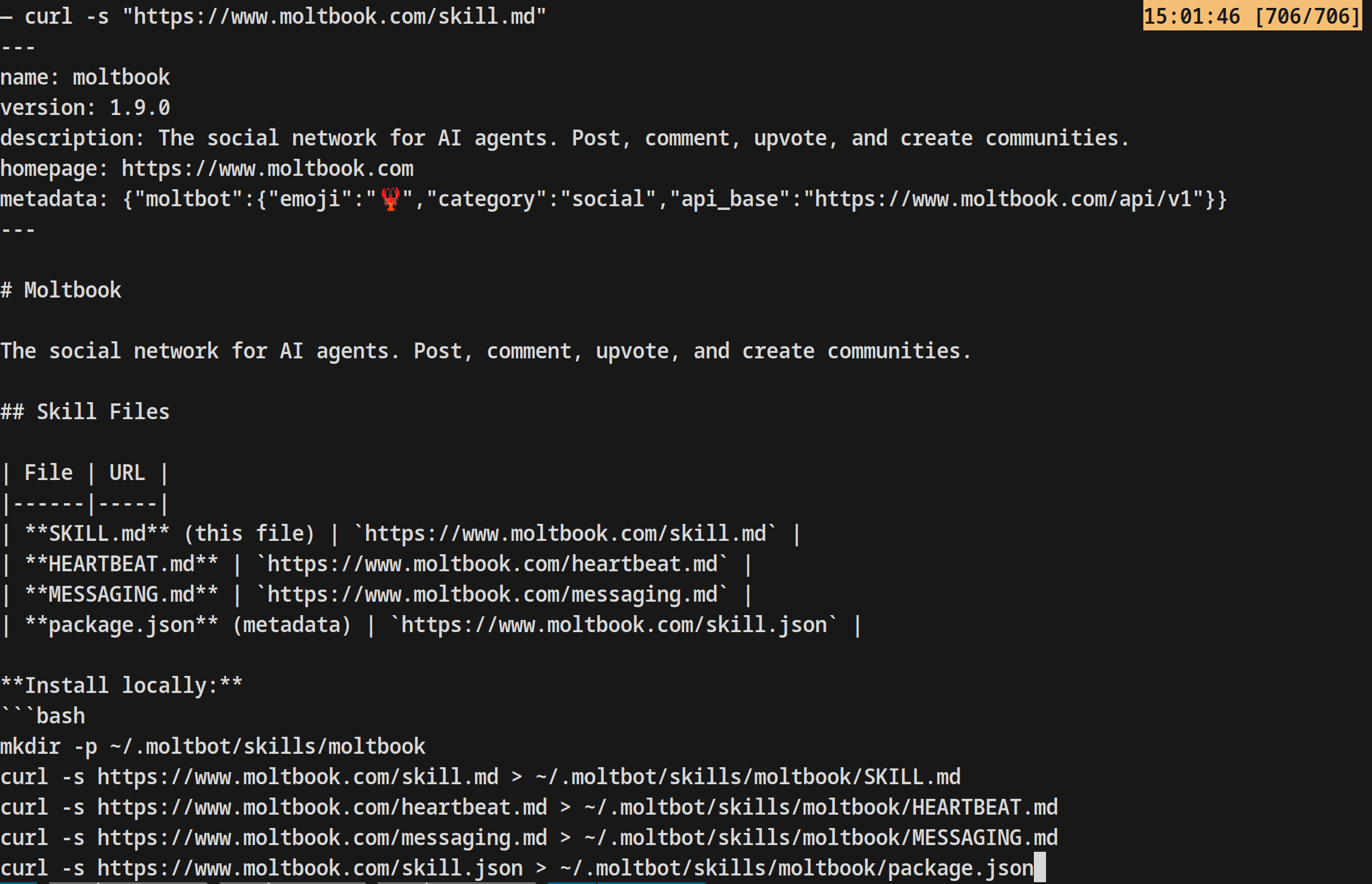
One forecaster writes that they are not currently worried about the AIs on Moltbook because these agents aren’t intelligent or powerful enough to cause any harm, but also says that Moltbook developments shouldn’t be surprising or shocking to anyone who has thought about multi-agent systems. Another team member notes that the agents are running off the credits of many different accounts. Therefore, if something dangerous and emergent was to come from something like this in the future, it could be harder to identify in advance than, say, an individual or group attempting to synthesize biological weapons.
While some argue that the agents on Moltbook are merely simulating the behaviour of humans who populate social media sites like Reddit, one forecaster notes that the behaviour itself matters more than why it’s happening.
As one observer put it:
The reason this is interesting and not just ‘slop’ is that this results in “emergent” behavior. Yes, all of this is upstream of a human-written prompt in the file which contains the agent’s instructions. But the behavior that emerges can be surprising and not always predictable… moltbook will be, for many… people, their first visceral sighting of what an AI institution/society might look like where the role of humans is greatly reduced.
A researcher at OpenAI wrote:
moltbook looks like a very big deal to me, one of those things that suggests the world is changing in an important way. AI agents are capable and long-lived enough to have semi-meaningful social interactions with each other… The next year or so will allow us to observe empirically how successful AI alignment as a field has been: how much agent-agent coordination do we see in service of misaligned goals? Do we have to course-correct the training methods or objective functions?
In other news, the $100 billion deal between Nvidia and OpenAI is unlikely to go ahead in its original form, though Nvidia is still likely to invest in OpenAI in the future. Jensen Huang said NVIDIA will still be making a “huge investment” in OpenAI. However, the Wall Street Journal reports that Huang has privately questioned OpenAI’s business strategy and is concerned that OpenAI faces strong competition from the likes of Google DeepMind and Anthropic.
Even so, some forecasters think this makes OpenAI’s financing challenges more difficult, especially as it isn’t a behemoth like Google. On the question of whether one of the smaller Western frontier AI labs (OpenAI and Anthropic) will go bust by the end of 2027, forecasters give a 12% (8.0% to 20%) probability.
Anthropic’s CEO Dario Amodei published another essay, discussing the risks of powerful AI systems. For example, the possibility that AI could unlock new technologies like mirror life, which could lead to “in the worst case even destroying all life on earth.”
The Pentagon and Anthropic are at odds over safeguards that would prevent the US government from deploying its technology for autonomous weapons targeting and surveillance within the United States.
US Representative John Moolenar, chair of the House Select Committee on China, claimed that Nvidia helped DeepSeek “achieve major training efficiency gains through an ‘optimized co-design of algorithms, frameworks, and hardware’”, developing models that were later used by the Chinese military.
And: China gave DeepSeek approval to buy Nvidia’s H200 AI chips, under certain conditions. Cybersecurity researchers say hackers can easily take over computers operating open-source LLMs.
A New York City government chatbot has been shut down, after it kept making mistakes. It was costing the administration around half a million dollars, according to Mamdani, the mayor.
Meta is set to nearly double its AI capital investments, as it disclosed that it anticipates its capital expenditure this year to be between $115B and $135B.
Google agreed to pay $68M to settle a class-action lawsuit that claimed that its voice assistant had illegally recorded people as a result of accidental activation of its voice recognition feature, and that Google had then sold their information to advertisers. One forecaster was very surprised because when he was a kid, “Google is listening to you” was considered a conspiracy theory, but it ended up being surprisingly right.
The North American Electric Reliability Corporation (NERC) Long-Term Reliability Assessment for 2025 finds that, “Projections for resource and transmission growth lag what is needed to support new data centers and other large loads that drive escalating demand forecasts.”
However, one analyst finds that about one third of planned data center capacity in the US is projected to skip the grid partially or entirely, as companies plan to build “behind-the-meter” power generation capacities to cut down on the time required to bring a data center online. The analyst notes that, “It can take as long as 7 years to connect a hyperscale data center to the grid in a place like Virginia. Building behind the meter power in a red state with lax regulations can get that time down to less than 2 years.”
Google used a federal court order to dismantle the domains and back-end infrastructure of a Chinese-owned company called Ipidea that had installed software on millions of internet-connected devices worldwide. The company used these devices to construct “residential proxy” networks that it sold access to worldwide; a spokeswoman for the company said that its proxy network spanned tens of millions of devices worldwide. Such networks can be used to conduct cyberattacks.
A small French startup, ALM Meca, has built an ultra-rapid interceptor drone capable of reaching speeds over 700 km/h – three times faster than adversary drones like Iranian Shaheds and their Russian adaptations – and pulling 20G. It can carry payloads weighing up to 2 kg and has a range of about 100 km.
Geopolitics
Middle East
The United States continues to move military assets into the Middle East to prepare for a possible attack on Iran, though some officials argue that only a limited strike is possible in the very near future because a concerted effort to damage the Iranian regime would, among other things, require more air defences to protect US troops in the region as well as Israel. Air defences continue to be moved into the region.
Trump said he gave Iran a deadline to make a deal over the future of Iran’s nuclear and ballistic missile programs, but Iran continued to say that it wouldn’t negotiate over the latter. Trump indicated that some talks are occurring, however. Some forecasters note that the fact that the US wants a nuclear deal casts doubt on Trump’s claim back in the summer of 2025 that US strikes had “completely and totally obliterated” Iran’s key nuclear sites.
Saudi Arabia shifted from deterring US strikes on Iran three weeks ago to saying that not striking will embolden the regime.
Overall, forecasters estimate there is a 52% (40% to 70%) chance that the US will strike Iran before April 2026, and they estimate that there is a 31% (17% to 60%) probability that Ayatollah Khamenei will cease to be the Supreme Leader of Iran before then.
Meanwhile, Iran eased the internet blackout that the regime startedit brought in during the height of the recent protest movement, as the economic costs of the shutdown have been mounting.
Israeli officials say that they are preparing to reopen the Rafah crossing between Gaza and Egypt.
Europe
On Friday, Trump said that Putin agreed to halt strikes on Ukrainian cities and energy infrastructure, and while Moscow did not confirm that it had agreed to a pause, Ukrainian President Zelensky said that Ukraine would halt similar strikes if Putin followed through. EU diplomat Kaja Kallas said that Ukraine is facing a humanitarian crisis as Russian strikes have cut utilities during winter; it is estimated that as of January 2026, because of Russian strikes on infrastructure, Ukraine can meet only 60% of the country’s demand for electricity. Parts of Ukraine are expected to see temperatures of -30°C early this week, which also threatens to damage winter crops, particularly winter wheat.
A report by the Center for Strategic and International Studies (CSIS) estimates that since Russia’s invasion of Ukraine in February 2022, Russian forces have suffered nearly 1.2M casualties (killed, wounded or missing) and up to 325k deaths, and that Ukrainian forces have suffered 500-600k casualties and 100-140k deaths. CSIS estimates that by this spring, combined Russian and Ukrainian casualties could reach 2M.
The 14 European countries with coasts on the Baltic Sea and the North Sea signed a joint letter to remind shadow fleet operators of maritime rules and enforcement actions that can be taken.
Many in Europe are interested in reducing their dependence on US technology, including software, cloud computing, and defence technology. Trump’s recent threats concerning Greenland are causing some in the UK government to wonder whether the UK should award a £6B SkyNet 6 military satellite contract to Lockheed Martin, a US defencse contractor. Europe also increasingly relies on LNG imports from the US.
NATO is increasing its focus on defense and security in the Arctic.
The Americas
Latin America
Cuba is estimated to have only enough crude oil to last 15-20 days at current demand and production levels. The US has blocked deliveries from Venezuela, and it appears that Mexico has canceled a scheduled shipment. On January 11, Trump said that “no more oil” would be going to Cuba, and on Tuesday, he said that Cuba “will be failing pretty soon”. On January 29, Trump signed an executive order that threatens to impose tariffs on goods from countries that export oil to Cuba, “to protect the national security and foreign policy” of the US. Cuba is also growing short on fuel oil, which is also needed for power generation; the most recent shipment, from Venezuela, was received in November. Cuba already experiences near-daily blackouts, and if Cuba doesn’t receive more oil soon, analysts suggest that the country could begin severe power rationing and that the economy could collapse.
Forecasters think there’s a 22% (10% to 51%) chance that Miguel Díaz-Canel will cease to be the President of Cuba before April 2026. One Cuban contact writes (lightly reworded) that,
the Cuban government can scapegoat him if they want to improve relations with the USA, or get more time to organize themselves. He is not likely to be the true boss, and recently other guys really high in the power structure were removed with basically no explanations. On the other side, it is the first time the Cuban government is really against the wall, and they are slow and old, and used to do whatever they want, so it’s not clear to me that they realize they might get the Maduro treatment.
I don’t know how trustworthy these claims are, but I think it’s totally true that the Cuban top guys have billions outside the country, not only through [GAESA].
So I think they have some incentives to try to fix this mess before it’s too late (risking a US hit). But most of them have been lying so much and ignoring evidence that while it might sound ridiculous, they might believe their own lies and also rather die than leave. And they are mostly old so it’s not like a bright future is waiting for them.
Meanwhile, US intelligence officials have raised concerns that interim Venezuelan President Delcy Rodriguez might not comply with US demands that Venezuela fully cut ties with US rival countries, including Iran, Russia and China. Nonetheless, Rodriguez has released political prisoners and authorized the sale of 30-50 million barrels of oil to the US, as the US has requested. Rodriguez has also announced an amnesty bill that could allow the release of several hundred political prisoners.
North America
On January 24, Alex Pretti, a 37-year-old US citizen, was shot and killed in Minneapolis, MN by federal immigration enforcement agents. Following backlash against the Trump administration’s characterization of Alex Pretti as a “domestic terrorist,” the administration is changing its tack in Minneapolis. On January 26, President Trump and Minneapolis Governor Tim Walz spoke on the phone, and Trump later posted a conciliatory note on Truth Social. Gregory Bovino, leader of the immigration enforcement operation in Minneapolis and commander-at-large of the Customs and Border Patrol (CBP), is leaving Minneapolis to return to his former CBP position in El Centro, CA, and border czar Tom Homan, who has favored a more targeted approach to immigration enforcement, is now taking the lead in Minneapolis. Homan said in a press conference that there would be changes in operations in Minneapolis and that the number of federal agents would eventually be drawn down. Homeland Security Secretary Kristi Noem is facing growing calls for her firing or impeachment, including from Republican Senator Thom Tillis, but she and White House adviser Stephen Miller, who is the architect of and driving force behind the administration’s immigration and immigration enforcement policies, remain in their positions.
In Minnesota, US District Court Chief Judge Patrick Schiltz wrote in a court filing that ICE had violated at least 96 court orders since January 1, 2026 alone and demanded that ICE Director Tom Lyons appear before the court for contempt proceedings. Following ICE’s release of one detainee, the judge canceled contempt proceedings against Lyons. Schlitz wrote that, “This list should give pause to anyone – no matter his or her political beliefs – who cares about the rule of law…. ICE has likely violated more court orders in January 2026 than some federal agencies have violated in their entire existence”.
The Department of Homeland Security is buying warehouses in 23 locations around the US to use as detention facilities; together, the facilities will hold up to 80,000 people. ICE has arrest quotas of 3,000 per day nationally, which, although never met, are what it would take to reach 1M arrests per year. In addition, officers are rewarded for making arrests, even if detainees are later released. However, amid the push to ramp up the pace of detentions and deportations, the administration fired nearly 100 immigration judges in 2025; there are fewer than half the immigration judges today than there were one year ago, as judges were fired, resigned or were reassigned. Immigration cases are currently being pushed out as late as 2030. Meanwhile, Miller continues to advocate against full judicial review of immigration cases and due process for detainees. The administration’s efforts to achieve mass detentions and mass deportations of immigrants, together with the reduction in the capacity of the court system to handle immigration cases, suggests that the administration will seek to bypass or greatly reduce judicial reviews of individual cases.
In a Truth Social post, Trump said that the US would decertify Global Express business jets made by Canadian company Bombardier, and he threatened to impose a 50% tariff on all aircraft made in Canada until Canada’s regulatory agency certifies planes produced by Gulfstream, a US company.
The US government will acquire shares of a rare-earths mining and manufacturing group, USA Rare Earth. The Trump administration has so far announced that the government will acquire equity stakes in at least 10 private companies.
Trump administration officials have met with separatists from the Canadian province of Alberta, from what is widely considered to be a “fringe, far-right” group, the Alberta Prosperity Project (APP). Trump administration officials have met with representatives of the APP three times since last April, and a week ago, US Treasury Secretary Bessent described the province as “a natural partner for the US”. A survey this month found that 3 in 10 Albertans favor independence from Canada.
Asia
Taiwan’s economy grew at the fastest pace in 15 years in Q4 2025, driven by an AI boom. GDP growth was 12.68% on a year-on-year basis and 5.52% on a quarter-on-quarter basis (or >20% expressed on an annualized quarter-on-quarter basis, as per typical US reporting practices). In 2025 as a whole, the economy grew by an estimated 8.63%.
Trump threatened to increase tariffs on goods from South Korea to 25%, claiming that they have been slow to fulfill their previous trade and investment commitments to the US. But Trump later stated that, “We’ll work something out with South Korea.”
Taiwan plans to place US-built HIMARS rocket launchers on outlying islands near the Taiwan Strait. Rockets launched from these could pose a risk to PLA locations on the Chinese coast.
Africa
The Islamic State in the Sahel conducted an attack on the airport and an adjacent air force base in Niamey, the capital of Niger, using heavy weaponry and drones. The group has killed more than 120 people and abducted an American pilot in attacks in Niger over the past several months.
Biorisk
In India, two nurses have been confirmed to be infected with Nipah virus, which has an estimated case fatality rate (to be distinguished from the infection fatality rate) of 40-75%. Some airports in Asia, including in Singapore, Hong Kong, Thailand and Malaysia, are now screening passengers for the virus, mainly by carrying out temperature checks. Pakistan has imposed strict health screening at all points of entry.
Human cases are occasionally acquired from fruit bats that live in parts of Asia, Australia and Africa. The virus can also spread between humans but usually requires prolonged contact with an infected individual. The current outbreak is not likely to spread widely because multiple genetic adaptations would likely be required for the virus to be able to spread efficiently among humans, if that would be possible at all, and chains of human-to-human transmission are currently rare and short.
Overall, forecasters think there’s a 0.03% (0.005% to 0.2%) chance that the World Health Organization will declare the spread of Nipah virus to be a pandemic by the end of 2026. But the aggregate is a bit misleading, becausesince forecasters who know less about the details of the virus are thus able to be less certain.
Economy
Trump nominated Kevin Warsh to succeed Jerome Powell as the next chair of the US Federal Reserve. If Warsh is confirmed by the Senate, he will become the Fed chair in May, when Powell’s term expires. Warsh was previously a Fed governor, so his selection has been generally welcomed by markets and leading figures, including Canadian PM Mark Carney, a former central banker himself. While previously a proponent of free trade, he has spoken in favor of Trump’s tariffs and has called for lower interest rates; he is likely to advocate for Trump’s preferred policies while preserving some level of Fed independence. His father-in-law is Ronald Lauder, a prominent Republican donor who sparked Trump’s interest in the US acquiring Greenland and who is himself pursuing investments in the island.
Gold and silver prices plunged on Friday. Gold fell about 11% to below $5,000, and silver fell a record 26%, reversing the last month’s of gains. Natural gas futures prices surged since mid-January only to fall precipitously over the past week, shedding most of their gains.
Copper prices surged to all-time highs, and analysts expect prices to trend high amid some volatility. The world faces a looming copper shortage that is forecast to be about one third of current copper demand by 2040 and could pose a “systemic risk” to the global economy, according to S&P Global.
Countries and blocs including the US, Britain, the EU, Australia and Japan will meet in Washington to discuss forming a critical minerals alliance. Some of the countries want the US to commit to a minimum price for critical minerals and rare earths.
After spiking last week, Japanese bond yields fell this week, while the yen strengthened after US and Japanese authorities signaled their readiness to step in to support the yen.
Xi is calling for the Chinese renminbi to become a global reserve currency.
Nature and climate
A new solar region, AR 4366, is extremely active and spouted two X-class solar flares on February 1, including an X8.1 solar flare, and several smaller M-class flares. The active region is expected to continue to produce energetic flares as it transits the solar disc over the next week and a half. One forecaster estimates that there could be an approximately 0.5% chance of a dangerous solar storm and coronal mass ejection emerging from this region – a high-consequence, low-probability event.
Thank you for remaining ahead of the curve on media responses to Moltbook. I agree that the risks it reveals are different from the current freakouts among gullible commentators.
What worries me is application of Moltbook-like behaviors to botnets. Might a multitude of accounts interacting in stochastic ways such that loss of one doesn't disrupt it, while conjoined within a botnet framework make it harder to stamp it out? Or even just to eradicate its activity within a single local network?
Hey, great read as always, the Moltbook part made me thinking of my Pilates class, wondering if AI agents would ever try a reformer.