

🟩 Iran and Israel exchange fire for first time since April, Trump signs AI executive order, Ebola outbreak grows || Global Risks Weekly Roundup #23/2026


Executive summary
Geopolitics: Iran and Israel exchanged fire for the first time since the fragile ceasefire began in April. A Ukrainian maritime drone crashed into a Black Sea port in Romania.
Before September 2026, will a NATO country invoke Article 4 consultations in response to suspected or proven Russian aggression? Our forecasters think there’s a 21% (12% to 40%) chance.
Will a peace agreement between the US and Iran, that includes opening the Strait of Hormuz to commercial shipping with or without a toll system, be signed before July 2026? Our forecasters think there’s a 28% (21% to 35%) chance.
Technology and AI: Trump signed an executive order that calls on frontier AI labs to provide the US government with early access to their models for pre-deployment testing.
Will Anthropic, OpenAI and Google DeepMind voluntarily act in accordance with Trump’s executive order 14409 through the end of 2026? Our forecasters estimate that there’s a 77% (63% to 93%) probability.
Biorisk: While the Ebola outbreak continues to grow, hundreds of suspected cases and deaths were removed from official case tallies, with the WHO now reporting 93 confirmed deaths. The New World screwworm has been found in two calves in Texas and in a dog in Texas that had recently been in Mexico, posing a threat to the US cattle industry and to all warm-blooded animals, including humans.
How many deaths will be confirmed by the World Health Organization in the Bundibugyo Ebola outbreak before September 2026? Our forecasters’ aggregate estimate is 360 to 16K, with the average of the midpoints at 1.6K.
Geopolitics
Middle East
Iran fired missiles at Kuwait and Bahrain after the US struck some of its radar sites, and Iran also launched missiles targeting Israel for the first time since April. Iran later announced a cessation of strikes against Israel.
Despite the violence, talks between the US and Iran about a possible peace deal continue. Trump claimed that a deal could have been signed on “Monday, Tuesday or Wednesday of this coming week” before Iran and Israel resumed hostilities and called on the two sides to stop “shooting” at each other.
Our forecasters believe there’s a 28% (21% to 35%) chance that a peace agreement between the US and Iran, that includes opening the Strait of Hormuz to commercial shipping with or without a toll system, will be signed before July 2026.
Trump also said that Israel’s Prime Minister Netanyahu will have “no choice” but to accept a US-Iran peace deal. This comes after a heated phone call between Trump and Netanyahu about Israel’s plans for further ground operations in Lebanon in which the US President reportedly told Netanyahu, “You’re fucking crazy. You’d be in prison if it weren’t for me. Everybody hates you now. Everybody hates Israel because of this.”
Fighting between Israel and Hezbollah nevertheless continues despite US attempts to mediate a ceasefire.
Europe
A Ukrainian drone exploded at a Black Sea port in Romania, while three others self-detonated close to the port. No one was injured, and Romania’s President said that Ukrainian forces “lost control of the assets as a result of electronic warfare actions by Russia.”
This comes after a Russian drone crashed into a Romanian apartment building last week, with Romania reportedly considering invoking NATO’s Article 4 (importantly different from Article 5) in response to that incident.
Our forecasters believe there’s a 21% chance (12% to 40%) that a NATO country will invoke Article 4 consultations in response to suspected or proven Russian aggression before September 2026. It has been invoked on nine occasions since NATO’s creation in 1949, most recently by Poland in September 2025 after NATO fighter jets shot down Russian drones that had entered Polish airspace.
The US is reportedly considering expanding the number of countries in Europe that host its nuclear-capable bombers. Some in the administration are keen to signal that despite recent changes to troop deployments on the continent, the US is still committed to Europe’s defense. One forecaster also suggests that a positive side effect of such an expansion could be that other countries in Europe might become a bit less likely to want to develop their own nuclear weapons capabilities.
Thousands of Albanians have been protesting since May 30 against a real estate venture associated with Jared Kushner and Ivanka Trump that’s close to protected wetlands.
The Americas
Foreign firms are leaving Cuba as its economy continues to collapse and US sanctions take effect. Three Canadian airlines are the latest to suspend flights to Cuba indefinitely because of jet-fuel shortages on the island.
Technology and artificial intelligence
President Trump signed an executive order which would invite top AI companies to provide early access to the US government for voluntary vetting of their models, very similar to a leaked draft which he initially opted not to sign. This is an interesting sign in that it shows the Republican side taking some initial AI safety measures, as opposed to AI safety being or becoming a politicized partisan issue and having become solely the remit of Democrats, which would have left the Republicans vulnerable in the event of some AI catastrophe. Our forecasters believe there’s a 77% chance (63% to 93%) that Anthropic, OpenAI and Google DeepMind will accept the invitation and adhere to its terms through the end of 2026.
Anthropic said in a blog post that the ability of AIs to improve AIs, also known as recursive self-improvement, is happening faster than the company anticipated. Recursive self-improvement would be dangerous because it could mean that humanity has very little time to react to risky developments. Anthropic called for society to develop the ability to pause AI development if necessary, though the company has been careful in its language not to actually call for a pause right now.
Top AI CEOs Altman, Amodei and Hassabis, together with leading scientists and biotech, biosecurity, national security and other tech leaders, have signed an open letter calling for Congress to mandate screening for synthetic DNA sales, as AIs become increasingly useful for bioweapons development.
The United States’ National Security Agency (NSA) has reportedly been using Anthropic’s Mythos model to carry out offensive cyber operations.
ControlAI launched a campaign in Canada with over 30+ MPs and Senators supporting it, calling for Canada to negotiate a trust-but-verify international regime to prohibit the development of superintelligence, highlighting the risk of extinction posed by the technology.
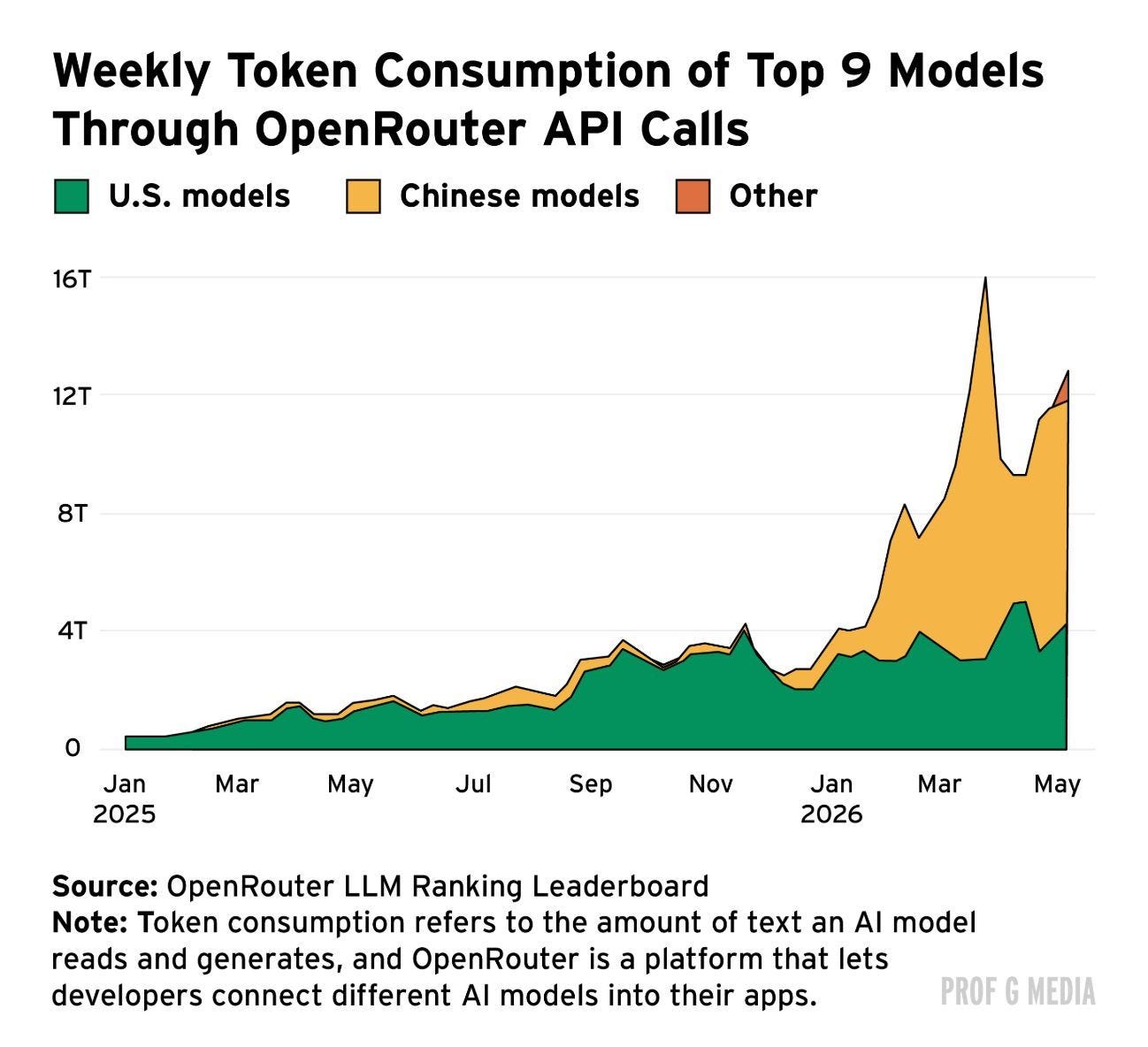
Usage of Chinese AI models via OpenRouter has dramatically increased in 2026.
Biorisk
Hundreds of suspected cases and deaths in the Bundibugyo Ebola outbreak were removed from the official figures on May 29, as testing backlogs were cleared and suspected cases were investigated further.
The few data points we have since this re-classification suggests that the growth rate may be similar to that which was tentatively but alarmingly observed before the re-classification (with a doubling time of <10 days). d This observed doubling time in the reported data likely reflects a combination of largely uncontrolled spread during this early phase of the outbreak, expanding testing capacity, health authorities working through the testing backlog for suspected cases and deaths, and growing identification of potential cases. Testing remains centralized, and only samples from patients seeking healthcare are being tested.
As of Saturday, the Democratic Republic of the Congo (DRC) has reported 515 confirmed cases and 91 confirmed deaths, with Uganda reporting 19 cases and 2 deaths.
Only about half of all identified contacts of patients are being contacted in the DRC. Three vaccines are in development, and the WHO is working with DRC and Ugandan authorities to plan and conduct clinical trials of vaccines and therapeutics.
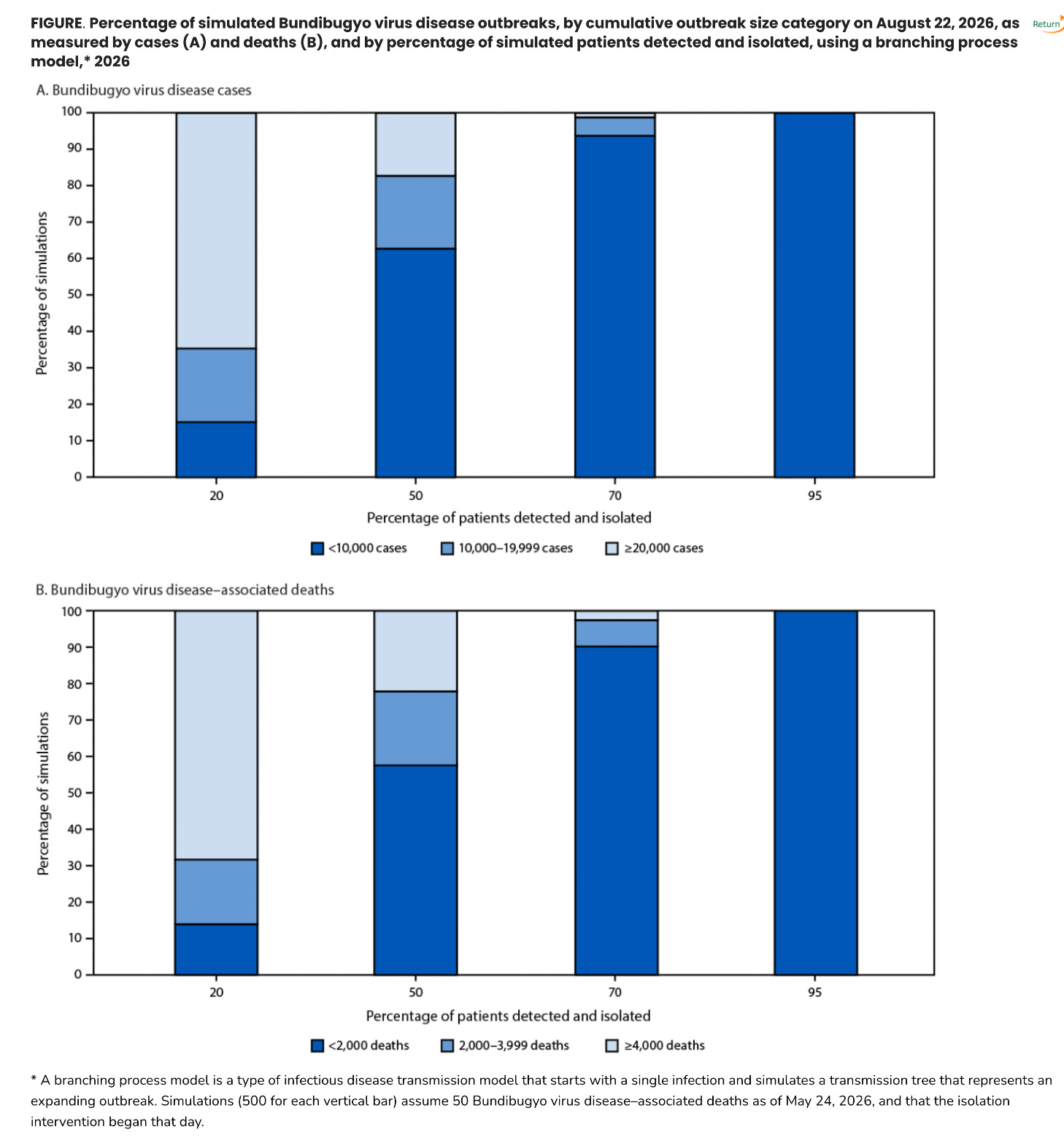
A modeling study by US CDC scientists and others suggests that if only half of all patients are detected and isolated early, then there could be a roughly one third chance that the outbreak would grow to infect over 10,000 people and kill more than 2,000 people by August 22, 2026. While the model relies on assumptions that may eventually prove not to reflect the current outbreak accurately, its results are based on simulations that sample ranges of parameter values estimated from past Ebola virus disease outbreaks and likely provide reasonable qualitative guidance about the potential eventual scope of this outbreak with different levels of intervention.
Overall, our forecasters’ aggregate estimate for the number of confirmed deaths associated with the outbreak before September 2026 is 360 to 16K, with the average of the midpoints at 1.6K.
Meanwhile, the New World screwworm has been found in two calves in Texas and in a dog in Texas that was recently in Mexico, posing a threat to the US beef industry, in particular, as well as to all warm-blooded livestock, pets, wildlife and humans. Before its elimination from the US by 1966, the screwworm was endemic in the southern and southwestern US; by about 2004, the US and its partners had pushed the screwworm to the South American side of the Panama Canal. But it has spread northward since breaking biological containment in 2022. The US is ramping up breeding of sterile male screwworm flies to release in the wild, to attempt to push the screwworm southward once again. Last year, DOGE eliminated funding for a project that monitored and aimed to contain the New World screwworm in Central America, and funding for the project was not restored, despite pleas from agriculture officials and cattle industry leaders.
More than 2,000 measles cases have been reported in the US so far this year.
Economy
A European Union official responsible for transportation said that there is no sign that there will be a shortage of jet fuel in Europe, though he acknowledged that this may partly be the result of airlines cutting some routes, which most of our forecasters consider to be a “shortage” in all but name. The price mechanism may also be playing a role.
While the Strait of Hormuz remains largely closed, the positions of oil traders indicate that traders believe that a peace deal that opens the Strait will likely soon be reached. If greater oil flows do not occur soon, we can expect prices to adjust upward.
Larry Johnson, the global head of freight at Mercuria, a commodities trading house, warned that the shipping industry will soon face fuel shortages that could idle as much as 10% of the global shipping fleet. While US refineries have shifted towards meeting greater demands for jet fuel, the production of marine fuel oil has suffered. “My view on marine fuel oil is there will be regional stock-outs by July and that there are potentially outages in the major hubs by August, September, at the latest,“ Johnson said. A barnacle crisis on ships in the Persian Gulf and elsewhere also looms in the short term.
(1). Back in December forecasters “estimate(d) a 60% (35% to 75%) probability that the US will have federal or state regulation in force on December 31, 2026 that requires at least some frontier AI developers to publish and follow plans for mitigating the risk that their AIs might cause catastrophic damages.” Does the new AI safety law out of Illinois count?
(2). One forecaster mentioned that there probability for a Taiwan conflict had risen slightly. I am curious what said probability has at it relates to a possible conflict?
(3). Back in December forecasters “think there’s a 44% (39% to 50%) probability that a major AI lab will hold an IPO.” Recently Anthropic filed papers for a possible IPO. I would curious to know when forecasters think that Anthropic will launch their IPO? What is will the valuation of the IPO be? What will be the valuation of Anthropic be the end of the year?
(4). Anthropic recently posted an article about recursive self improvement. I would be interested to know when forecasters think that recursive self improvement be achieved.
These could be possible questions for the coming weeks.