

🟩 Iran War persists with more US troops killed, Chinese startup releases Kimi K3, Ebola continues to spread || Global Risks Weekly Roundup #29/2026


Executive summary
Geopolitics: The US continued its nightly strikes on Iranian territory, while Iran retaliated against Gulf states and against US bases in Jordan and Iraq, killing at least three US servicemembers. Saudi Arabia and the Iran-backed Houthis ended a four-year truce, and the Houthis announced a naval blockade against Saudi Arabia, which could disrupt shipping in the Bab el-Mandeb Strait.
Will the US place 1,000 or more boots on the ground in Iran before September 2026? Our forecasters think there’s a 19% (10% to 45%) chance.
Will a new temporary or permanent ceasefire agreement be reached and put into effect between Iran and the US before September 2026? The team believes there’s a 53% (21% to 70%) probability.
Will the price of Brent crude oil reach $100 per barrel before 2027? Our forecasters believe there’s a 68% (60% to 80%) chance.
Will the Houthis attempt to seize or sink at least one ship before September 2026? Forecasters think there’s a 69% (51% to 77%) chance.
Technology and AI: Chinese startup Moonshot AI launched Kimi K3, an open-weight model that approaches frontier models produced by OpenAI and Anthropic in its capabilities. China set up an international body for cooperation on AI.
Will the President of the United States issue an executive order aiming to mitigate security risks associated with open-source AI models before 2027? The team thinks there’s a 52% (30% to 65%) chance.
Biorisk: The death toll in the Ebola outbreak in the DRC rose to 930, from 702 last week.
Geopolitics
Middle East
The United States continued its nightly strikes on Iranian infrastructure, including bridges and towers. Among the targets were transit points for Iran’s largest port, Bandar Abbas. Iran, in turn, launched strikes on Bahrain, Oman and Qatar and attacked a power and water desalination plant in Kuwait. US bases in Jordan and Iraq were also targeted; at least three US servicemembers were killed in these attacks, with more injured or missing.
Last week, the Islamic Republic also threatened to have its Houthi allies in Yemen disrupt shipping in the Bab el-Mandeb Strait, which would very likely increase energy prices further. And today, the Houthis announced a naval blockade of Saudi Arabia. Significantly, the Houthis fired missiles at Saudi Arabia in retaliation for a bombing of an airport in Yemen that the group blames on Saudi Arabia, meaning that a four-year truce has now been broken. Forecasters believe there’s a 69% (51% to 77%) chance that the Houthis will attempt to seize or sink at least one ship before September 2026.
The price of Brent crude oil rose to above $85 per barrel on Friday, briefly rose above $90 late on Sunday, and remained in the high $80s on Monday. Forecasters think there’s a 68% (60% to 80%) probability that the price will reach $100 per barrel again by the end of 2026, on an hourly basis.
On whether the conflict could expand further, forecasters think there’s a 19% (10% to 45%) probability that the US will place 1,000 or more boots on the ground in Iran before September 2026. Conversely, they think there’s a 53% (21% to 70%) probability of a new temporary or permanent ceasefire agreement being reached before then.
Meanwhile, Israeli ministers announced plans to set up settlements in the Gaza Strip and expand existing ones in the West Bank.
Europe
Zelenskyy fired Ukraine’s defense minister, Fedorov, after Ukraine’s commander-in-chief, Gen. Syrsky, gave the Ukrainian president “an ultimatum” to fire either Fedorov or him, as conflict between the two defense leaders had reached a boiling point. Fedorov brought a start-up management style to a push to modernize Ukraine’s defense technology and attempted to block corruption, while Syrsky is part of the old guard of Ukraine’s military leaders. Following protests against Fedorov’s firing, Zelenskyy is reportedly now considering firing Gen. Syrsky, and Fedorov apparently rejected an offer to return to a different position in government. While these personnel changes may reduce conflict within Ukraine’s military leadership, they also rock the boat at a time in which Ukraine is enjoying military successes.
The Ukrainian military continues its initiative to make Crimea “impossible to hold — systematically, ship by ship, substation by substation, bridge by bridge.” Holding Crimea has become a vulnerability for Putin.
The Hungarian parliament passed a constitutional amendment that would remove President Tamás Sulyok, a loyalist of former prime minister Viktor Orbán, from office. Hungary’s new Prime Minister has proposed that Hungarian chess champion Judit Polgár become the new President.
And, on Europe’s nuclear deterrence:
Macron’s initiative, outlined in March, to extend the French nuclear umbrella for collective European defense is gradually coming to fruition. So far, nine European countries – Germany, Norway, Poland, Sweden, Denmark, Greece, the Netherlands, Belgium and the UK – have signed up to come under the French nuclear umbrella, as European countries seek to rely less on the US for security.
Last week, German Chancellor Friedrich Merz announced that for the first time, the German military will participate in a French nuclear exercise later this year, furthering European nuclear cooperation. Merz also reaffirmed Germany’s commitment to the NATO nuclear sharing agreement, under which US nuclear bombs are stationed in Germany and German fighter jets have been certified to be capable of carrying the bombs. Merz said that, “the world we live in today requires new answers.”
Two weeks ago, Lithuania’s president announced that the country plans to lift a constitutional ban on hosting nuclear weapons or foreign military bases. A month ago, Finland lifted a ban on receiving, transporting and otherwise facilitating the movement of nuclear weapons within its territory, as part of allied defense operations.
Our forecasters note that while France’s extension of its nuclear umbrella to a broad set of European allies reduces the risk of nuclear proliferation within Europe as countries seek to rely less on the US for nuclear deterrence, it is still possible that countries such as Poland might pursue nuclear weapons in the future.
Asia
Anti-government protests led by the satirical youth movement “Cockroach Janata Party” and supported by the opposition Congress Party swelled in New Delhi, following the leak of an exam paper that was to be taken by prospective medical and dental students in India.
On China/Russia relations
China is building relationships with officials in Russia whom China believes may be involved in running the country after Putin.
And while US Secretary of State Marco Rubio said last year that the US could not allow Russia to become a “permanent junior partner” to China, Russia is increasingly becoming just that. Putin’s war in Ukraine has accelerated Russia’s decline in power relative to China, as it has handed China increasing economic leverage over Russia.
For example, China has been buying Russian oil at a discount and providing components needed by the Russian defense industry. Before Putin’s visit to China in May, China told Russia that it will not approve the development of a natural-gas pipeline, called the Power of Siberia 2, that would deliver gas from Russia to China, unless Russia agrees to sell natural gas to China at Russia’s own below-market, domestic rate.
And in August, China plans to open the Shanghai Cooperation Organization Development Bank, a regional development bank focusing on Central Asia that will use the Chinese yuan as its base currency and will increase China’s influence in the region. Putin acquiesced to this arrangement, and in exchange, is seeking assurances that the bank will ignore US sanctions
United States
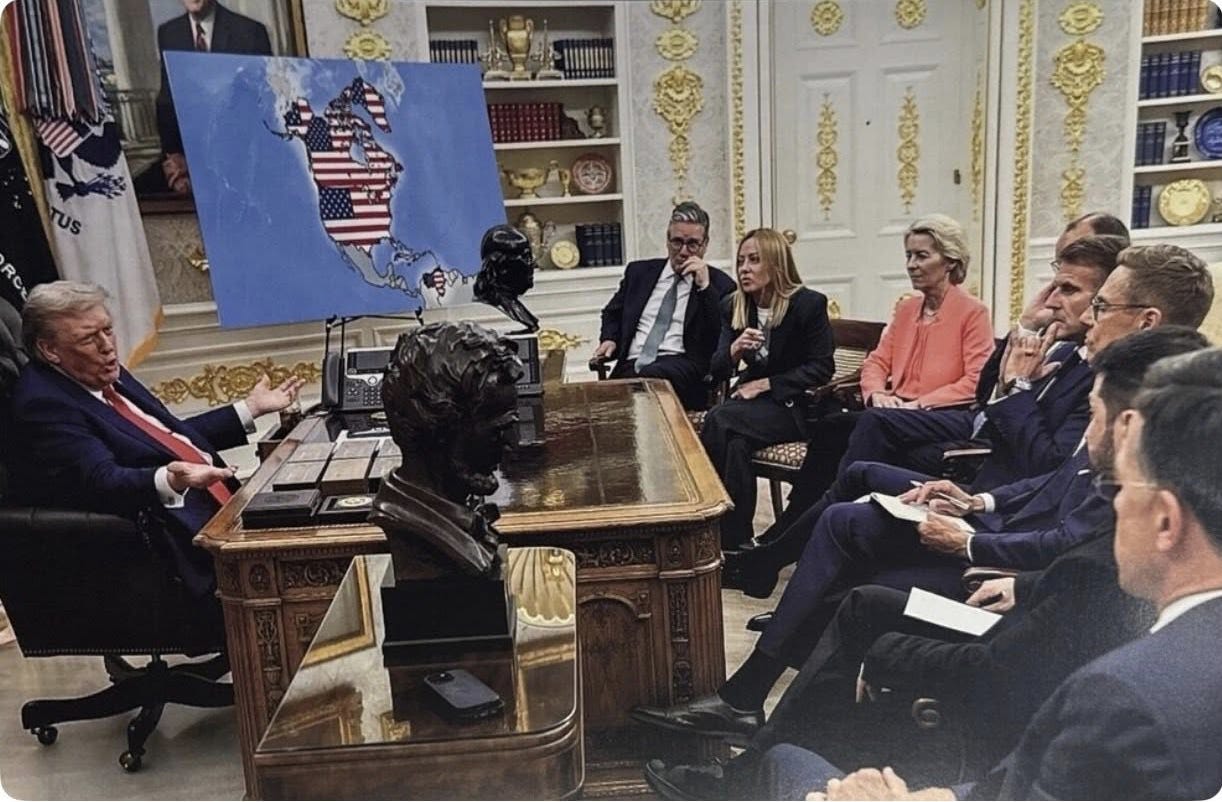
Donald Trump posted an AI image of himself showing a map to world leaders, in which Canada and Greenland have been taken over by the US. Our forecasters see this as a continuation of his “trolling” of other world leaders rather than a significant threat to these territories. Some find it amusing.
On Thursday evening, Trump released declassified documents related to previous elections, and in a speech, he claimed that these documents “reveal an election system so broken and so vulnerable that no one can possibly defend it. It is not defensible.” Multiple news organizations have found no “smoking guns” in the documents (read here) or his claims. Trump also accused China of election interference in the 2020 election and claimed that America’s election system is very vulnerable to cyberattacks. Republicans broadly welcomed his speech, while some Democrats said they agreed with Trump that election interference from any foreign actor should be stopped, but not on the specifics of his claims. Critics warned that one purpose of Trump’s speech was to cast doubt on US election integrity four months before midterm elections in which many Republican candidates will likely face challenging races.
Rubio, Miller, Bessent and other leading members of the Trump administration hosted representatives of 66 countries at a conference in Washington, DC, focusing on “the resurgence of political violence.” Speakers considered the alleged threat of leftwing violence but did not address a threat of rightwing violence. One of our forecasters notes that this speaks to a broader pattern of characterizing the left as representing an existential threat to the US, and wonders whether, taken together with Trump’s speech on election integrity, a case is being laid out for cracking down on political opponents in the future and, in the extreme, attempting to overturn election results.
On Thursday, Trump Media & Technology Group, which owns Truth Social, announced a paid, licensed data feed, called Truth API, which would provide early access to posts from Trump and 9 other top accounts on Truth Social. Trump Media has reportedly proposed to charge $100,000 per month, or $60,000 per month with a 3-year contract, to Wall Street traders and investment firms for access to the feed. Trump’s trust holds about 41% of the outstanding stock in Trump Media.
The Pentagon has been drawing up plans in recent weeks for a potential military invasion of Cuba. And as for the North, Trump threatened to increase tariffs on Canadian goods after smoke from Canadian forest fires blanketed multiple US states.
Technology and artificial intelligence
Chinese AI company Moonshot AI launched its Kimi K3 open-weight model, which approaches GPT-5.6 Sol and Fable in its capabilities. China also implemented rules that prohibit AI platforms from generating content that encourages emotional attachment, especially in minors, or is likely to erode real-world relationships. And it is setting up an international body known as the World AI Cooperation Organization, which could lead to international standards for AI development being set. Almost 30 countries, including Russia, Brazil and Indonesia, have joined. President Xi also presided over an event called the World Artificial Intelligence Conference in Shanghai.
The White House launched a program, named Gold Eagle, that will coordinate efforts in the private sector to find and fix vulnerabilities in critical digital infrastructure. The program will reportedly put the Trump administration, rather than AI companies, in charge of deciding which organizations are allowed early access to the most powerful new models.
The Trump administration is also reportedly considering creating an independent regulatory agency, with input from AI companies and Wall Street firms, to review the safety of and cybersecurity risks posed by new AI models. As envisioned, the agency would report to the Securities and Exchange Commission. Given speculation about whether the White House will issue an executive order that aims to mitigate security risks that could arise from open-weight models, our forecasters give this a 52% (30% to 65%) chance of happening before 2027.
An autonomous AI agent system intruded into Hugging Face’s infrastructure. Detection was also assisted by AI, and LLMs helped to reconstruct the timeline of the incident. However, closed-weight AI models blocked this analysis because of safety guardrails that could not distinguish defenders from attackers, so the open-weight model GLM 5.2 was used instead.
Google DeepMind CEO Demis Hassabis planted his flag by making an AI policy proposal that calls for the US to establish an industry-funded standards body overseen by the government to regulate powerful AI systems, that could test and block systems that are too dangerous from being released and could coordinate a slowdown of frontier AI development.
And: Ukraine launched perhaps the first-ever robotic amphibious assault. A sea drone landed and deployed an armed ground robot on the Kinburn Spit, in Russian-occupied territory. Claude’s Fable model may have produced a counterexample to the Jacobian Conjecture in mathematics, a long-standing and famously hard-to-crack problem. New York State became the first in the US to suspend the construction of new AI data centers.
Biorisk
The Ebola outbreak in the Democratic Republic of the Congo (DRC) is growing explosively. As of July 18, 2,340 confirmed cases have been reported in the DRC, and most cases are likely not being tested. Official confirmed deaths have doubled in the past approximately 15.5 days; based on data from previous outbreaks, actual cases and deaths are likely doubling more quickly. The official death toll rose to 930, up from 702 last week.
The outbreak is entering a critical period, as it will become increasingly difficult to bring under control because of its sheer size, and because health workers face a growing number of challenges. The outbreak is spreading in a province in the DRC that shares a border with South Sudan, which has limited public health infrastructure. And last week, dozens of staff at a hospital in Bunia, in hard-hit Ituri province, went on strike and closed the hospital, saying that they had not been paid for two months and were provided insufficient PPE. Community distrust remains a significant problem as well; on Thursday, a different hospital in Bunia was attacked, and the medical staff and up to 10 Ebola patients fled.
We reported last week that 21,000 community health workers are being trained to go door to door to identify and encourage people potentially sick with Ebola to go to treatment centers. With 80% of new cases not coming from case contact lists, such community outreach efforts will be critical to bringing the outbreak under control.
Doctors have noticed that Bundibugyo ebolavirus infections have a longer course than Zaire ebolavirus infections, which allows patients to spread the virus in the community longer but may also offer a longer window for treatment. Clinical trials for three treatments are underway in Ituri province.
A vaccine against the Bundibugyo ebolavirus is badly needed, but one might not be available for at least several months. The University of Oxford has begun a clinical trial for its new Bundibugyo ebolavirus vaccine, and about 50 adults in Oxford will be given the vaccine over the coming weeks to assess the vaccine’s safety and immune responses to the vaccine. The Serum Institute of India, which manufactures the vaccine, has produced about 620,000 doses of the vaccine and has provided about 4,000 doses for additional clinical studies, which would take place in Uganda. The Coalition for Epidemic Preparedness Innovations (CEPI) has committed to an initial investment of up to $8.6 million to develop the vaccine. Three other Bundibugyo ebolavirus vaccines are also in development.
Cholera has broken out in Sudan for the third year in a row, in the provinces of West Kordofan, North Kordofan and South Darfur. 1,547 cases have been reported in West Kordofan and North Kordofan as of July 15.
Economy
In recent weeks, Japanese bond yields have reached multi-decadal highs. Higher bond yields in Japan can be expected to increase sovereign borrowing costs elsewhere to a limited extent.
In South Korea, swings in the highly leveraged stock market have caused the Korean Composite Stock Price Index (KOSPI) to plunge 27% in recent weeks, reportedly triggering margin calls for 1.2 million brokerage accounts, representing up to 10% of brokerage accounts in the country.
Climate and nature
An AFP analysis found that there were at least 12k excess deaths in nine European countries during June’s heatwave. Some forecasters note that these deaths would mostly result from accelerating deaths among the elderly, and so the cost in terms of years of life lost would be much lower than for average people’s deaths, e.g., in car accidents.
Wildfires in US and Canadian boreal forests are increasingly burning over larger areas now than in the past, largely because the ground is becoming drier over time, very likely because of climate change. We can expect to see the average total area of North American boreal forests burned per year continue to increase over time, and with it, the spread of wildfire smoke.
Industrial shipping is being forced to reduce loads in the Rhine River, Germany’s most important inland waterway, as the water level continues to fall. Flow rates for waterways in France, including the Loire River, are also falling rapidly. In the US, Lake Powell and Lake Mead, the nation’s two largest reservoirs, have fallen to a level last seen in 1956, when the Glen Canyon Dam was under construction. Their water levels are expected to fall further over the coming years as the Colorado River basin becomes drier.
A study estimates that there’s a 10-23% chance that collapse of the Atlantic Meridional Overturning Circulation (AMOC) is already locked in. The AMOC is effectively a conveyor belt of heat and oxygen in the Atlantic Ocean that warms Europe, affects precipitation patterns on land surrounding the Atlantic, supports growth at the bottom of the ocean’s food chain, and enhances the ocean’s function as a carbon sink.
A new study finds that the impacts of severe solar storms on Earth satellites, electric grids and communication systems could be more extreme than previously thought. A new UN report on risks from severe solar storms and other extreme disruptions to communications and digital infrastructure “calls on policymakers, the private sector, and civil society to act now to prevent these risks from becoming a ‘digital pandemic’, urging for global commitment and coordinated action.”
A few comments on stocks below the paywall:
Keep reading with a 7-day free trial
Subscribe to Sentinel Global Risks Watch to keep reading this post and get 7 days of free access to the full post archives.