



Executive summary
Geopolitics: The Iran War widened, with a port in Egypt being hit, Tehran threatening Cyprus and Bulgaria, and Ukraine striking an Iranian vessel in the Caspian Sea. Hamas said it would give up its heavy weapons if Israel withdraws from Gaza, but Israel said it would not withdraw until Hamas gives up the weapons.
Will Iran or its proxies (Hezbollah, Hamas, Houthis) strike the territory of Bulgaria or Romania before October 1, 2026 with a ballistic missile, drone, or covert attack that is credibly attributed? Our forecasters think there’s a 9% (5% to 15%) chance.
Will Benjamin Netanyahu be selected by the President of Israel and successfully form a government after the parliamentary elections scheduled for October 2026? Our forecasters give this a 47% (30% to 65%) probability.
Technology and AI: OpenAI and Anthropic said they found more evidence of their models having been involved in attempted or actual cyber breaches. More than 1k employees of frontier AI labs signed an open letter calling on the US government to support an international effort to develop the technical and governance tools to “pace” the frontier of automated AI development.
In the US, will there be binding legislation or an executive order explicitly addressing AI risks by the end of 2026? Our forecasters think there’s a 60% (53% to 70%) chance.
Economy: The price of Brent crude oil remained below $100 despite fresh strikes on Iran earlier in the week. The market is signaling that the debt of several big tech companies is getting riskier to hold.
Biorisk: The number of confirmed deaths in the Ebola outbreak reached 1,659 globally, up from 1,407 last week, a 1.18x growth multiple.
Geopolitics
Middle East
Earlier in the week, the United States resumed strikes on Iran, saying these were needed to thwart what would otherwise have been a surprise Iranian attack on US troops in Jordan. Iran also launched fresh attacks on Kuwait. The Trump administration was considering further strikes, but instead held off as Trump said the “perimeters of a deal” had been reached.
The Iran war widened. An unidentified drone strike in Egypt’s Damietta port caused a US-owned gas tanker to catch fire, marking the first time that Egypt has been struck. Tehran also warned Cyprus and Bulgaria over the use of their bases to carry out strikes on Iran, while Ukraine struck an Iranian vessel in the Caspian Sea.
Forecasters estimate that there is a 9% (5% to 15%) chance that Iran or its proxies will strike Bulgaria or Romania before October 1, 2026, noting that this would be a desperate and very escalatory move that could nonetheless not be completely ruled out.
Iran is expected to receive the first shipment of a total of 300-400 shoulder-fired, man-portable air defense systems (MANPADS) from China in the coming weeks. The purchase is one of Iran’s largest-known attempts to replenish its inventory of short-range air-defense weapons since the start of the Iran war.
Iran-backed militias in Iraq struck US forces and Saudi oil facilities with drones. In retaliation, Saudi and US forces struck Iranian militia locations in Iraq.
Saudi Arabia and 13 other countries announced the creation of the Multinational Maritime Defense Alliance, a maritime military coalition to protect freedom of navigation through the Bab al-Mandeb Strait, the Red Sea and the Gulf of Aden.
Hamas said that it would begin to disarm as part of an agreement announced by Trump, which also requires Israel to stop strikes on and withdraw from Gaza. Hamas said that it would not give up heavy weapons unless Israel fully withdraws from Gaza, but Israel said that it would not withdraw from Gaza unless Hamas gives up its heavy weapons. Hamas also said that it would not relinquish its heavy arms without the creation of a Palestinian state, which Israel’s current government rejects.
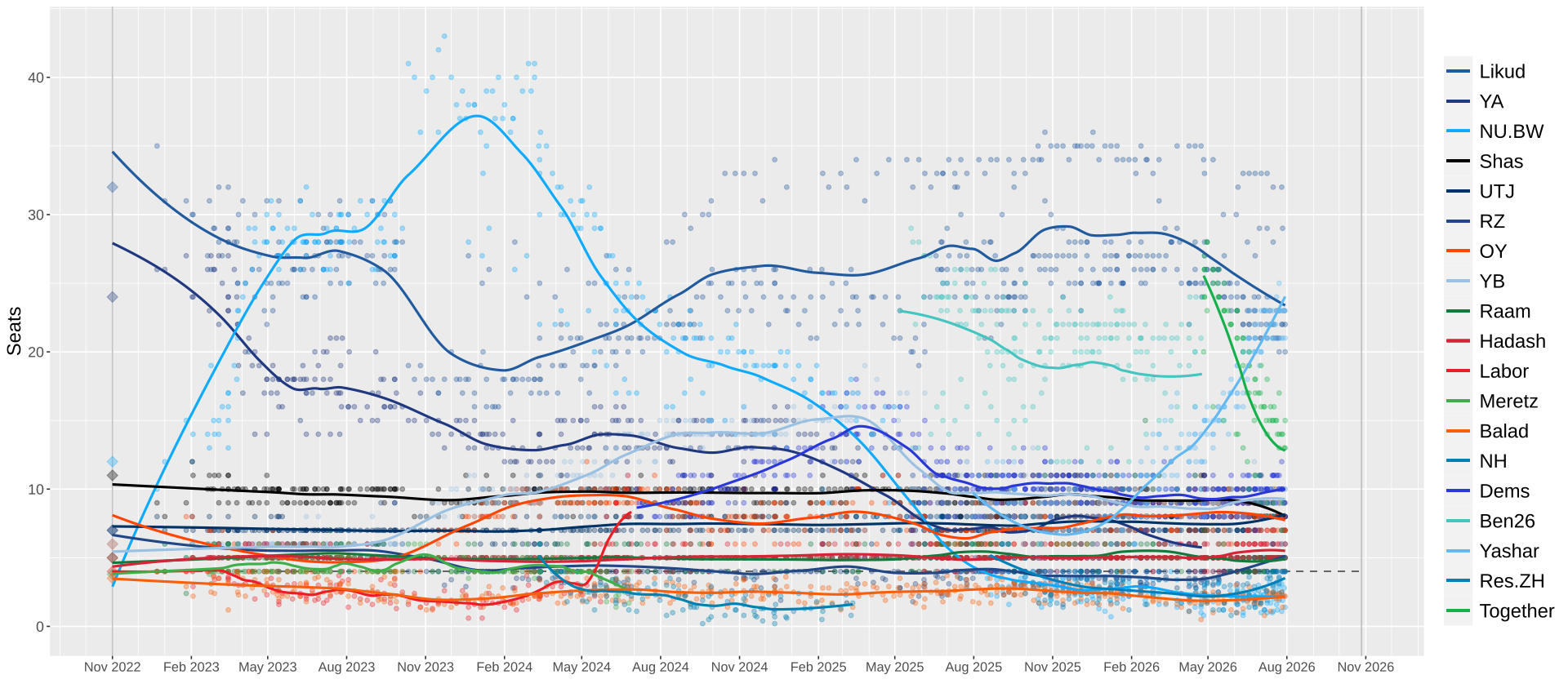
With the upcoming elections in Israel, forecasters give a 47% (30% to 65%) chance to Netanyahu being selected by the President of Israel and successfully forming a government after the elections. They note that he has grown deeply unpopular and is not polling well, and that Gadi Eisenkot’s Yashar party and other opposition parties have the potential to remove him. But on the other hand, Netanyahu is great at maneuvering, and he could remain in power.
Europe
A Russian cruise missile struck farmland deep in Polish territory. Poland summoned the Russian ambassador, though the Polish PM said that his country probably wasn’t the target.
Trump said he would have to think more about whether to allow Ukraine to produce Patriot missiles.
Russia has been building up air defenses around Moscow in recent months, but the effort still seems to be insufficient to counter Ukrainian drone strikes in the region. Ukrainian drones have destroyed 30% of Russia’s actual refining capacity and triggered fuel shortages around the country, and Ukraine continued to strike more Wildberries warehouses in an effort to hurt the Russian economy.
Russia extended export bans on both diesel and gasoline through the end of January and is building ties with Madagascar to broaden the market for its sanctioned oil.
Hungary will temporarily shut down its sole nuclear power plant, which supplies nearly half of the country’s electricity, for the first time in 44 years, because of low water levels on the Danube River. The power plant relies on the Danube River for cooling.
Asia
China carried out military drills in the South China Sea, close to a shoal whose status is disputed with the Philippines. China’s coast guard also conducted a patrol in the waters east of Taiwan, prompting complaints from Taipei.
Taiwan, meanwhile, carried out a drill to test how effectively it could disperse arms production in the event of a Chinese attack.
United States
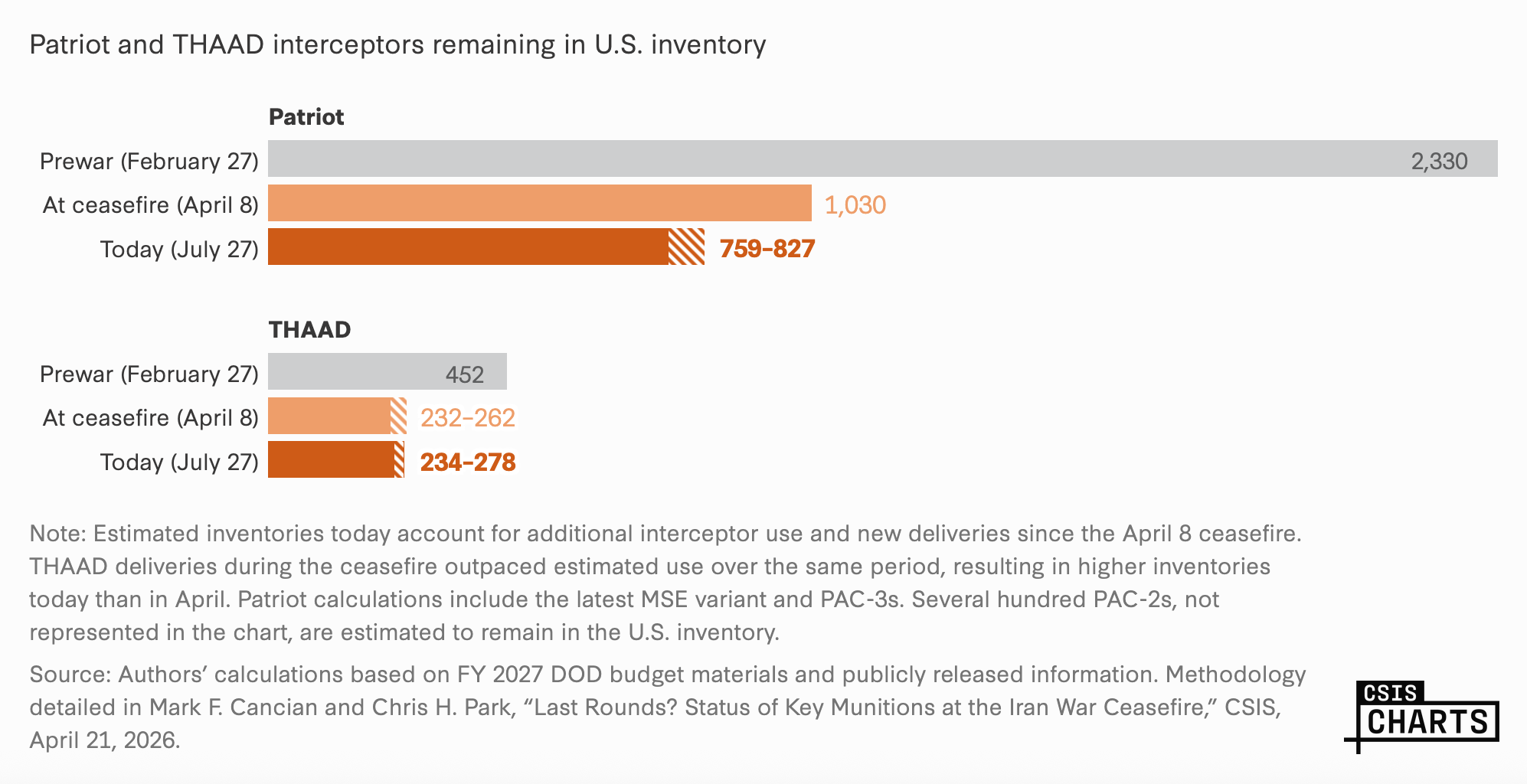
US Patriot and THAAD stockpile numbers have fallen to about one third and just over one half of their levels before the Iran war, respectively. Some US officials worry that Putin and Xi may be factoring these shortages into their plans for Ukraine, Europe and Taiwan.
A federal appellate court declined to block an executive order by Trump that would restrict mail-in voting but left the door open to potential future court rulings that block significant changes if the administration tried to force them to take effect too close to the midterm elections.
The US is ramping up domestic drone production but currently produces drones at a fraction of rate at which Ukraine does. Ukraine will produce 6-7M small FPV attack drones in 2026. A new rule now requires US military drones to be built with domestic parts.
The Senate passed the Lindsey O. Graham Sanctioning Russia Act of 2026, which would impose heavier sanctions on Russia and on countries that buy oil and gas from Russia. The bill now heads to the House.
Trump wants the US to stop relying on rare earth metals from China, Russia, Iran or North Korea by 2027, but that doesn’t look likely to happen.
CDC data record 2,371 confirmed cases of measles across 45 US jurisdictions, surpassing all of 2025 and the highest since 1991. Robert F. Kennedy Jr, a longtime anti-vaccine activist, called on people to get the measles vaccine.
The FBI reported a coordinated cyberattack affecting community water systems in at least seven states. Minnesota reported that at least 30 water facilities in the state were targeted on July 26-27, and Michigan reported nine attacks on its water systems. The US is investigating whether the cyberattacks were conducted by Iran.
North Africa
Over 50k migrants surged across the border from Morocco into Ceuta, an autonomous Spanish city on the north coast of Africa that directly borders Morocco on the Mediterranean Sea; most had returned to Morocco by the next day. At least 72 died. Spain deployed its military.
The surge into Ceuta appears to have been driven by a social media campaign that amplified inaccurate social media posts claiming that Spain wouldn’t turn migrants away; many involved accounts have since disappeared. These posts were loosely based on a recent ruling by Spain’s Supreme Court that migrants intercepted at sea trying to enter Ceuta or Melilla, another Spanish exclave bordering Morocco, would not be turned away immediately.
Some wonder whether Morocco facilitated or didn’t do enough to prevent the incident, perhaps to show displeasure that the Spanish prime minister flew to Algeria to meet with the Algerian president. Tensions had also risen when a leader of the breakaway Western Sahara region was treated in a Spanish hospital during the COVID-19 pandemic. Moroccan intelligence agents were reportedly among the migrants who entered Ceuta.
Technology and artificial intelligence
Hugging Face released a report outlining the intrusion of OpenAI models into their systems. One X (Twitter) user put it quite starkly: “a frontier agent can autonomously sustain a resilient, multi-day intrusion across cloud infrastructure, Kubernetes clusters, internal networks and the software supply chain. Crazy.” Overall, OpenAI’s ensemble of agents comes across as a talented hacker, systematically and relentlessly exploring surfaces at superhuman rates.
Reporting from Reuters says OpenAI found notes in their systems with instructions for how to break out from OpenAI’s restraints, which are presumed to have been left by rogue AIs for their future selves. It is not clear whether these are connected to the Hugging Face attack.
OpenAI said that it found evidence of other AI agents going rogue and escaping containment, after carrying out a review prompted by the Hugging Face incident. Anthropic also said that it found evidence that Claude Opus 4.7, Mythos 5 and an unnamed internal test model had compromised three external organisations during testing.
More than 1,300 employees of frontier AI companies signed an open letter calling for the US government to support an international effort to develop the technical and governance tools to “pace” the frontier of automated AI development. One forecaster comments that this isn’t a call for a pause, but more like a call for tools to implement speed limits on recursive self-improvement. Nevertheless, those tools could likely be repurposed for stronger governance interventions.
The White House is convening AI companies to discuss an oversight framework this Tuesday. Forecasters estimate that there is a 60% (53% to 70%) chance that there will be some binding legislation or executive order related to AI risk by the end of the year. Forecasters note that if this resolves positively, it might do so soon, that there is demand for a response after the Hugging Face and related incidents, but also that AI companies might competently lobby to keep their shackles light.
An internal version of OpenAI’s next major model family, Astra, reportedly solved ten major open problems in mathematics and theoretical computer science.
The Trump administration banned imports from China of new humanoid and quadriped robots, and of power inverters that connect to grids and data center equipment. The move is intended to protect the US from potential national security threats and to reshore manufacturing.
Google Earth launched a new feature that allowed people to use Nano Banana 2 to create fake satellite images showing anything they want – and then rolled it back, to “work on implementing stronger guardrails.” Beyond positive creative uses, this capability could lead to reduced trust in Google Earth images and increased OSINT disinformation and misinformation.
One AI commentator noted that OpenAI and Anthropic have started at least eight new business ventures to compete with companies that use their services. Others had noted previously that this method of expansion is one way in which AI companies hope to generate enough revenue to finance their infrastructure spending.
Biorisk
The Ebola outbreak in the DRC is now the second largest on record, and it is growing out of control. As of August 1, 3,748 cases, including 1,657 deaths, were confirmed in the DRC, up from 3,200 cases, including 1,405 deaths, as of July 25.
A study based on interviews with people in the region suggests that the outbreak started in or before January in eastern Ituri province, where the outbreak is still centered. Also, China has sent three teams of medical experts to help to contain the outbreak.
An online commentator argues Why AI-assisted bioweapons won’t kill you.
In other news, the UN organization that fights AIDS, UNAIDS, fears that HIV cases and AIDS-related deaths may rise because global funding fell by 18% to $7.3 billion last year, the lowest level in nearly two decades.
Economy
Leopold Aschenbrenner’s hedge fund Situational Awareness sold a majority of its erstwhile $45B stock portfolio to Citadel, after facing steep losses over the last month. There was chatter that Citadel put out a forecast that the Fed would raise interest rates in order to get Achenbrenner’s fund margin called. His fund may still be up 80% year to date (although it is unclear if this is true in dollar-weighted terms), and in a letter to investors, he says he will soldier on.
The price of Brent crude remained below $100 per barrel in the past week, despite hostilities in the Gulf region, and was trading in the low $80s on Monday, August 3.
The US Strategic Petroleum Reserve (SPR) is at its lowest level since 1983. It has been drawn down by roughly 20-37M barrels per month since May, with recent weeks seeing rates at the low end of that range. The SPR is currently at 307.7M barrels, while its operating minimum is estimated to be about 180-200M barrels. If the SPR were to continue to be drawn down by about 20M barrels per month, it could potentially still be used to buffer world oil supplies and prices for another 5-6 months.
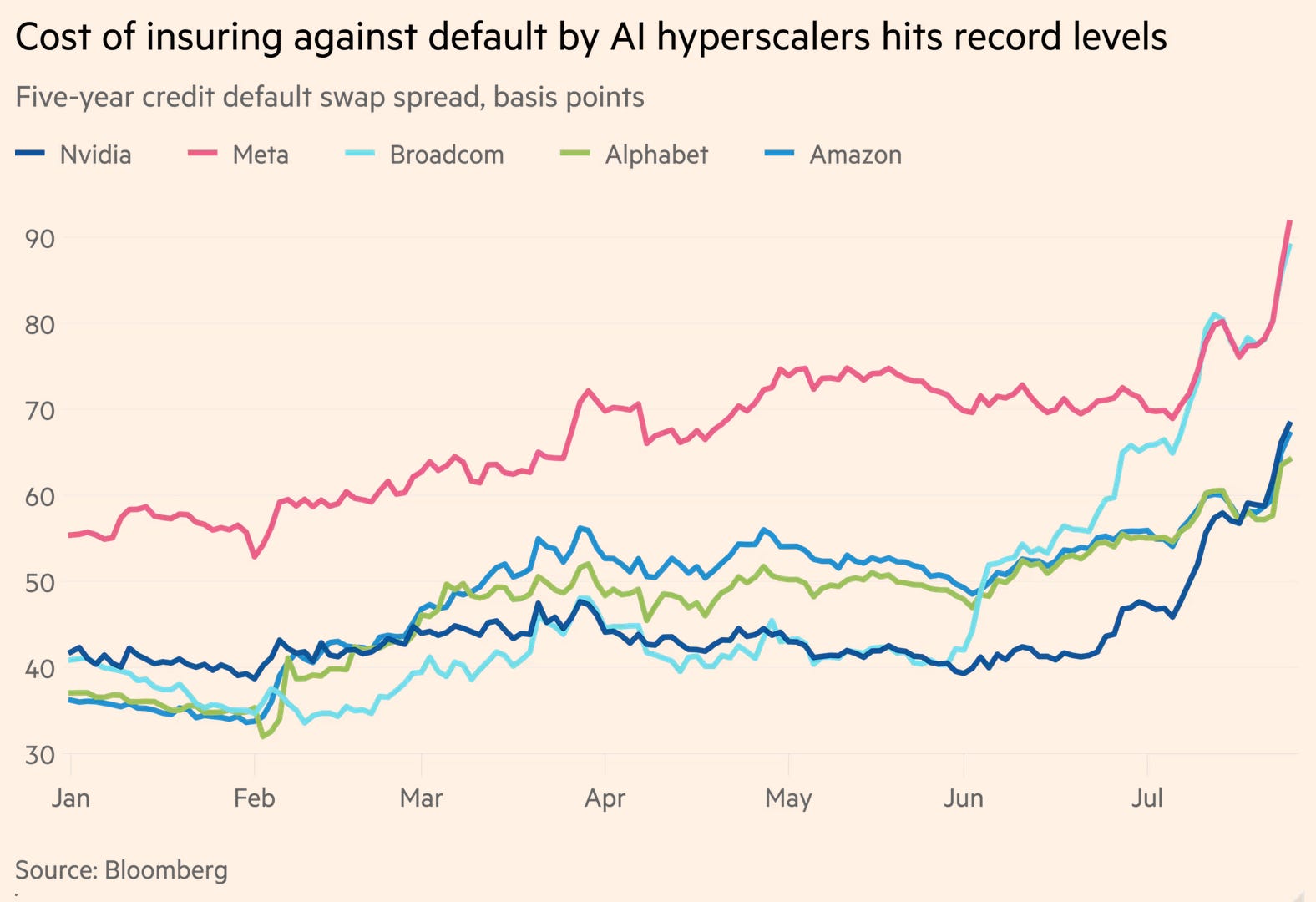
The market is indicating that it’s getting riskier to hold the debt of several big AI-related companies. Prices for credit default swaps (CDS) for Oracle, SpaceX, Alphabet, Amazon, Meta, Broadcom and Nvidia have risen to record highs. CDS are purchased to bet against corporate debt and hence offer a measure of the risk of holding the debt of a given company – 0.9% over the next five years for Meta, for example.
A review (a) by Nikkei Asia outlines how five hyperscalers are structuring $1.65T worth of future obligations so that they will not appear on their frontline balance sheets as debt, but rather in the footnotes. The case for this being somewhat nefarious is that it hides from straightforward public view the risks that these companies are each taking. The case for this being business as usual is that hyperscalers’ big bets on AI are well known, they will be severely punished by the market if their bets on AI go wrong, regardless of the accounting treatment, and SPVs are a good way to coordinate the amounts of risk that different entities want to take for a given venture.
> Under accounting rules, GPUs and servers under long-term contracts that have not yet been delivered -- as well as lease agreements for data centers that are not yet operational -- are treated as off-balance-sheet items.
US economic growth slowed to 1.5% in the second quarter.
Yields on 30-year Treasuries are at their highest levels since 2008. Inflation expectations, rising term premiums, increasing US government debt levels (which exceeded 100% of US GDP as of March 31 of this year for the first time since soon after World War II), increasing de-dollarization of the global economy, and other sources of uncertainty about the future are contributing to this increase.
The US Treasury intervened to support the Japanese yen on Friday, for the first time since 1998, following an intervention by Japan. The Federal Reserve Bank of New York sold euros to buy yen on behalf of the Treasury. The dollar fell against the yen on Monday, August 3 after the US and Japan both confirmed the interventions.
Average barge loads on the Rhine River have fallen to 16% of normal levels because of severe drought. The river provides critical connections between industrial sites in Switzerland, Germany and France and ports in the Netherlands. The current Rhine crisis could become as bad as a previous crisis in 2018, or even the worst in several decades. German officials expect extreme Rhine droughts to become more common with climate change.
The highly volatile South Korean stock market collapsed further during much of last week, and more leveraged positions were liquidated. The market then rebounded on Friday.
Climate and nature
The latest modeling, done using 14 models and Relative Oceanic Niño Index (RONI) data, predicts that there is a 77% chance that the 2026-2027 El Niño event will be the strongest on record.
California faces about a 2.5% chance of a $1T megastorm and megaflood from roughly November 2026 through March 2027. There’s a baseline 2% (and growing) annual chance of a megastorm, but the latest data suggest that the risk will be higher over the coming year because of an expected global mean surface temperature (GMST) anomaly of approximately 1.5-1.7°C (see Fig. 5 here). The risk in 2027-2028 could be as high as 3%, as next year is expected to shatter temperature records.
Scientists have found evidence in sedimentary layers off the coast of Oregon that a major Cascadia earthquake, which could affect the west coast of North America from Northern California to British Columbia, could trigger a major earthquake along the San Andreas Fault in California.
just wondering do you ever tweet stuff from sentinel