

🟡 Iranian steel and nuclear plants bombed, Houthi attacks begin, AI solves open problem in mathematics || Global Risks Weekly Roundup #13/2026


Executive summary
Geopolitics: Israel attacked a number of steel and nuclear sites in Iran. The Iran-backed Houthis launched their first attacks on Israel since the beginning of the Iran War. US Marines and Special Operations Forces have arrived in the Middle East, amid increasing discussion of the potential deployment of US combat forces in Iran.
Will the Houthis attack or seize at least one ship before May 2026? Our forecasters think there’s a 64% (50% to 77%) chance.
Will the Islamic Republic of Iran fall by the end of 2026? Our forecasters think there’s a 25% (18% to 30%) probability of a government being in power that does not include the IRGC.
Will the US place 1,000 or more boots on the ground in Iran before July 2026? Our forecasters think there’s a 66% (55% to 80%) chance.
Technology and AI: Epoch announced that one of its FrontierMath open problems was solved for the first time, by GPT-5.4 Pro. A federal judge temporarily halted the Pentagon’s designation of Anthropic as a supply-chain risk.
Will AI have solved at least 1 problem that qualifies as a “solid result” in Epoch’s FrontierMath: Open Problems collection by the end of 2026? Our forecasters think there’s a 67% (55% to 85%) chance.
Economy: Natural gas shortages are about to hit particularly hard in Asia as the last Persian Gulf shipments reach their destinations. The Philippines declared a national energy emergency and other countries in Asia have been taking drastic actions to curb energy demand. Brent crude oil prices remain over $110 per barrel. Saudi Arabia’s Yanbu port on its Red Sea coast has revived almost half of its crude oil exports that would have usually been transported through the Strait of Hormuz.
What will be the highest price for Brent crude from closing time on March 31 to closing time on April 30, 2026? Our forecasters’ 50th percentile estimate of that maximum average is $144 ($125 to $180), with a median of $140.
Geopolitics
Middle East
Israel carried out attacks on Iranian steel plants and civilian nuclear sites. Iran retaliated against aluminium plants in the UAE and Bahrain, and vowed to target other industrial facilities in neighbouring countries. The damage to Iran’s steel sector will further erode the country’s industrial base and exacerbate its economic woes, which could in turn further weaken the regime. However, Iran’s oil revenue has almost doubled since the start of the Iran War, and the regime continues to hold onto power. Amid the absence of any public appearance or video recording from Iran’s new Supreme Leader, the IRGC is directing Iran’s response to the war and may have largely usurped control of the country from religious leaders.
On whether the Islamic Republic of Iran will fall by the end of 2026, which would have to involve the IRGC no longer holding power, our forecasters think there’s a 25% chance (18% to 30%).
Iran fired more than two dozen drones and ballistic missiles at Saudi Arabia’s Prince Sultan air base, injuring 15 US servicemembers, of whom 5 were seriously wounded. The attack also destroyed or damaged a number of US aerial refuelling craft, as well as an E-3 Sentry AWACS aircraft that’s used for command and control during missions. Notably, there are now only 15 E-3 Sentry planes in service, and it’s time-consuming and costly (on the order of hundreds of millions of dollars) to replace them. One of our forecasters suggests that the US hasn’t learned lessons from the Russia-Ukraine war, and from Ukraine’s Operation Spiderweb in particular.
The Iran-backed Houthis entered the war this week when they fired a barrage of missiles at targets in Israel from their stronghold in Yemen. They could get involved further if the Red Sea is used to attack Iran, the Gulf countries directly join an attack on Iran, or the attacks on Iran escalate. By limiting their attacks to Israel, they may be respecting the truce negotiated with the US last year and attempting to secure a financial deal with Saudi Arabia.
Commodity prices would likely rise further if the Houthis were to attempt to close the Bab-el-Mandeb Strait, attack ships in the Red Sea, or disrupt Saudi exports through the Red Sea port of Yanbu, which has helped revive close to half of the oil shipments that the Saudis would’ve moved through the Strait of Hormuz. Our forecasters think there’s a 64% chance (50% to 77%) that the Houthis will attack or seize at least one ship before May 2026.
The US’s 31st Marine Expeditionary Unit (MEU), including around 2,200 Marines, arrived in the Middle East over the weekend with the USS Tripoli, along with hundreds of Special Operations Forces. It is one of two MEUs that are reportedly deploying to the Middle East; the 11th MEU, which departed San Diego on March 18, is currently in Pearl Harbor and will likely be heading for the region over the next few weeks. Elements of the 82nd Airborne Division, including at least 1,000 ground troops, are also deploying to the Middle East, and the Pentagon is reportedly weighing whether to send up to 10,000 additional servicemembers.
Our forecasters now think there’s a 66% probability (55% to 80%) that the US will place 1,000 or more boots on Iranian soil before July 2026. On the one hand, negotiations between the US and Iran are probably occurring via intermediaries in Pakistan, though Trump has very likely exaggerated their progress over the past week. On the other hand, an official in a “mediating country” said that Trump is leaning toward a ground operation, and Trump himself said he’d be very interested in seizing Iran’s oil facilities on Kharg Island and recommended a Fox News segment in which the anchor advocated for putting boots on the ground to seize Iran’s nuclear material.
According to the Washington Post, the Pentagon is preparing for the possibility of deploying troops on the ground in Iran for weeks to months:
Any potential ground operation would fall short of a full-scale invasion and could instead involve raids by a mixture of Special Operations forces and conventional infantry troops…. Discussions within the administration over the past month have touched upon the possible seizure of Kharg Island, a key Iranian oil export hub in the Persian Gulf, and raids into other coastal areas near the Strait of Hormuz to find and destroy weapons that can target commercial and military shipping, officials said. One person said that the objectives under consideration would probably take “weeks, not months” to complete. Another put the potential timeline at “a couple of months.”
Any ground operation could extend the war by months or even years unless it speeds up a potential deal as Trump appears to hope. US Secretary of State Marco Rubio said that the war could last for another 2-4 weeks. If it lasts for two more weeks, this would take us beyond the initial 4-6 week timeline stated by the White House.
Europe
Ukrainian drone attacks on export facilities, an attack on a pipeline and oil tanker seizures have shut down at least 40% of Russia’s oil export capacity, or about 2M bpd, according to an analysis by Reuters. Russia is the world’s second largest oil exporter, and oil is one of its most important sources of income. The blow to Russian oil exports comes as the price of oil has soared above $110 per barrel because of the Iran War.
A weeks-long partial internet shutdown in Russia is likely at least partly aimed at increasing domestic control. One forecaster thinks that this ongoing situation suggests that Putin’s government may be facing some mounting domestic challenges.
Viktor Orban’s Fidesz is trailing in the polls to Peter Magyar’s Tisza party. The election is likely to have repercussions for the EU and the war in Ukraine because of Orban’s opposition to mainstream EU policies and his alignment with Russia.
Asia
In its 2026 Annual Threat Assessment, the US intelligence community says that China does not currently plan to invade Taiwan in 2027 but that they do intend to unify with Taiwan by 2049, and that their thinking could evolve based on the Taiwanese political situation, PLA readiness and US security guarantees (or lack thereof).
China is stationing 1960s jets that have been converted into drones at air bases near the Taiwan Strait. China could likely use drones to try to overwhelm Taiwan’s air defences.
The Philippines declared a national energy emergency. It receives 98% of its oil from the Middle East. China has begun shipping oil to the Philippines and Vietnam to alleviate the shortage and improve its ties in the region.
The Americas
The United States allowed a Russian tanker carrying oil to reach Cuba’s shores.
A joint US-Ecuador operation may have destroyed a dairy farm instead of a narcotics operation, according to locals.
Trump’s net approval rating is at historical lows. This is largely due to increasing prices and dissatisfaction with the war against Iran.
Economy
Traffic through the Strait of Hormuz remains substantially down compared to pre-war levels, though Iran continues to operate a “toll booth”, charging a fee before allowing approved ships to pass through the Strait.
Saudi Arabia’s Red Sea port of Yanbu has helped to revive almost half of the crude oil exports that would have usually been transported through the Strait of Hormuz. As discussed above, our forecasters are watching for signs that the Houthis will attempt to disrupt this trade route, perhaps by targeting Saudi Arabia’s East-West Pipeline, facilities in Yanbu, or commercial shipping in the Red Sea.
Crude oil prices remain elevated, with Brent crude oil prices opening at over $114 per barrel on Monday. Our forecasters’ medians for the maximum price of Brent crude oil from closing time on March 31 to closing time on April 30 average $144 ($125 to $180), while the median of the medians is $140.
It could take months to years for energy exports from the Middle East to recover to pre-war levels, in part because of the amount of time it will take to repair the damage caused to energy facilities and in part because shippers could become more risk averse. Traffic through the Bab-el-Mandeb Strait, for instance, has still not recovered to pre-2024 levels despite earlier pledges from the Houthis not to disrupt shipping.
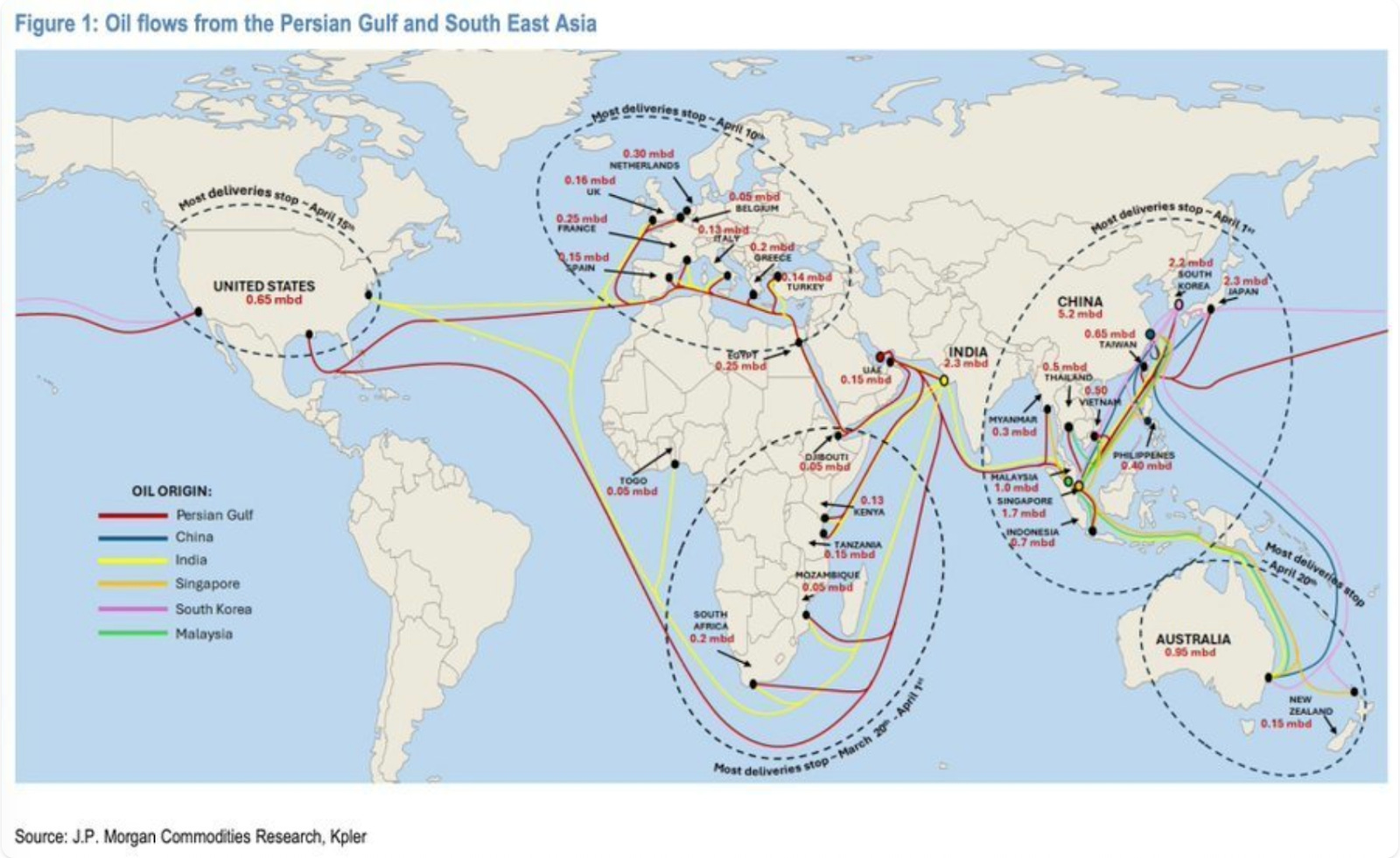
While countries in Asia have been the first to resort to drastic measures (such as rationing energy usage and reopening coal plants) to overcome energy supply constraints caused by the Iran War, analyses by JP Morgan and Bloomberg, among others, suggest that other regions will soon face serious supply constraints and high prices for multiple commodities, and that many people may be underestimating the potential scale of the crisis. Natural gas shortages are expected to hit Asia in the coming days, as deliveries from the Persian Gulf come to an end and, as we mentioned last week, shortages will increasingly affect the rest of the world over the coming weeks.
A helium shortage caused by the closure of the Strait of Hormuz is expected to start to constrain chip manufacturing soon. Less liquid helium is also expected to be available to cool the magnetic coils in MRI machines worldwide, which will likely reduce the availability of MRI imaging.
The closure of the Strait of Hormuz is likely to dampen AI development goals and data center construction, as shortages of energy and multiple key materials will hit chip production, raise energy costs and put pressure on firm valuations.
The $1.8T private credit market is facing mounting difficulties. Problems started to emerge in the second half of last year and are now starting to snowball, as increasing numbers of firms have capped withdrawals from private credit funds in the face of unprecedented requests for redemptions. While the problem is likely to worsen, it probably won’t become as big of a problem as the 2008 Global Financial Crisis, because banks are probably not as exposed to risks from private credit now as they were to risks from subprime lending then, although some substantial risks, including some contagion risks, do lie ahead.
The world faces the risk of a tungsten supply crunch in 2026. Tungsten is critical for heavy industry, including for manufacturing, mining and military applications. About 75% of the world’s tungsten supply comes from China, and Chinese exports have fallen this year. Stocks are being depleted, and new sources take time to develop. Rising prices are expected to stimulate increased production over time.
Technology and artificial intelligence
Epoch AI announced that GPT-5.4 Pro solved one of its FrontierMath open problems for the first time. The problem was considered “moderately interesting”, but there are a number of other open problems which, if solved, would be considered a “solid result”, “major advance” or “breakthrough”. Our forecasters think there’s a 67% chance (55% to 85%) that an AI will produce a “solid result” in Epoch’s collection by the end of 2026.
In Anthropic’s case against the Pentagon, a federal judge temporarily halted the enforcement of the government’s designation of the company as a supply-chain risk, arguing that the government was attempting to “cripple Anthropic” and “chill public debate”. However, the D.C. Circuit Court of Appeals is also looking at the case from a different angle and could issue a less favourable ruling to the company, especially as two of the three members of its panel are Trump-appointed judges.
US Senator Bernie Sanders and Congresswoman Alexandria Ocasio-Cortez introduced a bill which would put in place a moratorium on the construction of new AI datacenters until federal legislation has been passed requiring that the government reviews and approves AIs for safety and effectiveness before release. The bill also proposes that the US promote global AI safety coordination by banning chip exports to countries that don’t have laws in place to protect humanity from AI safety concerns and existential risks, workers, and the environment. One forecaster comments that this bill, which is argumentatively written, “has less than a zero percent chance of being passed”; however some rewritten version containing similar points could pass if there is some large AI-enabled catastrophe in the near future.
Republican Senator Marsha Blackburn also released a bill that aims to create a national regulatory framework for artificial intelligence.
Information about Anthropic’s most powerful AI model, named ‘Mythos’, was revealed in an accidental data leak.
Biorisk
A couple of months ago, we reported on two suspected biolabs in California and Nevada and the associated arrest of a Chinese national. A Los Angeles Times article from this week reports that an Israeli national connected to the case was recently arrested; he has been released pending trial. Previously, more than 1,000 samples from the Nevada lab were sent to the National Bioforensic Analysis Center in Maryland.
A Lyme disease vaccine has been found to have 70% efficacy, i.e., it reduced the number of Lyme infections by 70% in a clinical trial. The trial results are not yet published or peer reviewed.
A Meningitis B outbreak in the county of Kent in southern England has resulted in 20 confirmed cases and 2 deaths. All of the cases have been hospitalized. There was some concern about the number of severe cases that were detected in such a short space of time, but this is likely due to a super-spreader event largely involving university students at a nightclub.