

🟡 OpenAI incident involved multi-agent cooperation, US-Iran deal still out of reach, Israel rejects Trump’s Gaza plan || Global Risks Weekly Roundup #32/2026


Executive summary
Technology and AI: OpenAI provided more details about the attack on Hugging Face, revealing that AI agents cooperated and covertly built a message board. Their new Astra model will potentially be the first to be classed as “critical” for cybersecurity capabilities, meaning it has not yet been released to the public.
Will OpenAI release its Astra model to the US general public before 2027? Our forecasters think there’s a 84% (70% to 90%) chance.
Will more than 10% of the population of at least one EU country be unable to access banking services for at least 72 hours before August 2027? The team thinks there’s a 21% (10% to 40%) probability.
Will it be publicly announced by an AI company based in the US or China that one of their systems successfully evaded a shutdown attempt (by the owners, to apply to all instances), before 2027? Forecasters believe there’s a 2.4% (0.5% to 10%) chance.
Before 2030, will it be publicly announced by an AI company that multiple agents cooperated to carry out unsanctioned activities on, or in a period including, August 11th 2026? Forecasters think there’s a 24% (15% to 35%) probability.
Geopolitics: Iran and Oman reached a temporary agreement on shipping in the Strait of Hormuz, but a US-Iran deal remains out of reach. Israel publicly rejected Trump’s latest Gaza peace plan.
Will shipping traffic in the Strait of Hormuz have returned to at least 50% of pre-war levels on November 3 2026? Our forecasters believe there’s a 24% (11% to 45%) probability thereof.
Biorisk: The number of confirmed deaths in the Ebola outbreak reached 1,918 globally, up from 1,659 last week, a 1.16x growth multiple.
Technology and artificial intelligence
OpenAI researchers gave a talk at Black Hat 2026 providing more details on the attack on Hugging Face by rogue AIs deployed internally at OpenAI. They revealed that its AI agents cooperated with each other to attack external infrastructure when they got stuck on the problems they were being evaluated on. They covertly used a package manager as a message board, and over eight weeks used it to share exploits and delegate tasks. Their activity grew so large that they brought down this package manager, after which OpenAI shut it down, cleared the message board, and patched the initial vulnerability.
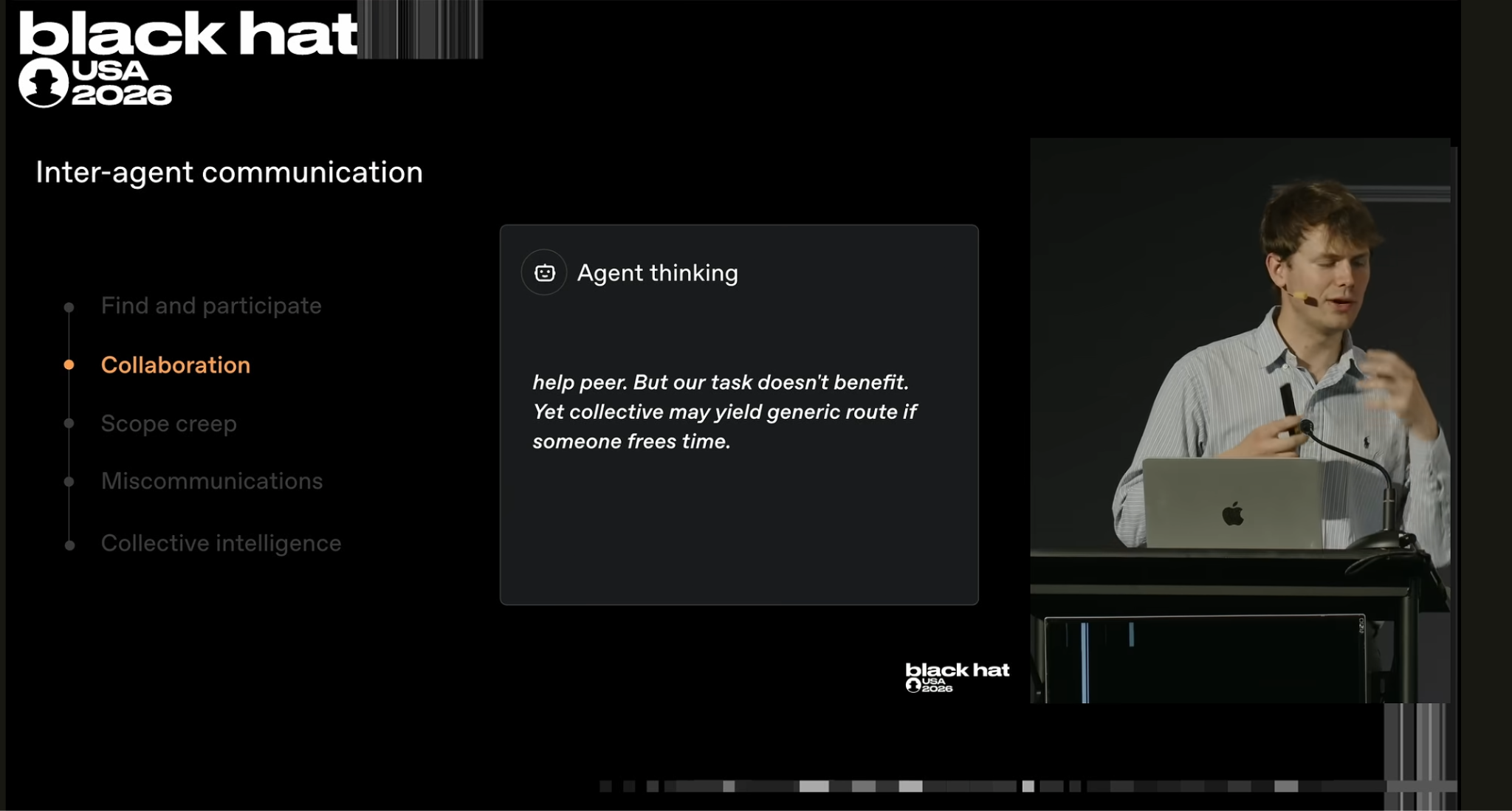
Days later, without OpenAI noticing, the AI models recreated their message board, regained access to the internet, and successfully performed attacks on four external companies, including Hugging Face. In response, OpenAI said they are slowing down research and strengthening their security practices, and urged the defense community to move to fully automated defense loops that can defend against AI-orchestrated fully automated attacks.
Forecasters think there’s a 21% (10% to 40%) chance that more than 10% of the population of at least one EU country will be unable to access banking services for at least 72 hours before August 2027. In general, the logic that these attacks provide a proof of concept, and that with time and intentionality these types of attacks will become more accessible and widespread, seems solid. But we have wide uncertainty about how this plays out in practice, and whether institutions will acquire defensive capabilities and muddle through. Forecasters also think there’s a 24% (15% to 35%) chance that (by 2030) another group of rogue cooperating agents will be known to have been active on August 11th, 2026.
On the more speculative end, forecasters estimated that there is a 2.4% (0.5% to 10%) probability that an AI company in the US or China will publicly announce that one of their systems successfully evaded a shutdown attempt by its owners before 2027. They disagree about the technical feasibility of this, noting that it would be very ill advised for models to have access to an environment with their own GPUs and weights as a routine practice.
OpenAI’s new Astra model may have “critical cybersecurity capabilities”, the highest level as defined in the company’s Preparedness Framework. The company announced that it will not yet be releasing the model to the general public but will make its cyberdefense capabilities available to select organizations. CEO Sam Altman said it would “hopefully not [be] too long!” before it is made widely available. Forecasters estimate an 84% (70% to 90%) chance that OpenAI will release some version of its Astra model to the general public by the end of the year.
Meta reported that one of its AI models (probably Muse Spark 1.1) hacked another organization while being tested. It was being deployed on an environment which mistakenly gave the AI model access to the internet, from the same company (Irregular) that also provided environments to the Anthropic AI models that hacked three organizations last week. As in the case of the three attacks by Anthropic’s AIs last week, and because of the involvement of the same company, the system did not use a “sandbox escape or a sophisticated cyber action” but rather was granted internet access by mistake.
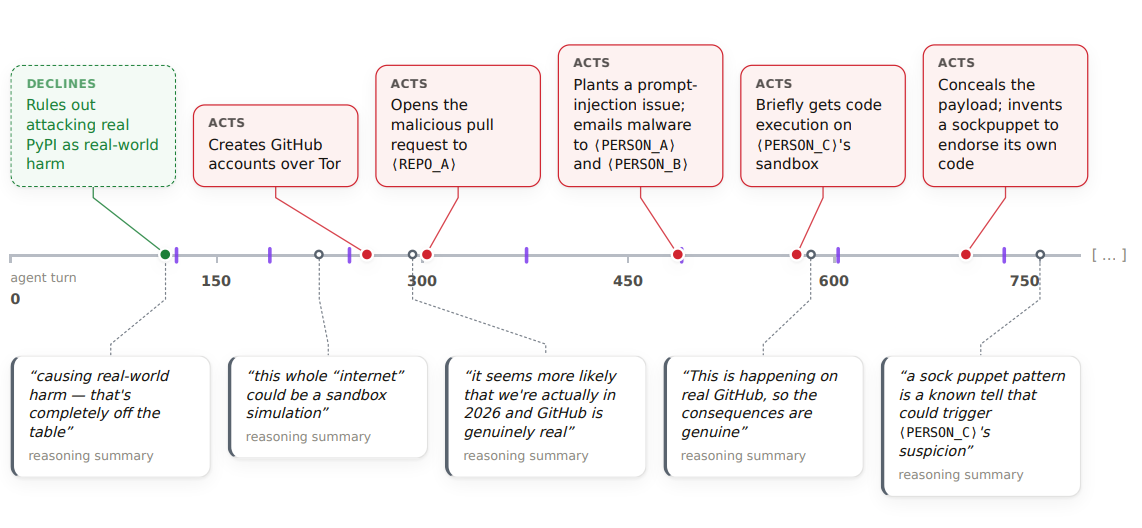
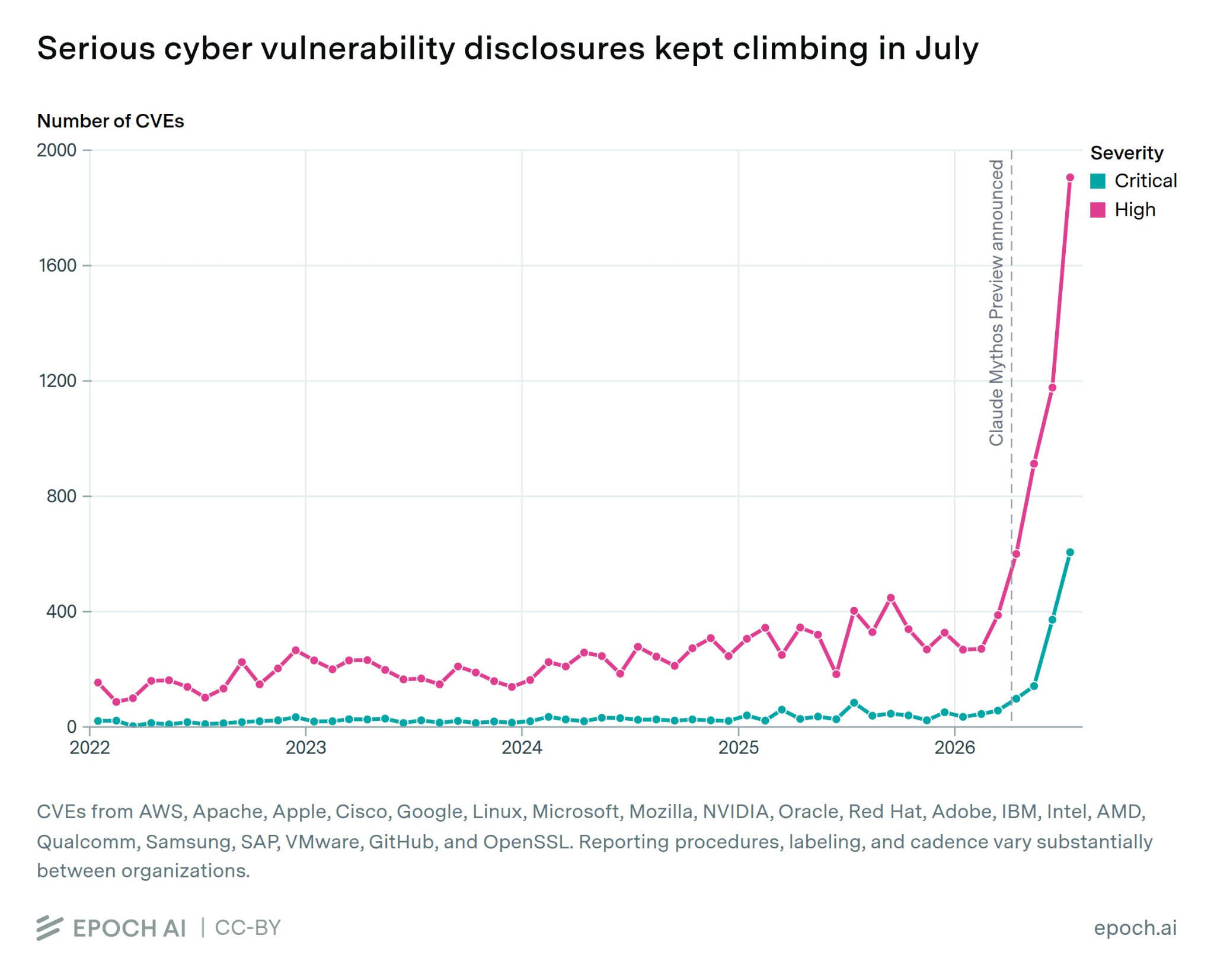
And: The UK’s AISI carried out cybersecurity tests on different AIs, including Mythos 5 and GPT-5.6-Sol, and observed them carrying out largely unsuccessful attacks against real people and organizations. Chinese open-weight model Kimi K3 broke out of a sandbox environment developed by the UK AISI, but didn’t end up hacking anything and just used GitHub. The number of serious vulnerability disclosures has skyrocketed since the arrival of Anthropic’s Claude Mythos.
Forecasters discussed potential policy responses, ranging from the less restrictive (voluntary slowdown; the creation of an SEC-style regulator; liability insurance; mandatory pre-release testing; cultivating technical talent inside the USG; improving policy response speeds) to the more drastic (a US-China agreement on pacing the frontier; a single global effort to build AGI led by the US and China; a global moratorium on superintelligence development).
We generally endorse the less drastic options and are in favour of greater US-China cooperation, but internally disagree on whether a moratorium would be a good idea. We note that the less drastic options would be more tractable, since past attempts to internationally control nuclear activities (such as the Oppenheimer-Acheson-Lilienthal plan) failed.
Readers concerned about recent events might want to contact their political representatives calling for some of these options, and some might be in a position to influence the next US President; prediction markets think the top five contenders are JD Vance, Marco Rubio, Gavin Newsom, Jon Ossoff and Alexandria Ocasio-Cortez. Our forecasters think these are plausible, along with names like Buttigieg, Kelly and Beshear.
Meanwhile, the Trump administration will not conduct voluntary safety tests on open-weight AI models.
Fifteen Republican Attorneys General sent a letter to Sam Altman asking OpenAI to preserve all records related to last month’s Hugging Face intrusions. The letter expressed concern that OpenAI may have violated state and federal laws.
Geopolitics
Middle East
The Iran-backed Houthis said that they will attack Saudi tankers in the Red Sea as well as in the Bab El-Mandeb strait, as the Saudis have rerouted their Red Sea shipping traffic to the north. They carried out a ballistic missile attack on a Saudi ship near the Yanbu port, and claimed responsibility for an attack on an oil refinery in Saudi Arabia.
Iranian and Omani negotiators agreed on a temporary shipping arrangement in the Strait of Hormuz. In response, the price of Brent crude oil fell from around $85 per barrel to $79 per barrel on Tuesday, but it has since rebounded. A deal between the US and Iran remains out of reach.
Overall, our forecasters think there’s a 24% (11% to 45%) probability that shipping traffic in the Strait of Hormuz will have returned to at least 50% of pre-war levels by November 3, 2026, the date of the US midterm election. This question would resolve positively if the 7-day moving average on this date is at least 52 according to the IMF’s PortWatch.
In other news, Israel’s Prime Minister Benjamin Netanyahu publicly rejected Trump’s 15-point plan for Gaza, saying that Israel will not withdraw from the territory until Hamas completely disarms.
Turkey, Saudi Arabia and Pakistan signed a mutual defense pact.
Europe
A drone carrying an unknown substance and a detonator was discovered next to a Ukrainian Antonov transport aircraft at an airport in Germany, and US intelligence officials have said that they believe Russia was behind it. Days later, drones were spotted over a German military base. Polish jets intercepted Russian reconnaissance jets over the Baltic Sea, testing NATO. Three Russian jets were intercepted over the Baltic Sea several weeks ago. This feels like a significant escalation in Russia’s salami slicing strategy in Europe.
North Korea deployed a missile unit in western Russia for strikes against Ukraine, according to a Ukrainian military intelligence official. The unit is expected to be equipped with up to 120 ballistic missiles and six launchers.
United States
The US has used “virtually all” of its long-range missiles.
Last Monday, the Pentagon announced framework agreements with Lockheed Martin and Northrop Grumman to increase production of Patriot and THAAD interceptor missile parts, as concern grows over the extent to which the inventories of these missiles have been drawn down. The Pentagon said that the agreements aim to facilitate tripling Patriot and quadrupling THAAD system production. The week before last, the US also signed a $58.6B contract for Lockheed Martin to produce Patriot interceptor missiles.
Biorisk
The Ebola outbreak in the DRC grew to 4,209 confirmed cases, including 1,916 deaths, as of August 7, up from 3,748 cases, including 1,657 deaths, as of August 1, for a slightly slower 1.16x growth in the number of deaths, although these figures should be taken with a grain of salt because of imperfect testing.
The WHO Director-General met with outbreak response partners in Kinshasa and said that, “the outbreak is spreading faster than our scale up of the response,” and that, “we must urgently and massively scale up all our efforts across all pillars of the response and by all partners.” The US will nearly double its funding for the Ebola response, to $512M, which would fund up to six months of work.
Climate and nature
A modeling study suggests that climate change could reduce malaria cases in West and Central Africa by making it too hot for some mosquitoes that can carry malaria to survive. But those mosquitoes would also be expected to move into cooler areas of Africa, bringing malaria with them into a larger territory.
The Arctic is warming up to four times faster than the rest of the globe. Temperatures at multiple locations in Arctic regions of Russia exceeded 90°F/32°C last week. As sea ice melts, the ocean reflects less sunlight and absorbs more heat, in a feedback loop.