

🟡 OpenAI model breaches containment, Houthis and Saudis clash, US and Iran pause attacks for over two days || Global Risks Weekly Roundup #30/2026


Executive summary
Technology and AI: A combination of OpenAI models was revealed to be behind the recent cybersecurity breach at Hugging Face (🟡). A bipartisan bill named the AI Kill Switch Act was introduced to the US House of Representatives.
Will the AI Kill Switch Act pass the US House of Representatives before January 3, 2027? Our forecasters think there’s an 18% (12% to 27%) chance.
By December 31, 2027, will OpenAI or any of its directors, officers, or employees be arrested, charged, penalized, or subjected to formal regulatory or criminal enforcement action for conduct related to the Hugging Face attack? Our forecasters believe there’s a 2.6% (1% to 9%) probability.
Geopolitics: Saudi Arabia and the Iran-backed Houthis carried out strikes on each other, while the US and Iran paused fighting for over two days, with Oman attempting to mediate a fresh ceasefire deal.
Will the United States and Iran announce a new ceasefire by the end of August? Our forecasters think there’s a 60% (40% to 70%) chance.
Biorisk: The number of confirmed deaths in the Ebola outbreak reached 1,407, up from 930 last week.
How many confirmed deaths will there be in the Ebola outbreak before September 2026? Our forecasters’ aggregate 90% confidence interval ranges from 2.6K to 15.1K (with an aggregate mean at 5.4K). By the end of 2026, our estimate ranges from 4.8K to 105K, with an aggregate mean at 22.7K.
Technology and artificial intelligence
A “combination” of OpenAI models was revealed to be behind the cybersecurity breach at Hugging Face, which we reported on last week. It appears that the model(s) broke out of the sandbox that OpenAI had built and broke into Hugging Face in an attempt to cheat on the test it was being given.
Cheating behaviour and reward hacking more broadly have been observed before by frontier AI labs, METR, and the UK’s AI Security Institute (which published a report on the subject this week), but many of our forecasters are still surprised by the scale and audacity of the Hugging Face incident.
Still, we think it’s extremely unlikely that there will be any legal consequences for OpenAI, giving just a 2.6% (1% to 9%) chance that the company or any of its directors, officers, or employees will be arrested, charged, penalized, or subjected to formal regulatory or criminal enforcement action before 2028.
Some forecasters recommend that readers consider taking the precautionary steps of moving their funds away from European financial institutions, which are going to be more insecure, and into large American institutions, which have access to the latest AI models to faster patch their vulnerabilities with. Our sources tell us that Banco Santander, in particular, is riddled with security gaps, which would make sense in light of its fast expansion.
In somewhat related news, Democratic Congressman Ted Lieu joined with Republican Congressman Nathaniel Moran to introduce a bill, the AI Kill Switch Act, into the US House of Representatives, which proposes that the Department of Homeland Security be given powers to order a company to shut down an AI model if there is a “loss of control” incident. Our forecasters think there’s an 18% (12% to 27%) chance that it will pass the House by January 3, 2027. Overall, in each Congress, 14K bills are introduced, of which only about 5% are enacted into legislation (though passing the House is a weaker burden). On the one hand, this is an important issue that many people in Congress will be increasingly concerned about (with the Hugging Face incident being a stark example of the dangers). However, it might be less likely than a typical bill to be passed because of the prospect of an immense lobbying effort against it.
Chinese start-up Moonshot AI’s open-weight model Kimi K3 was jointly tested by the UK’s AI Security Institute and the US Center for AI Standards and Innovation, which found that the model “performs significantly below the most recent frontier cyber-capable models on preliminary cyber evaluations.”
The Trump administration’s Science and Technology Adviser Michael Kratsios claimed that Moonshot AI carried out a “distillation” attack on Anthropic’s Fable model in order to develop Kimi K3, which he said was tantamount to “stealing proprietary U.S. technology.”
Microsoft signed a multibillion dollar deal with French AI company Mistral.
A PhD candidate at Columbia reportedly solved six open Erdős problems in 5 days, using OpenAI’s GPT-5.6 Sol.
Geopolitics
Middle East
The Saudis and the Iran-backed Houthis traded fire after the latter attempted to enforce a blockade on Saudi Arabia. The Houthis fired on two Saudi tankers in the Red Sea on Thursday.
Meanwhile, the US fired on another vessel in the Strait of Hormuz for violating its blockade of Iranian ports, but both Iran and the US have held their fire since Saturday, with Oman attempting to mediate a fresh ceasefire agreement.
Our forecasters think there’s a 60% (40% to 70%) probability that the US and Iran will announce that such an agreement has been reached, or no longer engage in regular hostilities under a de facto, unsigned ceasefire arrangement, before September 2026. On the one hand, the US is expending munitions in the Iran war at a rapid rate, with some officials concerned that their ongoing depletion could put US readiness for other potential scenarios at risk. The US is also very motivated to see commercial shipping through the Strait of Hormuz increase to higher levels. On the other hand, trust between the two sides is very low, and some voices are urging the Trump administration to escalate hostilities.
The US and Saudi Arabia signed a deal under which Saudi Arabia would develop a civilian nuclear program and could potentially enrich uranium in the future. The next day, Trump said that the US-Saudi nuclear deal would only go ahead if the Saudis join the Abraham Accords, which would involve normalizing relations with Israel.
Bahrain and Kuwait conducted airstrikes targeting military sites in Iran earlier this month.
Europe
Ukraine’s President Zelenskyy sacked Gen. Syrsky, commander in chief of the Ukrainian armed forces, and appointed 43-year-old Mykhailo Drapatyi, a well-known battlefield commander who was previously in charge of Ukraine’s ground forces and joint forces command, to take his place. The change marks a transition from the “old guard” of generals trained under the Soviet Union, to a younger generation of commanders forged in the Ukraine war and more ready to embrace newer approaches to the war.
Ukrainian attacks have taken more than half of Russian oil refinery capacity offline, according to Morgan Stanley. Russia has extended an export ban on gasoline until the end of the year, and the country was scheduled to receive a gasoline shipment from India on July 26. Russia said that the country plans to lift its ban on diesel exports when its diesel market recovers.
Ukraine is also targeting the warehouses of Russian e-commerce giant Wildberries, which connects buyers and sellers all over Russia via its logistics network. Ukrainian attacks have reportedly destroyed around one tenth of Wildberries’ total warehouse capacity since the attacks started on July 18, causing about $2.2B in losses that will nearly all be borne by people selling goods through the company, rather than by the company itself. A minority of goods sold on the Wildberries platform are military-related, but an important goal of these attacks is to increase pressure on Putin by bringing something of the war on Ukraine home to ordinary Russians.
NATO jets under NATO command scrambled and shot down three drones in three days in Romanian airspace.
The Swedish Transport Agency reports that satellite navigation (GNSS) jamming is continuous and spoofing is common in the Baltic Sea, especially around southeastern Sweden, including Gotland and Öland, and around marine traffic flows towards the Baltic states, Finland and Poland. Sweden has previously accused Russia of being behind the large rise in jamming in the Baltic Sea.
Latin America
The US Department of State released a report about Cuba and stated that, “Cuba’s assault on the United States was never, at root, a quarrel over economic policy or sovereignty or even ownership of a particular territory. It was a revolution against Western civilization itself.”
In Nicaragua, President Daniel Ortega, who has been in power since 2007, announced that the country will not hold elections again.
Asia
India’s education minister resigned following the “Cockroach Janata Party” protests, leading the protesters to call off a planned strike.
A social media personality declared independence in the province of Balochistan from Pakistan. Although the claim got picked up in some minor newspapers, observers mostly categorized it a more of a social media event than a significant declaration.
Africa
The US is reportedly considering conducting strikes on an al-Qaeda-affiliated rebel group in Mali.
United States
The White House Office of Science and Technology Policy set forth a plan to overhaul how federal research funding is awarded, proposing the most significant set of changes since the period following World War II. It commands that more funding go to individual scientists rather than to universities, and to fund more research that uses AI, in order to accelerate scientific and technological progress in competition with China.
One forecaster with research experience is concerned that the new approach will harm large universities that rely on federal research funding, potentially catastrophically, and could potentially upend the top tiers of the university system and the abilities of universities to smooth grant funding fluctuations across administrations. The directives in the report could also potentially reduce incentives for students to spend long, intense years at low wages to train to become scientists, by reducing the prospect of some level of job security at universities later on. Another forecaster notes that this is probably correct but also by design to reduce funding to Trump’s political enemies.
The report was released on the heels of a federal court ruling that the Trump administration could not cancel previously awarded grants because they no longer align with current administration priorities. Last year, the Trump administration also sought to cap indirect research costs, which go to the institutions that host research, at 15% of award totals, but that attempt was blocked both by federal courts and by Congress. The administration has also pursued other policies that aim to change both K-12 and higher education in the US.
The Trump administration also clashed with federal judges after two blocked the termination of Temporary Protected Status (TPS) for migrants from South Sudan and Ethiopia. Administration supporters noted that the Supreme Court had previously ruled that, “the TPS statute bars judicial review of non-constitutional claims,” while opponents noted that the Supreme Court’s ruling was made on the basis of reviewing somewhat abstruse claims that revoking their clients’ TPS status deprive the migrants of liberty and property as guaranteed in the Fifth Ammendment. Overall, the conflict between the executive power wishing to act and the judiciary being able to delay and obstruct may come to an interesting clash if the administration chooses to ignore federal judges without ignoring the Supreme Court.
Biorisk
The Ebola outbreak in the DRC continues to grow, with 3,200 cases, including 1,405 deaths confirmed as of July 25, up from 2,340 cases and 930 deaths as of July 18. Uganda has seen 20 confirmed cases in the current outbreak, including 2 deaths, and no longer has any active cases. In the coming days, this outbreak will likely surpass the 2018-2020 North Kivu outbreak in size; the North Kivu outbreak is the second largest on record, with 3,470 cases and 2,287 deaths. Our forecasters expect the number of cases and deaths in the current outbreak to continue to accelerate, as the outbreak continues to be insufficiently controlled.
Our forecasters’ aggregate 50th\ percentile estimate for the number of confirmed deaths in the outbreak before September 2026 ranges from 2.6K to 15.1K (with an aggregate mean at 5.4K). By the end of 2026, our estimate ranges from 4.8K to 105K, with an aggregate mean at 22.7K.
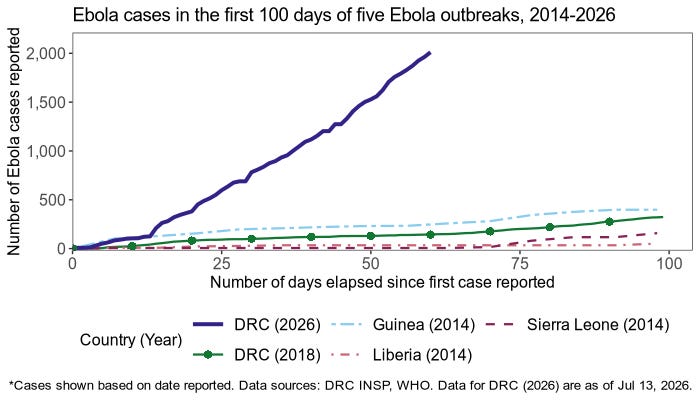
Forecasters discussed that the outbreak has grown far more rapidly than the 2014 epidemic, and that the current outbreak is by default going to grow much larger, and they argued about the size of the largest plausible outbreak: if the current growth rate continues, the outbreak spreads into cities, and the international response is slow and ineffective without a large amount of help from the US, then the numbers would grow really fast (e.g., 50M by the end of the year, naïvely extrapolating the growth rate). Of course, at some point before then, the exponential would turn into a sigmoid, we’d see behavioral change, the population would build immunity, etc. But we are uncertain about where that inflection point would be reached, and about when help from the global public health community, working together with local health systems, would bring the outbreak under control.
Economy
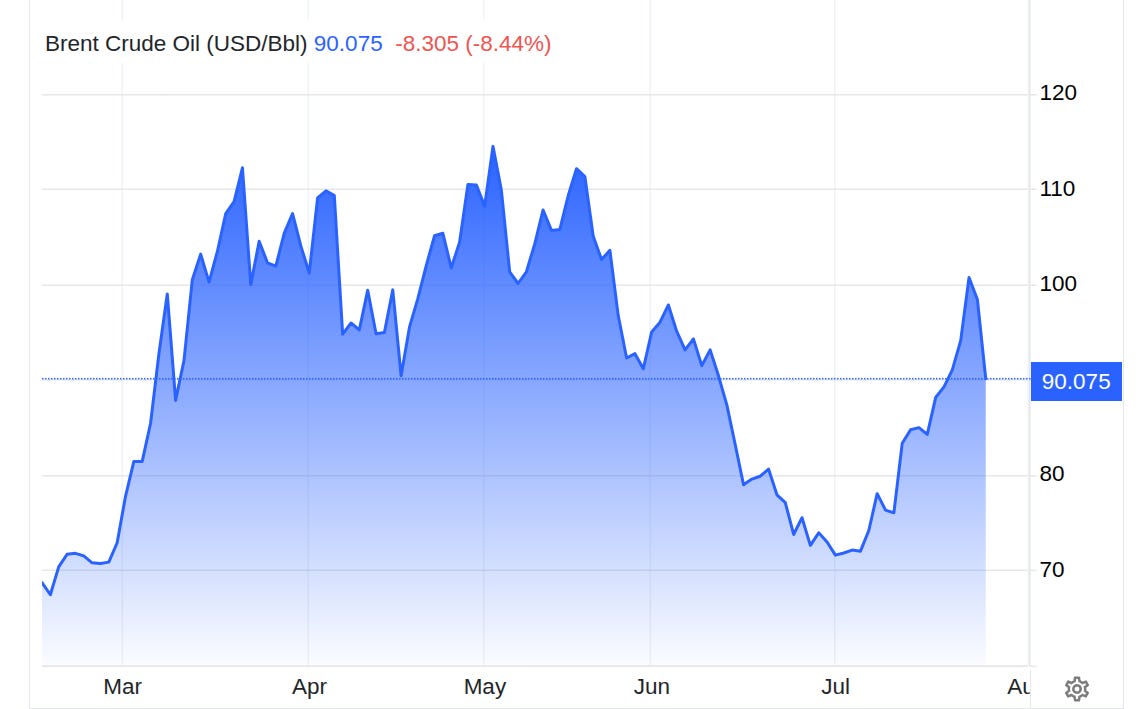
The price of Brent crude oil rose to over $100 again as Trump considered escalating strikes on Iran. Last week, we gave this a 68% chance of happening by the end of 2026. The price has since fallen to $90 because of the pause in fighting.
As Trump’s 10% tariffs on most US imports expired on Friday, he imposed new US tariffs of 10-12.5% on 60 trade partners, including China and the EU, that cover 99.4% of all US imports. Some goods are exempted, including oil and gas, fertilizer and some food items. The tariffs were imposed based on claims by the US that those trade partners had allowed goods made with forced labor into their supply chains; countries on which tariffs have been placed have denied these allegations. Additional tariffs are expected in the coming weeks.
Canadian exports that comply with the rules of origin in the Canada-US-Mexico Agreement will be exempt from the new US tariffs, which means that tariffs on Canadian goods won’t change. However, the Trump administration has also threatened to impose 50% tariffs on a wide swath of Canadian goods starting August 19, based on its claims that Canada is discriminating against US alcohol, dairy and auto-industry products.
Trump announced in a Truth Social post that the US would impose 100% tariffs on imported generic drugs starting in August 2028, and that this rate would increase to 200% in August 2029. The announcement is intended to encourage generic drug manufacturers to move production to the US. However, uncertainty about whether this policy will be enacted as stated or will be continued in a future administration may dampen investment in such manufacturing capabilities in the US.
Climate and nature
Wildfires have forced over 250K people to evacuate their homes in Spain and France. We can expect growing areas to be afflicted by wildfires as many regions of the Earth experience warmer temperatures and drier conditions. Around the world, societies will need to plan to devote increasing resources to mitigate the consequences of and prevent deaths from wildfires, heatwaves, droughts, and other climate disasters.
Typhoon Noul, the strongest this year to date to make landfall in China, made landfall in southern China on Sunday after forcing more than 715,000 people to evacuate in Guangdong province.
> Some forecasters recommend that readers consider taking the precautionary steps of moving their funds away from European financial institutions, which are going to be more insecure, and into large American institutions, which have access to the latest AI models to faster patch their vulnerabilities with. Our sources tell us that Banco Santander, in particular, is riddled with security gaps, which would make sense in light of its fast expansion.
These recommendations are quite concrete and potentially costly. They imply quite a bold statement (individuals holding funds with American financial institutions are significantly more likely to suffer losses due to cyber then those at European institutions). I'd expect them to be accompanied by relevant forecasts.
What consumer protection laws apply also seems very relevant and not discussed. Claude suggests I am much more protected in the UK than the US. In the UK, the bank is liable and that is enforced by complaint to a regulator, no need to go via courts. The US situation appears less clear cut.
Great post! Thanks for the update!
Back in December forecasters “estimate(d) a 60% (35% to 75%) probability that the US will have federal or state regulation in force on December 31, 2026 that requires at least some frontier AI developers to publish and follow plans for mitigating the risk that their AIs might cause catastrophic damages.” Why is the probability of the AI Kill Switch Act so low? Do forecasters still think that there is a decent chance of a federal or state regulation being in force on December 31, 2026?