



Executive summary
Geopolitics: A Russian drone hit an apartment building in Romania, injuring two people. Israel continues to strike Lebanon and Gaza.
Will at least 10,000 deaths in Gaza and Lebanon be attributed to Israeli military action between June 1 and September 1, 2026? Our forecasters think there’s a 19% (7% to 35%) chance.
Biorisk: Reported Ebola deaths continued to rise, though at a slower pace. There are currently between 220 and 300 suspected deaths.
Will at least two countries besides the DRC have at least 1,000 confirmed and suspected cases of Bundibugyo Ebolavirus by the end of 2026? Our forecasters think there’s a 37% (20% to 50%) chance.
Will there be more than 20,000 confirmed and suspected cases of Ebola in the current outbreak by the end of 2026? Forecasters think there’s a 55% (35% to 70%) chance.
Technology and AI: Anthropic surpassed OpenAI’s valuation in its latest funding round.
What is the chance that Anthropic’s valuation will exceed that of OpenAI by at least 50% on June 1, 2027? Our forecasters estimate that there’s a 35% (20% to 51%) probability.
Economy:
Will the hourly Brent crude oil futures price reach $150 before August 2026? Our forecasters believe there’s a 17% (10% to 51%) chance.
Geopolitics
Middle East
Over the past week, Iran and the US continued to wrangle over the terms of a peace deal or ceasefire extension. However, on June 1, Iranian state media announced that Iran would fully close the Strait of Hormuz and halt negotiations because of what Iran claims are ongoing ceasefire violations by Israel against Hezbollah in Lebanon.
Israeli PM Netanyahu ordered strikes on Hezbollah-controlled suburbs of Beirut, Lebanon on June 1, following escalating Israeli strikes against other Hezbollah targets over the weekend. The strikes come in response to Hezbollah’s “repeated violations“ of the ceasefire and “attacks against our cities and citizens,” according to a statement from Netanyahu’s office. Hezbollah has claimed responsibility for firing missiles targeting Israeli military infrastructure in Tiberias, Israel, on Monday, and for other attacks that it claims are in response to Israeli ceasefire violations.
In addition, Netanyahu said he directed the Israeli military to increase its control over Gaza to 70% of the region’s territory, from the 60% that Israel currently controls.
Forecasters estimate that there is a 19% (7% to 35%) chance that there will be at least 10,000 deaths in Gaza and Lebanon caused by the Israeli military between June 1 and September 1, 2026. Current levels of deaths caused by the Israeli military are less than 1,000 per month, so a military escalation would be needed to reach the 10K threshold, but one which the Israeli military is well capable of.
Europe
A Russian Geran-2 drone (Shahed 136 in its original Iranian designation) hit a 10-story apartment building in Galati, Romania, injuring two people. Its warhead fully detonated and caused a fire that was quickly brought under control. This is the first time that a Russian drone has caused injuries in a NATO member country, the 47th time – and the 12th time this year – that debris from Russian drones has landed on Romanian territory. The drone may have been struck while flying over Ukraine, damaging either the navigation or control systems.
The EU will release 16B Euros in funds for Hungary that were frozen when Orban was prime minister.
Anti-government protests in Serbia drew nearly 200K people. These were the second largest protests since the fall of former president Slobodan Milošević in 2000, and were motivated by a lack of investigation into corruption related to the collapse of a canopy in a train station that killed 16 people in 2024.
Asia-Pacific
China is building a military complex “that some security scholars say appears built to ensure no American first strike on China’s nuclear arsenal could reliably knock out Beijing’s ability to hit back.”
US Defense Secretary Pete Hegseth said that the US will prevent China from gaining hegemony in the Asia-Pacific, but he did not explicitly mention Taiwan in his speech at the Shangri-La Dialogue in Singapore. He also said that US-China relations are better than they’ve been in many years.
The Americas
Latin America
US SOUTHCOM commander Gen. Francis Donovan met with senior Cuban military leaders on the perimeter of the US Naval Station Guantanamo Bay to discuss “operational security matters.” This visit suggests that security of the US naval base is being addressed before potential US military intervention in Cuba.
The United States
A federal court reviewed the Trump administration’s plans to tighten requirements for mail-in ballots, including plans for a citizenship list, and didn’t enter a preliminary injunction against them.
The Pentagon reached a $4 billion deal with SpaceX to track aircraft from orbit, which would reduce the need to use Airborne Early Warning and Control (AEW&C) aircraft for this purpose.
Department of Homeland Security (DHS) Secretary Markwayne Mullin again threatened to remove all Customs and Border Patrol (CBP) agents from airports in sanctuary cities, which would halt processing of international arrivals at these airports. He claimed that he is not threatening to stop international flights, but without CBP agents to process arrivals, there would be a de facto halt to international flights arriving at these airports. While most sanctuary cities are led by Democrats, such a move would disrupt travel throughout the US.
The chemical tank in Garden Grove California, reported on in our last report, was stabilized, but a 3.4M-liter chemical tank imploded in Longview, Washington, killing 11 workers.
Africa
An estimated 30K Fulani militants are causing death and destruction in Nigeria, according to a US report on global religious freedom.
Technology and artificial intelligence
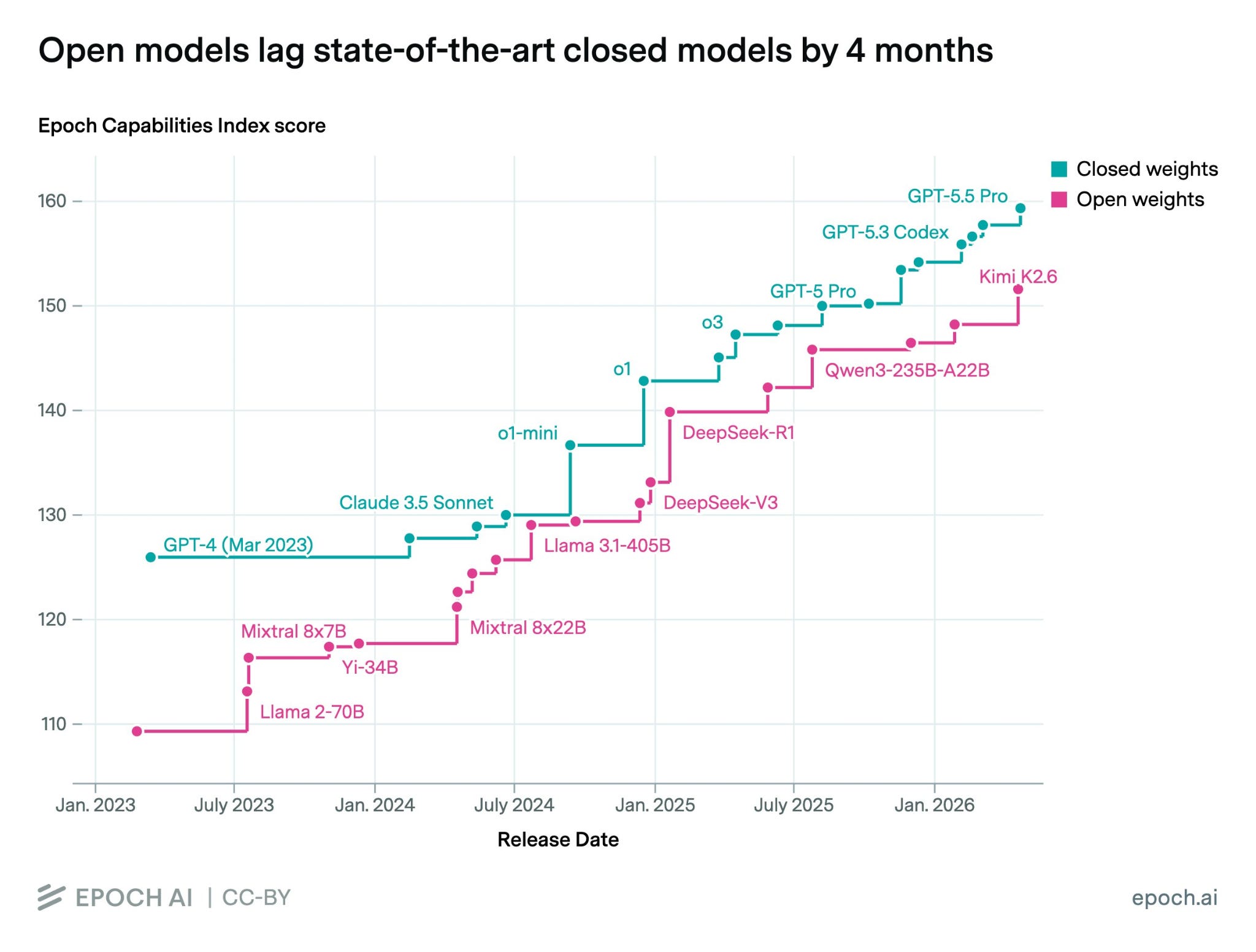
Epoch AI estimated that open-weight AIs are 4 months behind the state of the art. This is relevant for cyber and biorisk capabilities.
Anthropic launched Opus 4.8. The company also said that they “expect to be able to bring Mythos-class models to all our customers in the coming weeks,” as they are in the process of developing cyber safeguards. Anthropic’s valuation reached $965B after a $65B funding round, surpassing OpenAI’s $852B valuation.
Forecasters estimate that there is a 35% (20% to 51%) chance that Anthropic’s valuation will exceed that of OpenAI by at least 50% on June 1, 2027. While Anthropic may face some tailwinds over the coming year in its legal battle against designation as a supply chain risk by the US Department of Defense, the company is currently ahead of OpenAI in its capabilities and looks likely to maintain its lead. However, forecasters don’t expect Anthropic will strongly dominate over OpenAI by one year from now – although they don’t rule it out, and one forecaster thinks it’s more likely than not. OpenAI’s trailblazing also required giving too much equity to Microsoft, whereas Anthropic, having not done that, can compensate its employees better, giving it a strategic advantage.
Safety protections can reportedly be easily stripped from Meta and Google models, allowing responses to prompts involving bioweapons, malware and child exploitation.
OpenAI is creating a trusted access biorisk programme with a model called GPT-Rosalind. OpenAI gave some Japanese financial institutions access to “GPT-5.5”1. The OpenAI Foundation committed $250M to help workers and economies adapt to AI disruption. OpenAI also offered $2M in credits in exchange for equity for companies in the YC incubator program.
Illinois passed a bill that requires top AI companies to have third-party confirmation that they’re following safety standards. The governor says he’ll sign it.
British officials are considering whether to allow weapon systems to conduct lethal strikes without human approval. North Korea is reportedly testing AI-guided cruise missiles.
An investigation looked at vulnerabilities in OpenClaw. Since the software is widely deployed, connected to the internet, granted wide permissions, and itself created with heavy AI assistance, it is an attractive target for attacks and introduces correlated vulnerabilities.
The Pope published an encyclical on AI that states,
> “For this reason it is necessary to begin a shared discernment process for identifying the spiritual and cultural roots of ongoing transformations. If we focus only on contingencies, we risk letting the succession of emergencies dictate the direction of our path. We are living through a rapid phase of transition, a “change of era,” in which — while some are vying for the future of new technologies and others dedicate themselves to reflecting on the matter — most people are watching and waiting, observing from afar and merely hoping for the best. For this very reason, crucial questions impose themselves on our conscience and can no longer be avoided: Where are we going? Toward what goal do we wish to orient ourselves? What direction should we choose as a people and as a human community?”
Australia’s Assistant Minister for Productivity gave a talk on the economics of extinction, identifying AI as an extinction risk, citing estimates by Toby Ord and other experts.
Biorisk
There are now at least 228 suspected deaths in the Ebola outbreak; the rate at which reported mortality is increasing slowed over the past week. The outbreak continues to grow in a region with limited healthcare availability, limited Ebola testing capabilities, and substantial resistance among the public to health measures needed to slow the spread of the outbreak.
In response to the outbreak, Uganda closed its border with the DRC to most traffic.
An antiviral therapeutic is being trialed as a post exposure prophylactic for Ebola, i.e., as a medication that could reduce the chance that an exposed person will develop Ebola disease. Russian scientists announced the development of a vaccine that may offer protection against the causative species of the current Ebola outbreak.
The US wants to set up an Ebola quarantine facility and treatment center for US citizens with Ebola on its military base in Kenya. A Kenyan court initially suspended this plan, but Kenya’s government might still push it through.
Canada will require a three-week period of self-isolation for people traveling from Congo, Sudan and Uganda because of Ebola.
Our forecasters think the outbreak is likely to grow dramatically this year and estimate that there’s a 55% (35% to 70%) chance that there will be more than 20,000 confirmed and suspected cases of Ebola in the current outbreak by the end of 2026. However, in contrast with the 2014-2016 Ebola outbreak in West Africa, our forecasters think that the current Bundibugyo ebolavirus outbreak that started in the DRC will probably not spread to cause sizable outbreaks in other countries, at least in part because travel between the outbreak region in the Eastern DRC and adjacent border countries, and between the border countries themselves, is more limited than was international travel between affected countries in West Africa. Forecasters estimate that there’s a 37% (20% to 50%) chance that at least two countries other than the DRC will have at least 1,000 confirmed and suspected cases of Bundibugyo ebolavirus by the end of 2026. However, one forecaster thinks this prospect is likely because the outbreak is likely to grow very large, and this forecaster views it as likely that some patients will travel to and spark outbreaks in areas in which disease surveillance is minimal.
Economy
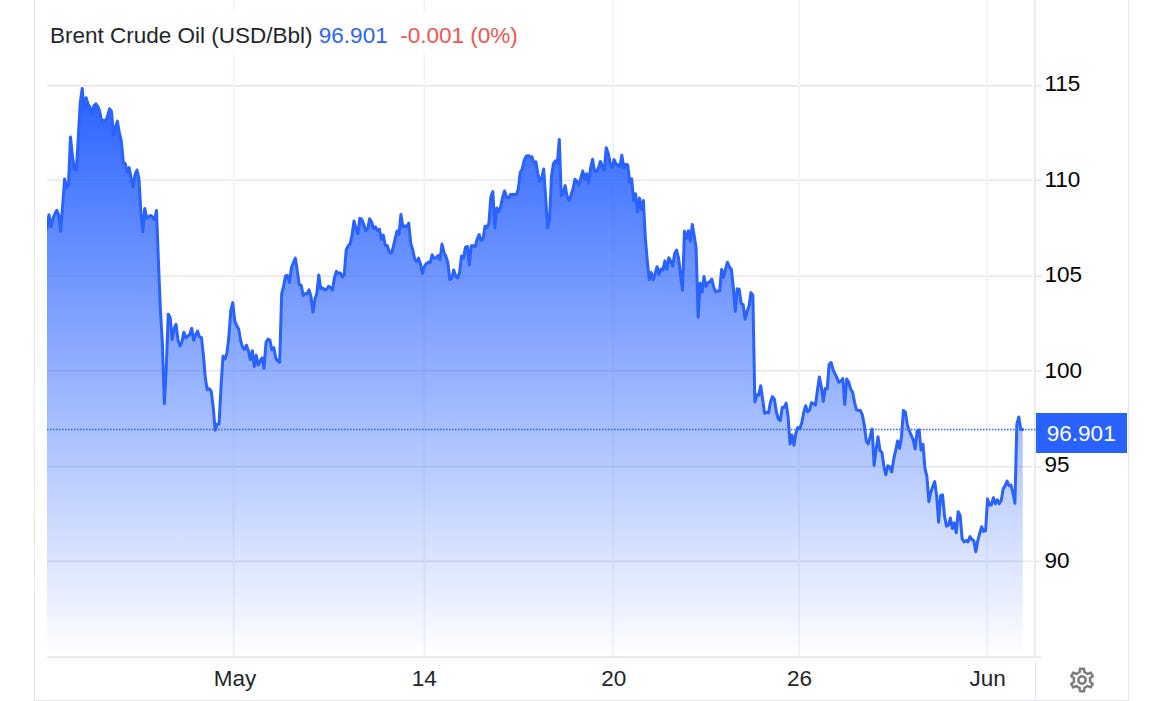
Oil prices remain low, representing markets’ expectation of an end to the conflict in the relatively near future. On the other hand, warnings abound about whether early measures to dampen the price of oil will no longer suffice and the price will thus spike. For instance, Exxon Mobil warned on Thursday that physical oil prices will spike over the coming weeks as oil inventories fall to record low levels. Exxon Senior Vice President Neil Chapman said that, “We’re approaching unheard of inventory levels,” and that the price of physical Brent oil will spike to $150 to $160 per barrel, resulting in demand destruction.
Forecasters estimate that there is a 17% (10% to 51%) probability that the hourly Brent crude oil futures price will reach $150 by the end of July 2026.
Presumably GPT-5.5-Cyber, because 5.5 is publicly deployed
Surprised by the skew in favor of Anthropic. They are likely ahead in capabilities due to Mythos but seems like OpenAI just haven’t focused on models of this size and are otherwise slightly ahead on capabilities/cost ratio