



Executive summary
Geopolitics: A peace deal between the US and Iran was officially signed by both parties, and traffic subsequently rose in the Strait of Hormuz but remained well below pre-war levels. Ukraine carried out its largest attack on Moscow to date, striking an oil refinery, and began EU accession talks.
Will shipping traffic in the Strait of Hormuz be over 50% of pre-war levels on July 15, 2026? Our forecasters give this a 43% (30% to 60%) probability, but see below for the operationalization of the question.
What about on October 15, 2026? Forecasters think there’s a 61% (60% to 65%) chance.
Will Ukraine become a full member of the European Union before 2030? Our forecasters believe there’s a 22% (11% to 45%) probability.
Technology and AI: Open-weight models are narrowing the gap with closed-weight frontier models on some benchmarks. The US fears that China has access to a lithography machine used to manufacture chips that is produced exclusively by Dutch company ASML.
Will the US government explicitly prevent an AI model trained by a company other than Anthropic from being released to the US general public, or impose export controls on it, before 2027? Our forecasters think there’s a 44% (30% to 60%) chance.
Will the US and/or China ban at least two open-source AI models before 2027? The team thinks there’s a 14% (5% to 50%) probability.
Biorisk: The number of confirmed Ebola deaths in the latest outbreak has risen to 256, from 183 last week.
How many confirmed Ebola deaths will there be by the end of July 2026? Our forecasters’ aggregate 50th percentile forecast is 2.5k, and our 90% confidence interval is 1.1k to 9.2k.
Geopolitics
Middle East
A peace deal between the United States and Iran was signed by both parties. In response, the price of Brent crude oil fell below $80. However, fighting between Israel and Hezbollah still poses a threat to the deal, with the US trying to rein in Israel and calling on Iran to stop Hezbollah from fighting.
US and Iranian negotiators met in Geneva for the next phase of talks. They were initially overshadowed by renewed threats from Trump against Iran, but both sides ultimately said that real progress had been made.
On Thursday, the number of AIS-tracked ships that transited the Strait of Hormuz was 25, the highest for months, though still well below the >100 that was commonplace before the war. Although the IRGC claimed on Saturday that it had closed the Strait again in response to Trump’s threats, shipping traffic still appears to be higher than it was for most of the war.
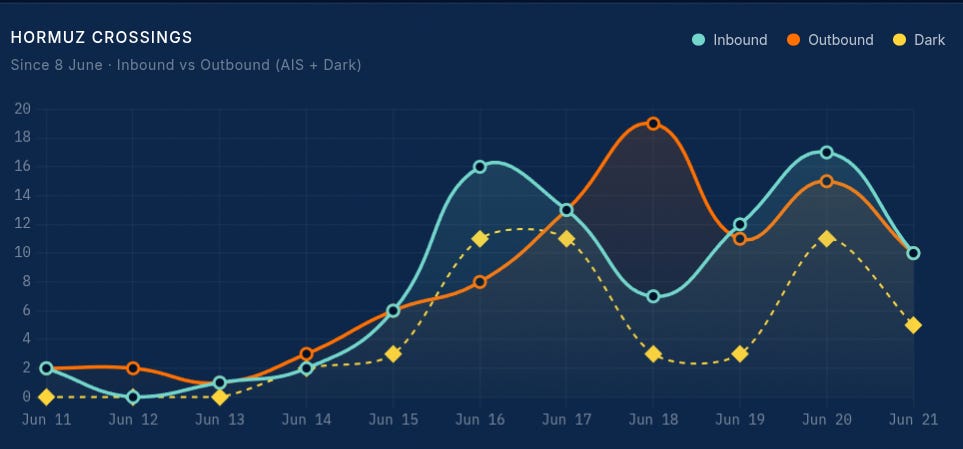
Overall, our forecasters think there’s a 43% (30% to 60%) probability that shipping traffic in the Strait of Hormuz will be above 50% of pre-war levels on July 15, 2026. This would require the 7-day moving average to reach 52, according to the IMF’s PortWatch, which only counts ships with their AIS transponders on. The team thinks there’s a 61% (60% to 65%) chance that this will be the case on October 15, 2026.
Europe
Ukrainian drone strikes on Russian territory continued, including on an oil refinery close to Moscow.
Ukraine’s President Zelensky gave Belarus one week to remove electronic equipment aiding Russian targeting in Ukraine before Ukraine strikes that equipment in Belarus.
Ukraine and Moldova began the first phase of European Union (EU) accession talks, after Hungary’s new government withdrew that country’s objections. Our forecasters think there’s a 22% (11% to 45%) chance that Ukraine will become a full member of the EU before 2030. Forecasters note that Hungary’s opposition is now gone, but that Ukraine has gotten into a row with Poland, and that integrating e.g., the EU Common Agricultural Policy would likely extend timelines.
British Prime Minister Keir Starmer announced that he will leave office within the next couple of months following pressure from his party’s lawmakers to step down. His resignation was called by Trump one day before. Andy Burnham, who was recently elected to Parliament in a by-election, is widely expected to replace him as leader of the Labour Party and Prime Minister. Our forecasters do not expect substantial changes to British policy on Ukraine, NATO, AI or biosecurity.
Technology and artificial intelligence
After Anthropic revoked access to its new Fable model following export controls imposed by the US government, White House officials told Wired that if Anthropic wants to re-release Fable, they need to ensure its guardrails can’t be circumvented. Many believe this would be quite difficult, if not impossible to accomplish, given the lack of formal guarantees built into model architectures and the abundance of past LLM jailbreaks. On the other hand, an Anthropic executive said that the company expects to be able to restore Fable access in the coming days, and Trump said that Anthropic has been “very responsible”.
Our forecasters think there’s a 44% (30% to 60%) chance that another company’s model will face a similar fate before 2027, either being explicitly banned from release by the US government or having export controls placed on it following its release. Two forecasters’ comments below:
It seems to me that people in Washington are genuinely kinda freaked out by Mythos (as they should be), but even if they weren’t, the stuff that will exist by the end of the year will [freak them out]. Due to competition for investment it seems unlikely that the industry will hold back on new public releases, and it seems unlikely that jailbreaks will be dealt with sufficiently in this period.
So far the administrations’ contention has been with Anthropic, and it seems likely that other companies can check with the US government before releasing any models that would be export-restricted, and that other companies can be more politically smooth and less adversarial.
Meanwhile, a low-skilled attacker reportedly used Claude Code and Codex to breach 14 companies. And here is an (AI-narrated) look at one (AI-assisted) supply chain attack: readers that want to have a sense of current cyberattacks might want to read the links.
The vice chair of the US Senate Intelligence Committee claimed that the head of the National Security Agency told him that Anthropic’s Mythos model “broke into almost all of their classified systems” within hours, though the journalist who reported on this is skeptical that this is exactly what happened.
Open-weight AI models are becoming increasingly capable. For example, GLM-5.2, an open-source Chinese model released by Z.ai, is ranked at number 3 on FrontierSWE, which tracks software engineering capabilities, behind only Anthropic’s Claude Fable 5 and Opus 4.8, and ahead of OpenAI’s GPT-5.5.
Our forecasters think there’s a 14% (5% to 50%) chance that the US and/or China will ban at least two open-source models before 2027. Forecasters generally think that it’s impractical to ban open source models, but one thinks that they will become scary enough that policymakers might still try.
US Commerce Secretary Howard Lutnick informed Dutch company ASML, whose lithography products are key to the advanced semiconductor supply chain, that China may be in possession of one of its extreme ultraviolet lithography (EUV) machines in violation of US export controls. ASML denies that it sold or passed such a machine to China. Our forecasters also wonder how easy it would be for China to have reverse engineered an ASML machine given that ASML itself has supply bottlenecks, most prominently the ultra-precise mirrors that it exclusively gets from Carl Zeiss SMT, a German company. Previously, China recruited former ASML engineers in order to build its own prototype.
The CEOs of Anthropic and Google DeepMind called for a US coalition to shape AI rules and standards. DeepMind also published an AI control roadmap and partnered with the British government to use AI to speed up planning permission for new housing.
And: Chinese AIs may be displaying awareness that they’re being evaluated.J P Morgan and Goldman Sachs blocked their staff in Hong Kong from using Anthropic models. Japan’s banking lobby said that lenders might be forced to suspend ATMs and online banking if advanced AIs end up posing a serious threat to the banking system. G7 leaders discussed a plan to grant “trusted partners”, potentially including AI security institutes, access to advanced AIs from US firms.
Biorisk
As of June 20, 1,003 people have been confirmed to have Bundibugyo Ebola disease in the Democratic Republic of the Congo (DRC), and 254 people have died of Ebola. Last week, two deaths at a camp for displaced civilians in northeastern Congo were reported; as of this week, Ebola has claimed the lives of at least 30 people in a different camp. Case numbers and deaths are likely to rise explosively over the coming weeks as insufficient percentages and numbers of case contacts are being monitored.
Our forecasters’ aggregate 50th percentile estimate for the number of confirmed Ebola deaths at the end of July 2026 is 2.5k, and our 90% confidence interval is 1.1k to 9.2k.
Forecasters comment:
The number of deaths is rising quickly. With an insufficient number of case contacts being followed, patients sometimes escaping healthcare locations, and not all patients seeking treatment, the situation is not at all under control. And now cases are rising within a camp for displaced persons, which is a disaster in the making. If there were no constraint on testing, with a doubling time of as little as 7.5 days possible, I think we could see as many as 11k deaths by the end of July. However, I think testing capacity is likely to remain an ongoing constraint
Uganda has done a good job at containment but DRC has major challenges with people wanting to collect bodies for burial and attacking treatment centers. CFR is currently around 25% but testing and reporting mean the actual number will be much higher than the reported number. So far Kinshasa has remained Ebola free. If it gets into Kinshasa and starts to spread, the number of deaths will be unprecedented based on previous Ebola outbreaks.
As of June 21, 15 cases of New World screwworm (NWS) have been reported in animals in the US. We can expect to see many more cases as the NWS spreads in the US southwest.
Nature and climate
Growing water shortages in Central Asia might to cause economic and political instability, increase regional tensions, and drive countries in the region towards greater dependency on China and Russia. China and Russia, in turn, will likely need to provide water to the region or face large-scale migrant inflows.