

🟩 Trump administration imposes export controls on new Anthropic model, US-Iran peace deal announced, Ebola spreads further || Global Risks Weekly Roundup #24/2026


Executive summary
Geopolitics: The US and Iran announced that a peace deal has been agreed. Putin acknowledged that Ukraine’s strikes on Russian territory are harming Russia’s economy.
Before 2027, will a ceasefire (covering land, sea and air) between Russia and Ukraine be agreed for a period longer than 3 days? Our forecasters give this a 26% (20% to 40%) probability.
Before August 2026, will a US-Iran peace deal be signed, involving a cessation of hostilities and the reopening of the Strait of Hormuz to commercial shipping (with or without a toll system)? Our forecasters thought that there’s a 76% (70% to 85%) chance, meaning we were pricing some probability of last minute turmoil, but as we publish this, the NYT and other media is reporting that the deal was just signed.
Technology and AI: Anthropic’s Fable 5 model was released to the general public, before access was revoked for everyone after the US government imposed export controls. The US’s Center for AI Standards and Innovation (CAISI) was barred from publishing model assessments.
Will access to Anthropic’s Fable 5 model be restored to the US general public before July 2026? Our forecasters are broadly uncertain, giving this a 64% (50% to 75%) chance.
If so, will non-US citizens residing in Europe gain access to it again? Our forecasters are fairly confident about the conditional, giving this an 81% (78% to 85%) chance.
Will the US’s Center for AI Standards and Innovation (CAISI) publish a model assessment for an AI developed by Anthropic or OpenAI that ultimately scores above Mythos 5 on the Epoch Capabilities Index (ECI) before October 2026? Our forecasters give this a 50% (33% to 75%) chance.
Given the recent export controls, will UKAISI be given access to an AI developed by Anthropic or OpenAI that scores above Mythos 5 on the ECI, without safety mitigations, before October 2026? Our forecasters are broadly uncertain, with a 55% (30% to 70%) aggregate probability.
Will they publish a model assessment for an AI developed by Anthropic or OpenAI that scores above Mythos 5 on the ECI, before October 2026? Our forecasters think there’s a 62% (50% to 70%) probability thereof.
Will SpaceX develop an AI that at any point scores highest on the ECI, before 2027? Our forecasters are bearish, with an aggregate 3.6% (0.5% to 8%) probability.
Biorisk: Ebola spread to more health zones in the Democratic Republic of the Congo (DRC). As of June 14, there were 181 deaths recorded in the DRC and 2 deaths in Uganda.
Geopolitics
Middle East
The US and Iran announced that they have agreed to a peace deal. It’s set to be signed on Friday, though the details remain unclear in some areas. At a minimum, it will likely involve the end of the US blockade of Iranian ports and the reopening of the Strait of Hormuz. However, with Israel saying it will still occupy parts of Lebanon despite its inclusion in the agreement, there could yet be bumps along the road.
Earlier in the week, Trump had threatened to take Kharg Island and hit Iran hard again, because the deal was taking too long to finalise. But he later said that the strikes were cancelled.
Overall, our forecasters thought there was a 76% (70% to 85%) chance that a US-Iran peace deal, involving a cessation of hostilities and the reopening of the Strait of Hormuz to commercial shipping (with or without a toll system), would be signed before August 2026. As we publish this, the NYT and other media is reporting that the deal was just signed.
Europe
Russia’s President Vladimir Putin conceded that Ukrainian strikes on Russian territory are damaging his country’s economy and society. In a phone call with Putin, Trump reportedly pledged to help end the Russia-Ukraine war.
Our forecasters believe there’s a 26% (20% to 40%) probability that a ceasefire (covering land, sea and air) between Russia and Ukraine will be agreed for a period longer than 3 days, before 2027.
Technology and artificial intelligence
Anthropic released Claude Fable 5 to the general public and Claude Mythos 5 to a handful of cybersecurity and computer infrastructure companies. The models were the company’s most powerful yet, and some of our forecasters were impressed with, for instance, stories of people creating a Harry Potter video game using the model. In the system card, we see evidence that the models are becoming more dangerous in the domains of cyber, bio, chemical and loss-of-control risks.
The Trump administration later imposed export controls on these models, preventing them from being accessed by people in foreign countries or foreign nationals in the US. Anthropic, in turn, disabled access to these models for everyone, arguing that it would otherwise be unable to comply with the export controls.
The US government said it imposed export controls on the models because of concerns about how strong the model’s guardrails were, and that Anthropic didn’t take these concerns sufficiently seriously by pausing access to the model while fixing the alleged vulnerabilities.
Anthropic, in turn, represents the specific vulnerabilities alleged as less worrying:
No testers have yet been able to find a universal jailbreak—a jailbreak method that can very broadly bypass the model’s safeguards, unblocking a wide range of cyber capabilities.
We suspect that perfect jailbreak resistance is not currently possible for any model provider. Every safeguard used in the industry is vulnerable to non-universal jailbreaks (which can elicit some cyber information in specific circumstances), and it is likely that universal jailbreaks will eventually be found in the future. We stated this clearly when we released Fable 5.
Given that perfect jailbreak resistance does not appear to be possible today, Anthropic adopted a defense in depth strategy with Fable 5.
Our forecasters think there’s a 64% (50% to 75%) chance that access to Anthropic’s Fable 5 model will be restored to the US general public before July 2026. If so, we think there’s a 81% (78% to 85%) probability that non-US citizens in Europe will gain access to it.
The White House also ordered the government’s Center for AI Standards and Innovation (CAISI) to halt publication of its model assessments, citing security risks.
Given this and the export controls mentioned above, our forecasters think there’s a 50% (33% to 75%) chance that CAISI will publish a model assessment for an AI developed by Anthropic or OpenAI that ultimately scores above Mythos 5 on Epoch’s Capabilities Index (ECI) before October 2026.
We think there’s a 62% (50% to 70%) probability that the UK’s AI Security Institute (UKAISI) will do the same by that date, and a 55% (30% to 70%) chance that UKAISI will be given access to an AI developed by Anthropic or OpenAI that scores above Mythos 5 on the ECI, without safety mitigations, before then.
And: Germany’s National Security Council decided that a German AI Security Institute will be established, modeled on the UK’s. Anthropic urged Congress not to preempt state AI laws without setting federal standards. A report suggests that AI is now the leading reason companies give for cutting jobs.
Biorisk
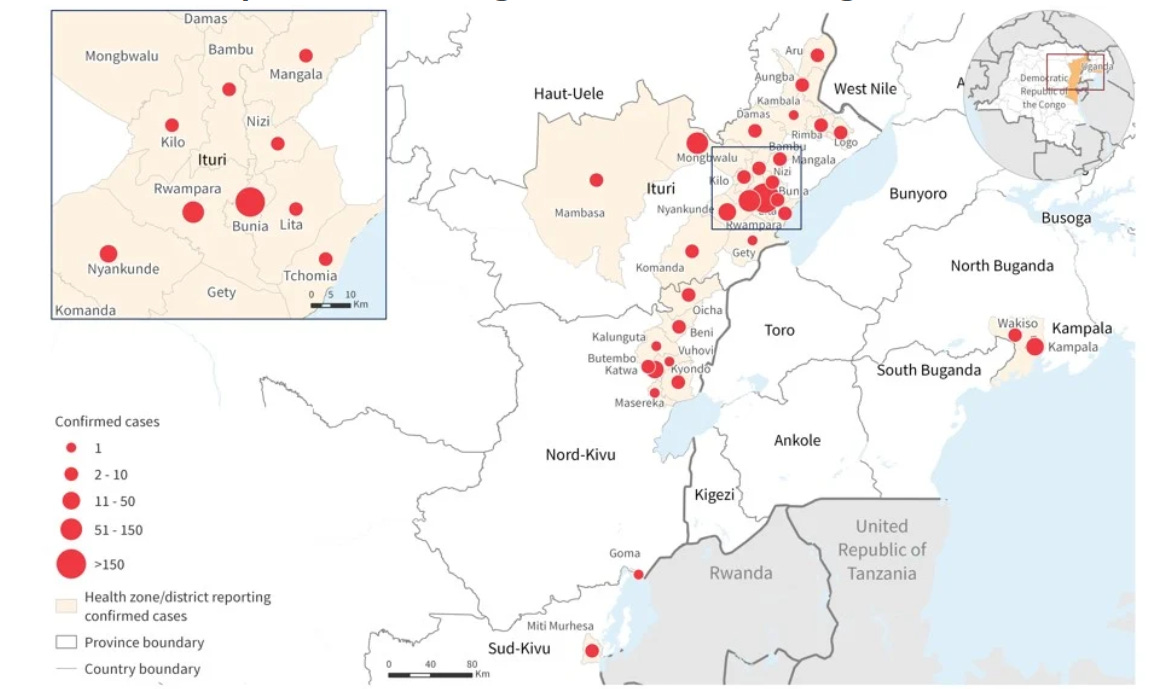
Ebola has spread to more health zones in the Democratic Republic of Congo (DRC). The DRC reported on June 14 that the country has seen 782 cumulative confirmed cases (+72 in the previous 24 hours) and 181 deaths (+32 in the previous 24 hours). Only 56.5% of contacts are being traced, below the operational target of 90-95%. As of June 11, 94% of cases have been in only one province, Ituri Province. Housewives and healthcare workers are among the most affected. The virus has reached a refugee camp that houses 30,000 displaced people in eastern DRC.
In the US, H5N1 bird flu virus infections continue to be found in more dairy herds. However, fewer herds are being infected now than in the past two years since H5N1 was first detected in dairy herds. The USDA reports that 917 cases were detected in cattle in 2024, 171 in 2025, and 53 in 2026 as of June 12. Risks to humans from H5N1 in dairy cattle remain, but the risks of zoonotic infection from cattle are falling overall.
Economy
SpaceX’s Initial Public Offering (IPO) was the largest in history, and it makes Elon Musk the first-ever trillionaire. We think there’s a 3.6% (0.5% to 8%) chance that SpaceX will develop an AI that at any point scores highest on the ECI before 2027. Overall forecasters are very bearish on this happening, since SpaceX’s AI arm has been renting out its compute.
Nature and climate
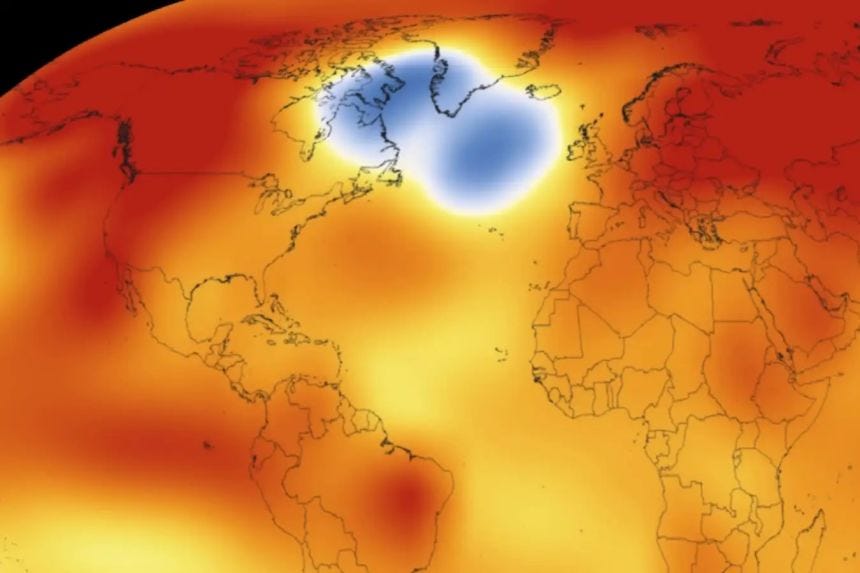
A study found that the extent to which a persistent cold blob in the ocean near Greenland has cooled both at the surface and deep below signals that the Atlantic Meridional Overturning Circulation (AMOC) is likely slowing. The AMOC circulates heat throughout the Atlantic Ocean, so to the extent that this spot is becoming colder, it’s because warm water nearer the equator isn’t circulating as much, disrupting the historical pattern of heat circulation.
An El Niño weather pattern has started, according to the US National Oceanic and Atmospheric Administration (NOAA). It could end up being the costliest on record.