

🟩 Trump administration mulls strikes on Iran and says the US will own Greenland, DOJ launches investigation into Fed Chair || Global Risks Weekly Roundup #2/2026


Executive summary
Geopolitics: Trump is seriously considering intervening militarily in Iran to assist anti-government protesters. He says that the US will “own” Greenland and that this can either be done “the easy way” or the “hard way”. And he says that the US will conduct strikes against drug cartels on Mexican soil.
Forecasters think there’s a 59% chance (55% to 65%) that the US strikes Iranian territory by March 31, 2026, and a 26.5% chance (10% to 51%) that Ayatollah Khamenei is out of power by then, for any reason (including death). Last week, they gave an aggregate estimate of 43% that the Iranian regime will fall by the end of 2026. Some readers, including some sharp prediction market traders, think those probabilities are too high.
They think there’s a 23% chance (10% to 40%) that the US annexes, acquires or enters into a compact of free association with Greenland in 2026. Last week, they gave an aggregate estimate of 36.5% for the remainder of Trump’s term.
They think there’s a 2.5% chance (0.5% to 7%) that the 25th Amendment to the US Constitution, which can remove the sitting President, will be invoked in 2026. This excludes Section 3, which has previously been invoked to allow the Vice President to become Acting President during medical procedures.
Economics: Trump’s Department of Justice launched a criminal investigation into Federal Reserve Chairman Jerome Powell, related to testimony he gave about renovations of Federal Reserve buildings. Powell accused the Trump administration of targeting him because of disagreements over monetary policy.
Tech and AI: xAI’s Grok was banned by Indonesia and Malaysia for generating pornographic imagery. Following an implied threat that X could be banned in the UK, the platform restricted the ability to edit images with Grok to paying subscribers, but Downing Street says all options remain on the table.
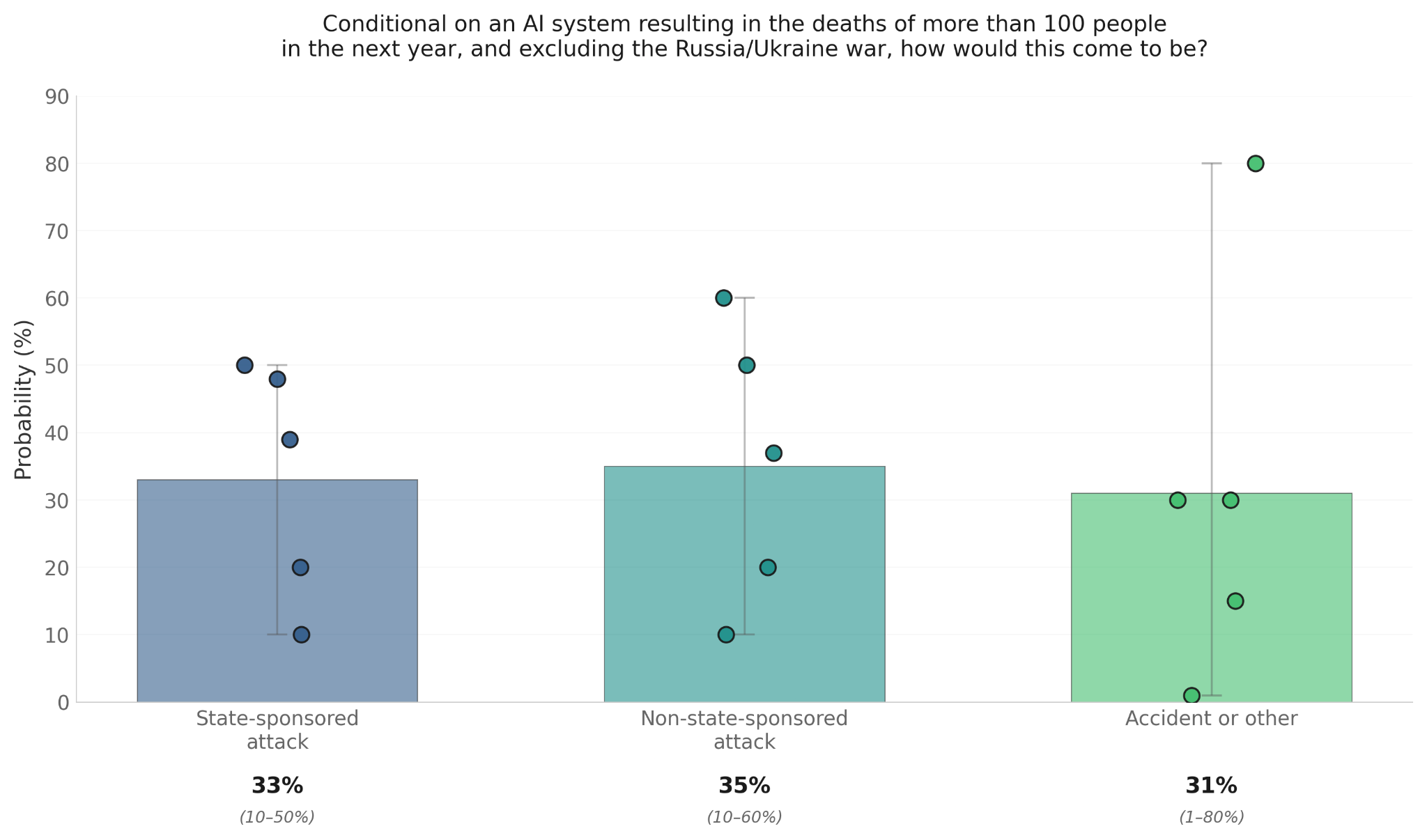
Conditional on at least one AI system causing more than 100 deaths in the next 12 months, and excluding any such use in the Russia/Ukraine war, forecasters think there’s a 33% chance that the first such incident would be because of a state-sponsored attack, a 35% chance that it would be caused by a non-state-sponsored attack, and a 31% chance that it would be the result of an accident/other.
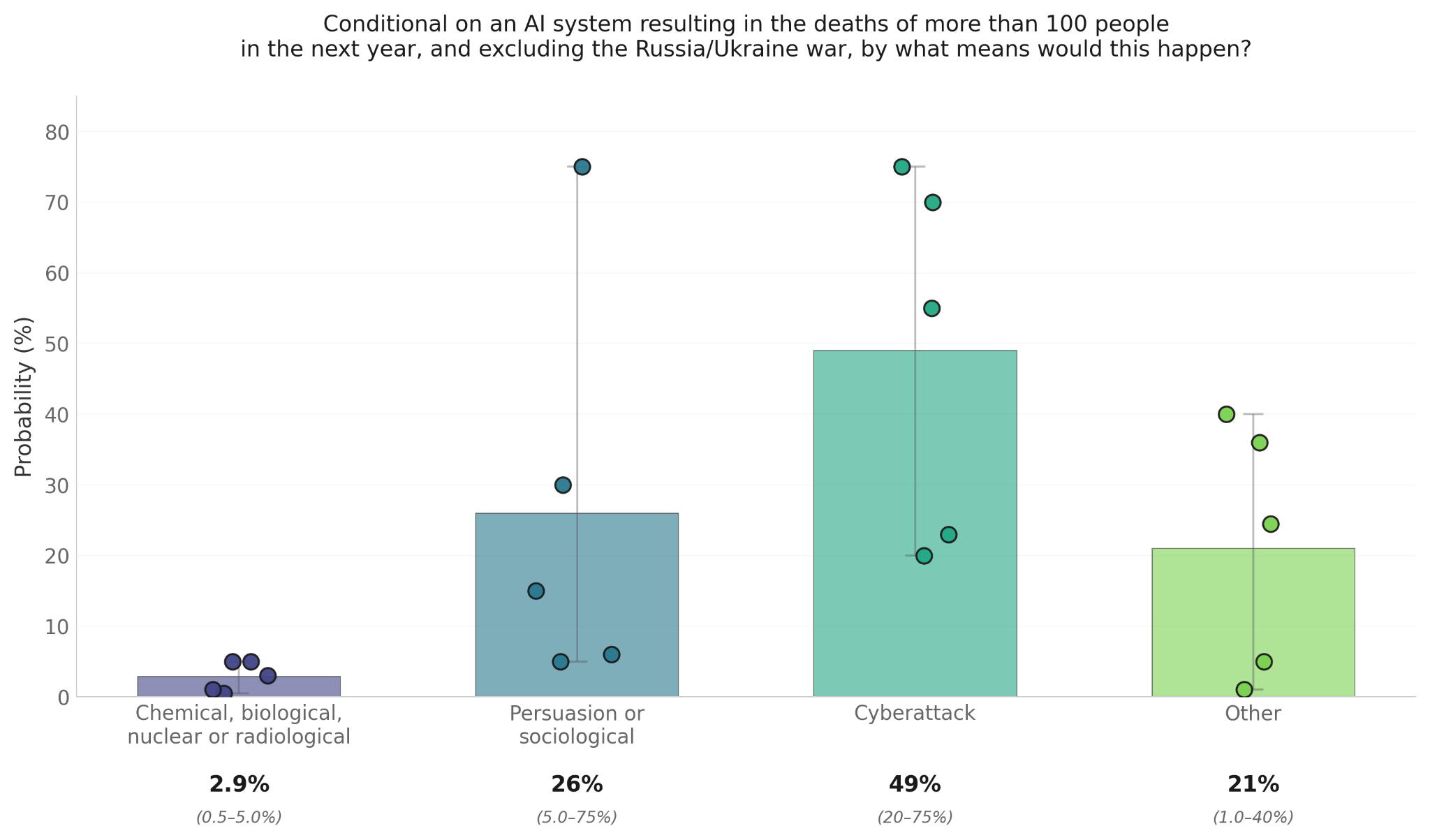
They also think there’s a 49% chance that it would be the result of a cyberattack, a 2.9% chance that it would be caused by a CBNR attack, a 26% chance it would be caused by persuasion or sociological means, and a 21% chance that there would be some other cause/mechanism. Forecasters’ estimates are fairly spread out, but they agree that most of the risk given this relatively low threshold does not come from CBNR attacks.
We have created (play money) markets on Manifold about these questions here and here.
Biorisk: Flu in the US at its highest level in 25 years.
Geopolitics
Middle East
Iran’s regime plunged the country into an internet blackout in an attempt to stem anti-government protests, which have now spread to a majority of the country’s provinces. At least 572 protesters have died, but social media reports claim that more than 2,000 may be dead. At least 2,300 people have been arrested during two weeks of protests; one watch group estimates that over 10,000 people have been detained. On state television, an Islamic Revolutionary Guard official warned parents to keep their children away from protests and said that, “If... a bullet hits you, don’t complain.” Some hospitals are reportedly overwhelmed with injured demonstrators, and US President Trump is seriously considering military intervention in the country to assist the protesters, though he is also being warned that such a move could backfire by allowing the regime to portray the protesters as pawns of foreign powers.
Forecasters think there’s a 59% chance (55% to 65%) that the US strikes Iranian territory by March 31, 2026, and a 26.5% chance (10% to 51%) that Ayatollah Khamenei is out of power by then. Last week, they estimated a 43% chance in aggregate that Iran’s regime will fall in 2026, and most forecasters updated higher in response to this week’s news. Partial or total internet blackouts have preceded regime change in some cases (e.g., Nepal in 2025, Bangladesh in 2024, and Egypt during the Arab Spring), but in other cases (including Iran in 2019), the regime survived.
In other news, Syrian government forces clashed with Kurdish forces around Aleppo.
Saudi Arabia carried out airstrikes on UAE-backed separatists in Yemen. Their leader later fled the country, allegedly aided by the UAE, and the UAE withdrew support for the group. The separatists lost control of all territory to Saudi-backed fighters.
Europe
The Trump administration continues to signal that it wants to seize control of Greenland, ideally by purchasing the territory but through the use of military force if that isn’t an option. Trump stated, “If we don’t take Greenland, Russia or China will. And I’m not letting that happen. … one way or the other, we’re gonna have Greenland.” On Friday, Trump said, “I would like to make a deal, you know, the easy way, but if we don’t do it the easy way, we’re gonna do it the hard way.” Greenland’s five main political parties released a joint statement saying that they do not want to be owned by the United States.
European leaders put out a joint statement in support of Greenland, but their responses have also differed in subtle ways. France said that Europe should prepare for the worst, while the UK has tried to persuade Trump that Europe is stepping up its efforts to boost Arctic security. UK Prime Minister Starmer held two calls with Trump in which the situation in the High North was discussed, and pointed to the US-UK cooperation during the seizure of the oil tanker Marinera (see below) to argue that cooperation is better than confrontation. However, Trump seems to be fixated on “owning” Greenland, asserting that the US will get more from ownership than it will from cooperation agreements.
Last week, forecasters estimated a 36.5% aggregate probability that the US would annex, acquire or enter into a compact of free association with Greenland by the end of Trump’s term. Most forecasters indicated that their estimates are now higher (but still <50%). This week, they estimate a 23% chance (10% to 40%) that the US will do so in 2026. One forecaster said it’s likely that at least 5 countries would leave NATO if the US took Greenland using military force, most likely some of the Nordic and Iberian countries, with France being more likely to leave than Britain, and that it would bump up their ~5% estimate of a Russian incursion into at least one of the Baltic States in the next three years by a few percentage points. Other forecasters are concerned that if the US were to take Greenland by military force, NATO could effectively be destroyed, and with it, alliances and the post WWII order that were built over decades.
In other news, the United Kingdom and France signed a declaration of intent to send troops to strategic locations in Ukraine away from the frontline in the event of a Russia-Ukraine peace deal. The outlines of this plan have been clear for many months, but there is now a legal instrument to back the plan up. The aim would be to provide postwar security guarantees to Ukraine and deter another Russian invasion, but in the near term, the goal is likely to make it more palatable for Ukraine to make territorial concessions if and when serious peace talks happen. The US said it would back the security guarantees up with intelligence and logistics support, and that it would come to the aid of the UK and France to defend Ukraine in the event of a Russian attack.
Russia struck Lviv, Ukraine with an Oreshnik Mach 10+, nuclear-capable intermediate-range ballistic missile (IRBM) with a multiple independently targeted re-entry vehicle (MIRV) payload. Lviv is ~70 km from the border with NATO ally Poland.
Meanwhile, the European Union and Mercosur, a South American trade bloc whose full members are Brazil, Argentina, Bolivia, Paraguay and Uruguay but that involves additional countries, reached a free trade agreement after 25 years of negotiations.
The Americas
Latin America
US President Donald Trump said, “we are going to start” conducting strikes against drug cartels on Mexican land. Meanwhile, Colombia’s President Gustavo Petro said in an interview that he sees a “real threat” of US military action in his country, and there were anti-American protests in Colombia. On the other hand, Colombia said that the country pledged to work with the US to combat drug trafficking, using US intelligence and technology, and Trump said that Petro is to visit the White House in the near future. Last week, forecasters assigned a 67% aggregate probability to a US intervention in a Latin American country other than Venezuela in 2026. At least one forecaster has not materially changed their forecast from last week.
In Venezuela, acting President Delcy Rodriguez remains in power, with her rivals, including Diosdado Cabello and Vladimir Padrino, pressured into cooperation by the threat of US intervention if they do not cooperate. Opposition leader Maria Corina Machado plans to meet with Trump this week. The aftermath of the US attack on Caracas saw armed militias known as colectivos being deployed by the Venezuelan regime as it attempted to assert its authority and demonstrate that there is not a power vacuum following the ousting of former President Nicolas Maduro. The militias are operating checkpoints, stopping people in their cars, and demanding access to people’s phones.
Meanwhile, the Trump administration is making plans for the US to control the Venezuelan state-owned oil company PDVSA. Venezuela will likely turn over up to $2B worth of crude oil to the US, in a move that could cut supply to China. Efforts by the Trump administration to secure more than $100B in investment that could increase Venezuelan production have so far received a lukewarm response from the US’s big oil companies, with Exxon CEO calling Venezuela “uninvestable” during a meeting between Trump and oil executives in the White House. At the meeting, Trump said that the administration, rather than Venezuela, would decide which companies are allowed to operate in the country, and following the meeting, he said that he’ll “keep Exxon out” of Venezuela because he “didn’t like their response”. On the other hand, many smaller operators in the industry, some with links to the region, see in the wariness of some of the big oil companies an opportunity to cut a deal with Trump.
On Saturday, Trump signed an executive order that prevents courts and creditors from seizing Venezuelan oil revenue in US Treasury accounts as compensation for past asset seizures by the Venezuelan government. He also announced on social media that Venezuela would be purchasing only US-made products with its oil revenue.
The US seized three oil tankers connected to Venezuela last week, but later released one. Among those seized was a Russian-flagged, Venezuela-linked oil tanker, the Marinera (formerly known as the Bella 1), in the North Atlantic Ocean. The US had previously attempted to seize the tanker in the Caribbean. The UK’s Ministry of Defence said it assisted with the operation by providing surveillance from the air and navy refuelling. US forces also made use of military bases in Britain. Some reports suggested that Russia was sending its own navy to attempt to escort the tanker, but US forces got to it first even if this was the case. The US later released two Russian crew members who were on the tanker, at Russia’s request. Several forecasters wonder whether the ship was carrying some special cargo to Venezuela, perhaps including weapons or special equipment intended to support Maduro’s regime, given the ship’s repeated refusals to be boarded, the protracted chase, and the UK’s involvement.
United States
The US Department of Justice launched a criminal investigation into Federal Reserve Chairman Jerome Powell, related to testimony he gave to Congress about renovations to Federal Reserve buildings. In a video address, Powell said that the Trump administration was targeting him after months of pressure on the Fed to lower interest rates more quickly. In 2025, Trump appeared with Powell on a building site and aired complaints about the cost of the renovations, which Powell refuted. Some lawmakers, including Republican Thom Tillis, condemned the move. Tillis, who sits on the Senate Banking Committee, which oversees the Fed, said that he would oppose the confirmation of any nominee for the Fed until the matter is resolved. The US dollar weakened against the pound sterling and the Euro in response to the news.
Protests erupted in Minneapolis and other cities in the US following the fatal shooting of US citizen Renee Good by an Immigration and Customs Enforcement (ICE) officer. US Department of Homeland Security Secretary Kristi Noem described Good’s actions as “domestic terrorism,” as did Trump advisor Stephen Miller, a description that has been disputed by others. The administration plans to send “hundreds more” ICE agents to Minneapolis this week.
Two people were shot and wounded by a Border Patrol agent in Portland.
VP Vance said that, “I think we’re gonna see those deportation numbers ramp up as we get more and more people online, working for ICE, going door to door“.
The Trump administration announced that the US will withdraw from 66 UN and non-UN international organizations, many focused on climate, labor and issues perceived to be related to DEI or “woke”.
In an interview with the New York Times, when asked whether there were any limits to his global power, Trump replied, “Yeah, there is one thing. My own morality. My own mind. It’s the only thing that can stop me…. I don’t need international law.”
South Carolina reported 99 new measles cases in 3 days, while cases continue to increase in at least 6 other states, including as part of an ongoing outbreak in the Utah/Arizona border region. Approximately 93% of last year’s cases were in unvaccinated people or in people with unknown vaccination status, according to CDC data. The CDC reported 2,144 cases in 2025, the highest number since 1991.
The level of flu-like illness so far this year is the highest in at least 25 years, and the flu season has likely not yet peaked. More than 92% of cases thus far this season have been of the H3N2 subtype.
Asia
China imposed a ban on exports of dual-use items to the Japanese military and has also started to restrict exports of rare earth minerals to Japan, in an escalation of its feud with the recently elected Japanese government.
Turkey is negotiating to join the Pakistan-Saudi Arabia Strategic Mutual Defence Agreement, a pact signed on September 17, 2025 that includes a NATO-style mutual defence clause treating an attack on one member as an attack on all.
Africa
Pakistan is to sell weapons and jets to the Sudanese government.
Technology and artificial intelligence
Indonesia and Malaysia blocked access to xAI’s Grok, because the AI was being used to generate pornographic deepfakes. Australia’s online safety regulator said it’s investigating Grok-generated sexual deepfakes, while the UK’s technology secretary called the images of women and children undressed by Grok “appalling and unacceptable in decent society”. The EU joined in condemning the spread of these images. The UK Prime Minister’s Office said “all options are on the table”, including a ban on X. Following this, X restricted the ability to edit images with Grok to paying subscribers, which the UK Government called “insulting”. Elon Musk in turn accused the UK Government of being “fascist”, and one Republican lawmaker in the US called for sanctions to be imposed on Britain if there is a ban. Meanwhile, xAI raised $20B.
In the most recent Metaculus forecasting cup, Mantic beat the community prediction, which aggregates 500 forecasters. This is a first.
The state of Washington is considering regulating aspects of AI such as deepfakes, AI companies, discrimination, and AI interactions with children.
Some autonomous coding frameworks, which run Claude Code autonomously without the need for human feedback for many hours, are getting some traction.
And: Character.ai and Google agreed to settle lawsuits over teen suicides. Google released a Universal Commerce Protocol to help agents shop. Two Chrome extensions were caught stealing ChatGPT and DeepSeek chats from 900k users.
I'm confused how 'flu is at its highest level in 25 years' (which I saw some headlines about) but wastewater data seems to show lower levels compared to last winter peak. Seems like they're measuring "percentage of outpatient visits for influenza-like illness", but I'm not sure if that's a better measure of prevalence. The CDC also has lower positive tests of influenza than last year, maybe there's another flu-like disease spiking?