

🟩 Trump walks back Greenland threats, US sends warships to the Middle East, Russia-Ukraine peace talks continue || Global Risks Weekly Roundup #4/2026


Executive summary
Geopolitics: Trump backtracked on plans for the US to own Greenland and to impose tariffs on imports from some European countries that opposed an American takeover of Greenland, and he also ruled out using military force to take the territory. The US continued to move military assets into the Middle East, with Trump saying that military action against Iran is possible. The first trilateral peace talks between the US, Ukraine and Russia took place in the UAE, but they made little progress. Tensions between protesters and ICE remain high in Minneapolis.
Will the US carry out a strike on Iranian territory before April 2026? Forecasters estimate a 66% (50% to 78%) probability.
Will there be regime change in Iran by then? This would involve the IRGC no longer holding power. Forecasters estimate a 17% (10% to 24%) chance.
Will there be a ceasefire of any duration (covering land, sea and air) between Russia and Ukraine before April 2026? Forecasters estimate a 5.1% (4.0% to 7.0%) probability.
Will Trump invoke the Insurrection Act before March 2026? Forecasters estimate a 30% (5% to 65%) chance.
Technology and AI: Google DeepMind CEO Demis Hassabis said he would support a pause on AI development if other companies and countries also agreed to this. Users across the internet are giving total control of their machines to AI assistants, and researchers found an AI-assisted malware framework. Alex Bores, who co-authored AI safety legislation in the State of New York, is running for NY’s 12th Congressional district, and his Democratic primary run is being strongly opposed by Big Tech.
Will Bores win the Democratic primary in New York’s 12th Congressional District? Forecasters estimate the chance thereof at 34% (30% to 37%).
Economics: Trump threatened to impose 100% tariffs on Canadian imports if Canada negotiated a trade deal with China. Canada said it had no intention of doing so and that Carney’s recent visit to China was about lowering trade barriers in specific sectors.
Geopolitics
Europe
Trilateral talks among the US, Ukraine and Russia in the UAE ended without an agreement being reached, following a meeting between US President Donald Trump and Ukrainian President Zelensky in which the latter said that US security guarantees for Ukraine (to be put in place if a peace deal is negotiated) had also been agreed. However, it remains unlikely that Russia’s President Vladimir Putin will endorse such guarantees, and Russia also reiterated its demand that Ukraine withdraw from parts of the Donbas that it still controls. On whether there will be a ceasefire of any duration (covering land, sea and air) between Russia and Ukraine before April 2026, forecasters’ aggregate falls at 5.1% (4.0% to 7.0%).
US President Donald Trump backtracked on plans for the US to control Greenland and to impose tariffs on imports from eight European countries that opposed an American takeover of Greenland, following a meeting with NATO Secretary-General Mark Rutte. Trump claimed that he would instead be working on a “framework agreement” with NATO, and no longer said that the US would seek to “own” Greenland, even when directly asked. He also mentioned the stock market in his speech. Greenland and Denmark reiterated that “sovereignty” remains a red line but expressed openness to discussing anything else.
Some reports suggested that this agreement could involve carving out small pockets of Greenland for the construction of US military bases that are under US sovereignty, similar to how British bases in Cyprus are under British sovereignty. Others suggested that the US could get a perpetual lease for these pockets of land, similar to how Guantanamo Bay is indefinitely leased by the United States, even though it technically remains under Cuban sovereignty. It was also speculated that any agreement could involve restricting any Russian or Chinese economic access or involvement in Greenland.
In other news, Trump further ignited tensions between the United States and its NATO allies by questioning whether they would ever support the US in a war. After Mark Rutte pointed out to him that NATO allies had fought with the Americans after 9/11, Trump later claimed in an interview that soldiers from those countries had stayed away from the front lines, despite hundreds of soldiers from those countries dying. UK PM Keir Starmer called Trump’s comments “insulting” and “appalling”, while Republican Senator Thom Tillis wrote that Americans will always remember the sacrifices made by soldiers from US-allied countries. After a phone call with Starmer, Trump partially walked back his comments and said that British soldiers in Afghanistan were “among the greatest of all warriors”.
Middle East
The US continued to move military assets into the Middle East, including F-15 fighter jets and the USS Abraham Lincoln. Trump signalled that a “military option” with respect to Iran remains on the table, and said that Iran needs “new leadership”. On the other hand, the base rate for a US strike on Iran in any two-month period is low, and Trump indicated that a strike on Iran isn’t certain to go ahead, saying: “We’re watching Iran. We have a big force going towards Iran. And maybe we won’t have to use it... We have a lot of ships going that direction. Just in case, we have a big flotilla going in that direction, and we’ll see what happens”.
Overall, forecasters think there’s a 66% (50% to 78%) probability that the US will carry out a strike on Iranian territory before April 2026, and a 17% (10% to 24%) chance that there will be regime change in Iran, which would have to involve the IRGC no longer holding power, before then. Clerics no longer being officially in charge of the IRGC but the IRGC still holding power would not be sufficient.
A forecaster writes:
> This would have to involve the IRGC no longer having power. Firstly, I don’t think there’s a credible internal threat to the regime before April as the protests seem to have died down. It all hinges on what the US and/or Israel will do. Even if they do strike, they might not even target the Ayatollah or succeed in toppling him. Even if they do topple the Ayatollah, it’s possible that a deal will be struck with other members of the regime, as in Venezuela. And even if they are aiming for total regime change, the IRGC still has more than 100,000 members so any fighting could last for a while and take us beyond the end of March. So, overall, I think this is unlikely in this timeframe, but higher than the base rate of ~3-4% per year since the end of the First World War (1921/1925, 1953, 1979).
> Iran’s economy is collapsing to the point that the regime may soon no longer be able to pay the IRGC. Moreover, it appears very likely that the US military may soon strike Iran, potentially with the goal of regime change. Given recent US actions in Venezuela, it is possible that a similar approach could be employed in Iran; agreements with potential leaders of a new regime could be reached behind the scenes ahead of any military strikes.
The US is moving up to 7,000 ISIS prisoners from Syria to Iraq. The prisoners have been held in regions of northeast Syria that have been controlled by Kurdish forces; the Kurdish forces recently signed a ceasefire with the Syrian government that calls for their forces to be integrated into the Syrian military.
The Americas
Latin America
Further reporting suggests that Venezuela’s interim President, Delcy Rodriguez, cut a deal with the Trump administration before Maduro was captured. We first reported that Rodriguez may have contacted US officials through backchannels or intermediaries back in October 2025.
The US reportedly aims to facilitate regime change in Cuba by the end of this year.
Trump calls the mystery weapon used in the raid to take out Maduro the “discombulator”.
North America
Conflicts between federal immigration enforcement agencies and the Democratic Minnesota governor and Minneapolis mayor escalated after ICE agents shot and killed an anti-ICE protester, Alex Pretti, in Minneapolis on Saturday. This incident and the Trump administration’s responses to it increase the chance that Trump will invoke the Insurrection Act over the coming weeks.
When ICE agents came in contact with Pretti, he was holding a phone. Pretti was legally carrying a gun, but it was holstered; Pretti never drew or fired his gun, and an ICE agent removed it before Pretti was shot. At least 10 shots were fired. The death fueled further protests in Minneapolis. The Department of Homeland Security tried to block state and local law enforcement from investigating the shooting, and the state is suing in federal court to gain access to evidence. Minnesota Governor Tim Walz deployed members of the Minnesota National Guard to assist local law enforcement.
A war of words has ensued between Walz and Minneapolis Mayor Jacob Frey, on one side, and Trump administration officials on the other side. Secretary of Homeland Security Noem stated that Pretti had committed an “act of domestic terrorism,” and Trump advisor Miller tweeted that, “A domestic terrorist tried to assassinate federal law enforcement”.
In a Truth Social post on Sunday, Trump blamed Pretti’s death and another recent death on Democratic leaders “creat[ing] dangerous circumstances” by “REFUSING to cooperate with ICE” and “encouraging Leftwing Agitators to unlawfully obstruct their operations”.
Trump then wrote, “I am hereby calling on Governor Walz, Mayor Frey, and EVERY Democrat Governor and Mayor in the United States of America to formally cooperate with the Trump Administration to enforce our Nation’s Laws”. It is possible that this post could potentially set the stage for the administration to claim at a later date that an insurrection exists in any state with a Democratic governor or city with a Democratic mayor who chooses not to “formally cooperate” with the Trump administration in its immigration enforcement efforts. Forecasters think there’s a 30% (5% to 65%) that the Insurrection Act will be invoked before March 2026. Forecasters agree that the Trump administration has been working towards it, but disagree about the immediacy.
Last week, several hundred active-duty military police in the Army’s 16th Military Police Brigade stationed at Fort Bragg in North Carolina were given orders to prepare to deploy to Minneapolis, reportedly in case the president invokes the Insurrection Act. The week before, about 1,500 active-duty troops in the Army’s 11th Airborne Division were given orders to prepare to deploy, as well.
The Catholic Archbishop at the head of the Archdiocese for the Military Services, embedded into the US military, said that it’s “morally acceptable” for troops to disobey orders.
Other immigration enforcement incidents in the past week have inflamed tensions in Minneapolis as well. On Wednesday, a Border Patrol agent sprayed pepper spray into the face of a protester who was restrained on the ground, inches away. Immigration agents also detained a 5-year-old boy who is in the US legally pursuing an asylum claim.
An internal ICE memo dated May 12, 2025 asserts that ICE agents have powers to use force to enter homes without a warrant issued by a judge, to arrest someone on an administrative warrant issued based on a final order of removal. This advice is in conflict with mainstream legal understandings of Fourth Amendment protections against government searches and seizures without a judicial warrant issued based on probable cause.
Trump signed the charter for his new Board of Peace in Davos, Switzerland, in the presence of leaders and representatives from Argentina, Turkey, Hungary, Bulgaria, Bahrain, Kazakhstan, Kosovo, Qatar, Armenia, Azerbaijan, Morocco, Paraguay and Pakistan. The board’s charter specifies that Trump can only be replaced as chairman through “voluntary resignation or as a result of incapacity, as determined by a unanimous vote of the Executive Board.” Countries can join for free to become members for up to 3 years; only countries that contribute at least $1 billion will be permanent members.
Tensions between Canadian PM Mark Carney and Trump increased again after Carney said he strongly opposed Trump’s Greenland threats in a speech at Davos and broadly criticised the US government’s behaviour. Trump called him “Governor Carney” (he gave a similar nickname to Justin Trudeau) and said that, “Canada lives because of the United States… Remember that, Mark, the next time you make your statements.” Although the Canadian government had said that it wouldn’t pay the $1B fee to become a permanent member of Trump’s “Board of Peace”, Trump announced that he had withdrawn Canada’s invitation.
The US Department of War published a National Defense Strategy. It envisions a greater focus on the Americas, including access to Greenland and the Panama Canal, and reduced engagement with Europe.
Concerns about Trump’s cognitive function mounted after he appeared to confuse Iceland and Greenland in a speech to the World Economic Forum in Davos, Switzerland.
The website worstdaysofar.com is tracking US mass rights violations and democratic collapse.
Canadian military planners gamed out responses to a US invasion.
Asia
In China, Xi Jinping purged his long-time ally and Politburo member Gen. Zhang Youxia from the Central Military Commission (CMC), the Chinese military’s top leadership committee, “for suspected serious violations of discipline and law”, including allegedly leaking nuclear secrets to the United States. An investigation into Liu Zhenli, chief of staff of the CMC’s Joint Staff Department, was also started. The purge leaves only Xi and one other member beneath him on the CMC and concentrates Xi’s power further, and it has sent shockwaves through PLA leadership. Xi has purged many military leaders over the years.
In the United States’ latest National Defence Strategy, the Pentagon does not mention Taiwan directly, though it does say that it would focus on deterring China in the Indo-Pacific. It describes China as the most powerful state relative to the US since the 19th century. It also encourages South Korea to take the lead in countering North Korea.
> The Indo-Pacific will soon make up more than half of the global economy. The American people’s security, freedom, and prosperity are therefore directly linked to our ability to trade and engage from a position of strength in the Indo-Pacific. Were China—or anyone else, for that matter—to dominate this broad and crucial region, it would be able to effectively veto Americans’ access to the world’s economic center of gravity, with enduring implications for our nation’s economic prospects, including our ability to reindustrialize.
Africa
Drone strikes intensified around al-Obeid in central Sudan.
An operation against Nigerian kidnapping gangs killed 200.
Technology and artificial intelligence
Some on the internet are experimenting with giving an AI assistant, clawdbot, total control of one’s device, buying Mac Minis for the purpose.
Researchers identified a more capable and mature AI-assisted malware framework they named Voidlink, which composes, commands and orchestrates lower-level attacks. On the one hand this is an example of increasing capabilities, though on the other hand the framework is chaining and coordinating existing tooling together rather than creating its own.
A Google Gemini AI prompt injection vulnerability was discovered that would allow hackers to use calendar invites to steal data. Meanwhile, researchers have found that Microsoft and Anthropics MCP servers, which are used to provide AI services, have severe cybersecurity vulnerabilities.
OpenAI implemented age prediction on its users globally to determine whether an account is likely being used by a child. Reuters reports that this comes as OpenAI prepares to allow adult content on ChatGPT.
A paper explores using AI agents for deanonymization: “LLM-based agents make such re-identification attacks easy and low-effort“, and “existing safeguards can be bypassed by breaking down the re-identification into benign tasks“.
Last week saw a decentralized training run of a 72B model.
Google DeepMind’s CEO Demis Hassabis said that he would support a pause on AI if all other companies and countries would do it. Hassabis also said there’s a 50% chance that AI will have all the cognitive capabilities humans have by 2030, while Anthropic CEO Dario Amodei was very confident that AIs will exceed human capabilities in almost all cognitive domains by then.
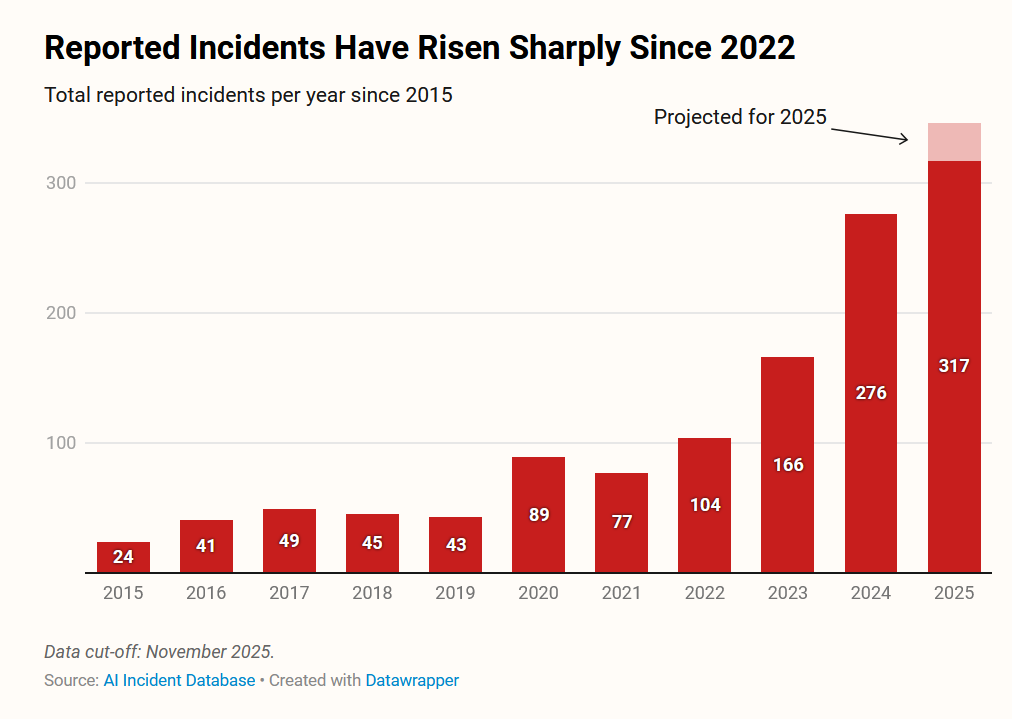
TIME reports that AI incidents have increased sharply since 2022.
South Korea brought its AI Act into force, which establishes an AI safety institute. It requires human oversight of AI in “high-impact” uses, e.g., in which public safety could be affected. It also requires that products and services that employ generative AI must be labeled as such. And it requires AI companies to identify, assess and mitigate risks throughout the entire AI lifecycle, when an AI has been trained with more than a certain amount of compute. South Korea is the first country to implement measures at this level, though the EU, California, and New York have passed similar laws.
Brazil has given xAI 30 days to prevent Grok from producing sexual deepfakes. One study estimated that Grok generated about 3 million sexual images in 11 days. Malaysia’s communications regulator announced that the country has lifted its block on Grok, after Twitter implemented new safety measures.
And: Salesforce’s CEO Marc Benioff said some AI chatbots are “suicide coaches,” describing a Character AI chatbot, and called for better regulation. The UK’s Treasury Committee urged the Financial Conduct Authority and Bank of England to start running AI-specific stress tests of financial services. AOC and Paris Hilton are backing a bill targeting sexual deepfakes.
Economy
In a speech to the World Economic Forum in Davos, Switzerland, Mark Carney said that the post-war liberal international order was undergoing a “rupture,” not a “transition,” though some forecasters thought it was unclear what this means in practice and would like to explore some predictions that could be made conditional on our being in a “rupture” timeline or a “transition” timeline. To one forecaster, many of the multilateral initiatives that Carney mentioned in his speech were broadly consistent with a “business-as-usual” timeline.
Trump threatened to impose 100% tariffs on imports from Canada if it negotiates a trade deal with China. This came after Mark Carney met with Xi Jinping in Beijing to agree to a mutual lowering of trade barriers. Canada said it had no intention of negotiating a comprehensive free trade agreement with China, and that Carney’s recent visit to China was about lowering trade barriers in specific sectors.
The price of gold rose past $5,000 per ounce for the first time, as global investors sought to invest in the metal as a safe haven amid global turmoil.
Japanese 40-year bond yields rose to over 4% for the first time last week, in anticipation of national elections that could give Japanese PM Takaichi a mandate to increase government spending. As Japanese yields rise, US yields are expected to follow, but only to a limited extent, because trading volumes in Japanese bonds are so much smaller than trading volumes in US Treasuries. Nonetheless, a Bloomberg article argues that the Japanese bond market poses a $7T risk to global markets and that “more unpredictable and violent price swings are expected.”
US home sellers outnumbered buyers by a record proportion in December, signaling a buyer’s market. However, it is not a typical buyer’s market, as the number of buyers has fallen to its lowest level since records began in 2012, as people are finding a home purchase increasingly difficult.
Biorisk
Cattle in a Mexican state bordering the US have been found to be infected with the New World screw worm.
A Federal Lab in Montana reported the potential theft, loss or release of a dangerous biological agent back in November 2025.
The Africa CDC is no longer classifying mpox as a “Public Health Emergency of Continental Security”.
Nature and climate
The largest solar storm in over 20 years occurred but caused little disruption on Earth.
I'm not a crypto guy, but it seems to me that bitcoin would be a better safe haven than gold since it's easier to transport across a border in the event of an emergency. Wonder why its price has been flat.
I notice that all PMs are booming right now, and they all appear to be useful for the construction of datacenters. I talked to an AI about engineering a squeeze on precious metals to make datacenters more expensive to construct, but sadly the AI didn't think it would move the needle much. https://www.lesswrong.com/posts/FzSSrx6nbmCZRoKkq/ebenezer-dukakis-s-shortform?commentId=o2WJRkaX9GAoZjAnX