

🟩 US and Iran resumed fighting before renewing ceasefire, Crimea declared state of emergency, access to new OpenAI model restricted || Global Risks Weekly Roundup #26/2026
& Federal Reserve Independence & a deadly fungus.


Executive summary
Geopolitics: Shipping traffic markedly rose in the Strait of Hormuz before falling back because of renewed fighting between the US and Iran, who later agreed to a renewed ceasefire. Russian-occupied Crimea declared an emergency following supply shortages and power cuts resulting from Ukrainian attacks.
Will shipping traffic in the Strait of Hormuz be over 50% of pre-war levels on July 15, 2026? Our forecasters think there’s a 43% (30% to 62%) chance.
What about on October 15, 2026? Our forecasters believe there’s a 71% (60% to 80%) chance.
Will Ukraine control all of Crimea by the end of 2026? Our forecasters give this a 14% (3% to 75%) probability.
Will Putin still be the President of the Russian Federation on July 1, 2027? We think there’s a 87% (65% to 94%) chance.
Will more than 5,000 Pakistani law enforcement, other security personnel and troops be killed in 2026 within Pakistan? Our forecasters think there’s a 3.4% (0.1% to 15%) probability.
Technology and AI: Alex Bores, who co-authored one of the world’s few pieces of legislation that attempts to mitigate catastrophic risks, lost his US House primary race. OpenAI’s GPT-5.6 is not currently being released to the public following a White House demand, while Anthropic’s Mythos model will be released to a small number of trusted partners again.
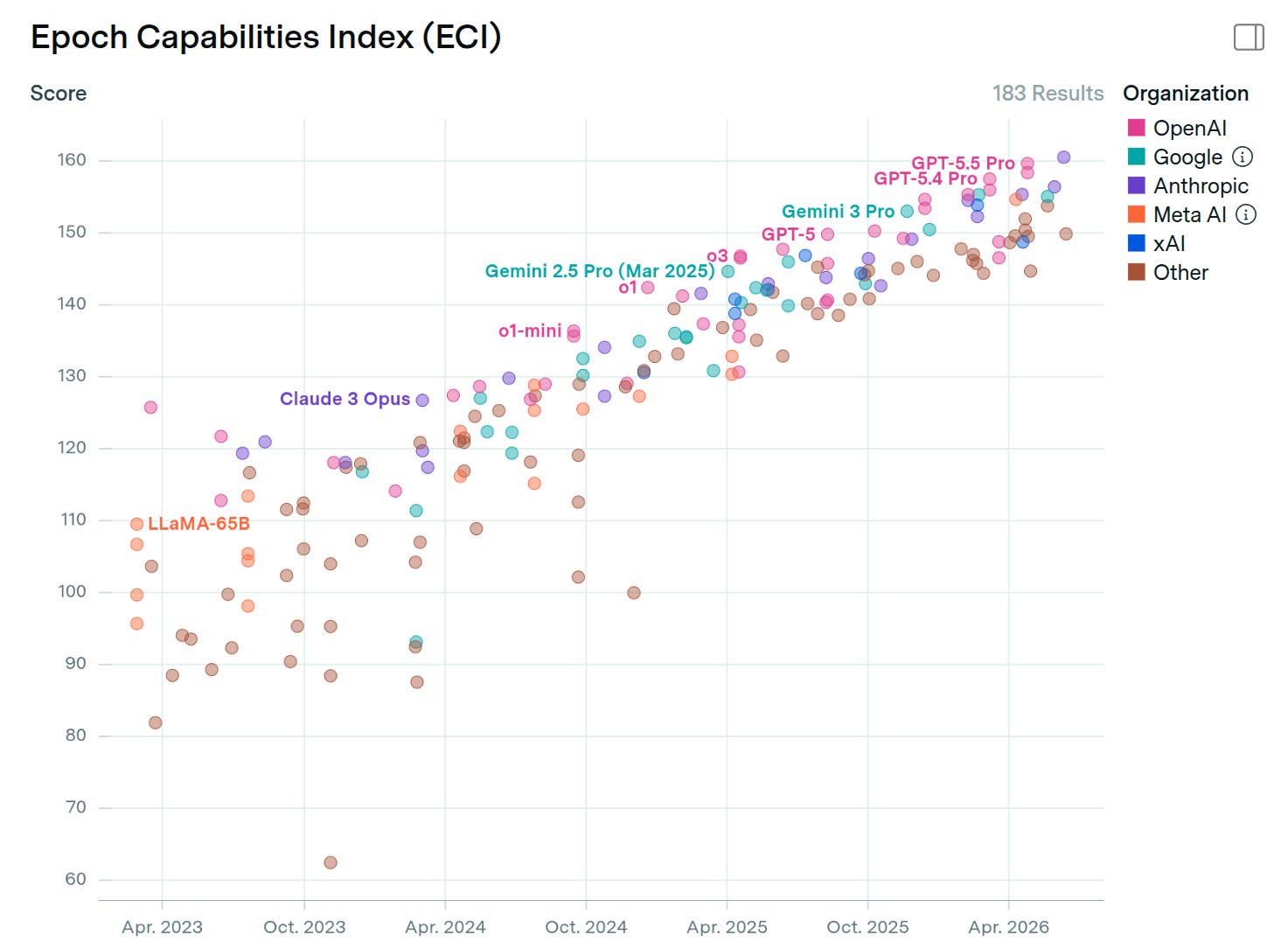
Will any model that scores above 165 on the Epoch Capabilities Index (ECI) be available for public use in the US and globally, with its use not subject to US export controls, before 2027? The team thinks there’s a 65% (59% to 70%) chance.
Biorisk: The number of deaths in the Ebola outbreak has risen to 360, from 256 last week. And a deadly fungus is spreading in South America.
Geopolitics
Middle East
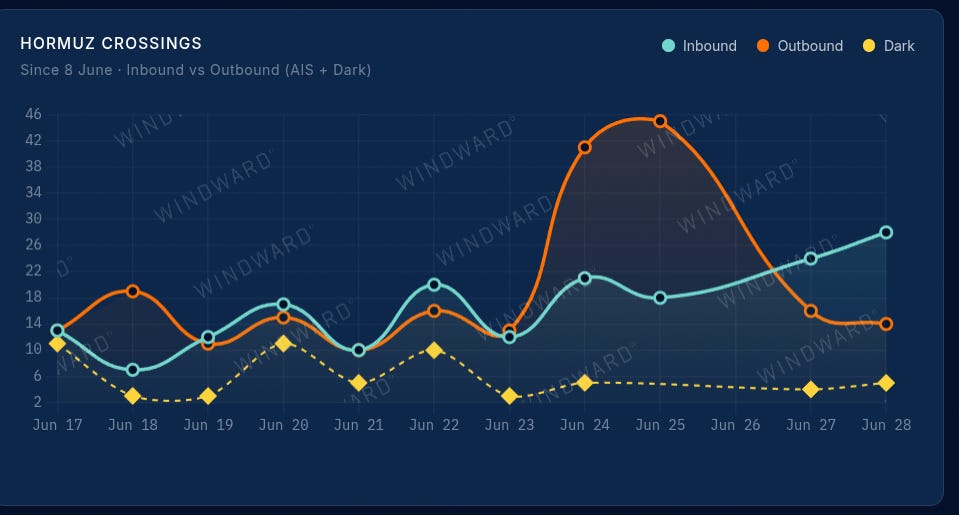
On Wednesday June 24, shipping traffic in the Strait of Hormuz rose to above 60 transits, by far the highest daily figure since the start of the Iran War, amidst falling insurance premiums for ships looking to transit the Strait. Many of the ships were using the ‘Omani route’, but Iran then fired on a ship that was using the route, causing traffic to fall again. In response, the US struck targets in Iran, and Iran, in turn, attacked Bahrain and Kuwait. Both sides have now agreed to cease hostilities once again.
Although the Strait of Hormuz traffic level on Wednesday was over 50% of the daily average on the eve of the Iran war, this is not sufficient to positively resolve our question from last week, which specified that the 7-day average had to move above 52 transits. This week, our forecasters think there’s a 43% chance (30% to 62%) that this will be the case on July 15, 2026, and a 71% chance (60% to 80%) that it will be the case on October 15, 2026. Forecasters were encouraged by the Wednesday figure as it provided a proof of concept.
Meanwhile, US-Iran negotiations continue, with the Iranians and the Americans disagreeing about whether an agreement has been reached to resume IAEA inspections of Iranian nuclear sites, which were progressively restricted by Iran after Trump pulled out of the JCPOA in 2018, before coming to a halt following US-Israel strikes on Iran in June 2025. The IAEA Chief, for his part, says that the interim peace accord between the US and Iran does propose such inspections.
Europe
Russian-occupied Crimea declared a state of emergency following sustained Ukrainian attacks on its supply routes and power facilities. Some observers are suggesting that Crimea could soon become “untenable for Russian military use” and that Ukraine may retake the territory. Crimea is both strategically and symbolically important to Russia, and its loss to Ukraine would deal a crippling blow to Putin and to Russia’s war in Ukraine. Our forecasters believe there’s a 15% chance (5% to 75%) that Crimea will be fully under Ukrainian control by the end of 2026. In aggregate they assign a 87% chance (65% to 94%) that Putin will still be President of the Russian Federation on July 1, 2027.
Last week, Ukrainian President Zelensky gave Belarus an ultimatum to dismantle equipment being used to provide targeting information to Russia. Belarus has backed down and stopped providing targeting information to Russia, in an acknowledgment of Ukraine’s growing military success and power. Despite this ongoing shift in the balance of power in favor of Ukraine over Russia, Putin is pressuring Belarus to join the war against Ukraine.
A Ukrainian company plans to produce a ballistic missile interceptor and to have its first missiles ready by the end of the year.
United States
In April, the Pentagon revised its battle targeting principles to allow for the possibility of a greater role for AI in the future, with the use of “systems where AI initiates actions with human monitoring,” in contrast with current “‘human in the loop’ systems, in which a human initiates actions.” The document further states that, “The speed of future warfare, along with our adversaries’ own advances in AI, may require the joint force to adopt completely autonomous systems”. A Pentagon official commented that currently, “Department AI technologies do not autonomously select or strike targets; it ensures commanders remain in charge of every decision”.
Former US National Security Adviser John Bolton pleaded guilty to mishandling classified information. Back in October 2025, we gave Bolton a 90% chance of being convicted.
Gen. Chris Donahue, the top US Army commander in Europe, will relinquish his US command and retire on July 2, after reportedly being forced out of his position by Secretary of Defense Pete Hegseth. The move comes in the broader context of Hegseth’s stated goal of reducing the numbers of top military officers, and of an unstated goal of “squeezing out officers with track records of battlefield valor and command experience in favor of less accomplished political loyalists,” per the WSJ.
The US Supreme Court decided not to allow Trump to fire Federal Reserve governor Lisa Cook, preserving that institution’s independence. However, it did grant the executive branch greater authority over two dozen other institutions, including the FTC.
> The Court declines to sow doubt as to the status of one of the Nation’s (and the world’s) most important financial institutions, and would not so quickly unsettle this “special arrangement sanctioned by history.”
Asia
Pakistan’s interior minister claimed that over 1,000 security personnel were killed in 2025 in militant attacks; this probably includes both police and security forces. Data from the South Asia Terrorism Portal appear to corroborate the claim. Our forecasters think there’s a 3.4% chance (0.1% to 15%) that over 5,000 Pakistani security force personnel will be killed in 2026, with potential escalation between Pakistan and either Balochistan separatists or the Taliban regime in Afghanistan driving the higher forecasts. In the extreme, we could see another partition of the subcontinent, as with the Bangladesh War of Independence.
Africa
The US government warned that the rebel Rapid Support Forces (RSF) may be planning mass killings in El Obeid, a city in south-central Sudan that is strategically important both militarily and economically.
Technology and artificial intelligence
OpenAI announced its newest series of AIs, GPT-5.6 Sol, Terra, and Luna. The company said it is restricting their release, following a request from the Trump administration, but added “[w]e don’t believe this kind of government access process should become the long-term default. … We are taking this short-term step… while we work with the Administration to develop the cyber Executive Order framework and a repeatable process for future model releases.” Since OpenAI’s model was also interdicted, this should shift one’s estimation that the USG’s interdiction of Anthropic’s Fable model was about genuine security concerns, not just animosity from the USG towards Anthropic.
The US government partially reversed its ban on Anthropic’s top AIs, permitting Anthropic to provide Mythos 5 access to some trusted US organizations, including many Fortune 500 companies.
The White House has reportedly been pressing Meta to agree to AI reviews.
Taking the above into account, our forecasters think there’s a 65% chance (59% to 70%) that an AI model with an Epoch Capabilities Index (ECI) score of over 165 will be available for public use in the US and globally, with its use not subject to US export controls, before 2027. Forecasters wonder whether the US government might impose a capability ceiling at some point on models to be released for public use. Z.ai’s open-source GLM 5.2 model would probably be at 150-155.
Meanwhile, Alex Bores lost the Democratic primary for New York’s 12th Congressional District, coming in second place to Micah Lasher in a heated race that saw millions of dollars spent by rival AI interests for and against his nomination, but also significant backing of his candidacy by Effective Altruists. Bores co-authored New York’s RAISE act, one of a small number of pieces of legislation in the world that attempt to provide some treatment for AI catastrophic risk. Back in January, we thought there was a 66% chance that Bores would lose the primary.
Leaders of the Five Eyes cybersecurity agencies issued a rare joint public statement, warning of the immediate threat of AI cyber-risk. They say the timeline is “not years, it is months”, and that AIs are anticipated to exceed industry expectations. They recommend a series of practical measures to mitigate risk that should be implemented, saying that “[w]e must act now”.
Members of the US Congress are taking increasing interest in AI safety and security. Rep. Nathaniel Moran (R-TX) introduced a bill to Congress that would require AI developers to report dangerous capabilities, security breaches, and safety incidents. Another bill is being introduced by Reps. Josh Gottheimer (D-NJ) and Josh Moolenaar (R-MI) that would let US cloud companies notify the government of suspected foreign misuse of powerful AIs. And the US House Science Committee is advancing legislation to codify the Center for AI Standards and Innovation (CAISI).
Biorisk
Ebola cases continue to surge in the Democratic Republic of the Congo (DRC). As of June 27, the country has seen 1274 confirmative cases and 360 deaths; these numbers very likely undercount the true numbers of cases and deaths because testing is centralized and requires special equipment and supplies. Neighboring Uganda has so far been able to control the spread of Ebola, but that could become increasingly difficult as cases increase in the DRC. France confirmed its first Ebola case in the current outbreak, in a doctor who returned to France from the DRC.
A deadly fungus that infects cats and can also infect people and dogs is spreading in South America. It causes skin ulcers, and if untreated, it causes a respiratory infection and spreads throughout the body. In cats, it is 100% fatal without treatment and often fatal even with treatment; in humans, it can be severe and can kill those with weakened immune systems. The fungus was first identified in cats in Brazil in the 1990s, and since then, it has been found in cats, dogs and people in Paraguay, Chile, Argentina and Uruguay. The fungus has sickened and killed thousands of cats and infected more than 11,000 people and at least 200 dogs to date. A medical mycologist at the US CDC warned that, “It’s just a matter of time” until the fungus reaches the US; “We’re waiting.” He worries about the fungus spreading in big cities around the globe and in rural areas in the US. “All it takes is one traveler [from South America] bringing their cat with them, and it can emerge anywhere… This is something we are very, very worried about.” Because the fungus can live in soil, one forecaster worries that it could be extremely difficult to eliminate from any new area that it spreads to and within. The good news is that the fungus has so far appeared to spread to new regions very slowly; the bad news is that over the very long term, its geographical spread may be inexorable.
Nature and climate
A heat wave gripping Europe has killed over 1,300 so far; the final toll will likely be substantially higher. Some of our forecasters believe that parts of Europe have been too slow to adopt air conditioning. Another extreme heat wave is now starting in the US.
5-75(!) % of Crimea retake by end of 2026 is utterly insane. Southern front is primarily supplied through the Mariupol--Melitopol corridor, not through the Crimea. If Ukraine's middle and deep strikes will endanger the collapse of the southern front logistics (which itself is unlikely, but not impossible: maybe 5-15% likely), Putin will just take Ukraine's offer of mutual deep strikes ceasefire which is still on the table.
The fact that Crimea will become hardly liveable won't make it easily retakeable by Ukrainian army at all, which itself has very dire situation with troops.
The forecasts of Ukrainian retake of the south and Crimea in the summer 2023 counteroffensive, which ended up advancing by mere 10-15km at most(!), out of *hundreds* that should have been covered for a complete retake, has taught your forecasters nothing.