

🟩 US attacks Venezuela and captures Maduro, threatens Iran, Mexico, Colombia and Denmark || Global Risks Weekly Roundup #1/2026


Executive summary
Top items:
Geopolitics: The US struck targets in Venezuela and captured its former President Nicolás Maduro. Trump and others in his orbit also threatened to take over or called for military action in Iran, Mexico, Colombia and Greenland. Anti-government protests continue in Iran.
Tech and AI: xAI has come under fire, including from French ministers, after Grok AI reportedly produced child sexual abuse imagery that was shared on social media.
Forecasts:
Forecasters believe there’s a 42% chance (10% to 75%) that the Islamic Republic of Iran will fall by the end of 2026, with the Islamic Revolutionary Guard Corps (IRGC) no longer having power.
Forecasters think there’s a 36.5% chance (34% to 40%) that the US will annex, acquire or enter into a compact of free association with Greenland by January 20, 2029, up from 25% (12% to 40%) at the end of March 2025.
They believe there’s a 67% chance (50% to 90%) that the US will strike a country in Latin America other than Venezuela in 2026.
They think there’s a 43% chance that interim President Delcy Rodríguez will still be the de facto leader of Venezuela on June 30, 2026, with a 28% chance that opposition leaders Edmundo González or María Corina Machado will be in charge, and a 29% chance that someone else (perhaps another Venezuelan politician or military official, or an American administrator) will be in charge of making day-to-day decisions.
And their 50% confidence intervals (from the 25th percentile to the 75th) for the barrels of oil per day Venezuela will produce are 800K to 1.4M for 2026, 900K to 1.6M for 2027, and 1M to 2M for 2028.
Geopolitics
Latin America
The United States carried out “a large-scale strike” on Venezuela, resulting in explosions in the capital Caracas, the capture of its President Nicolás Maduro and his wife, and dozens of deaths. Maduro will face criminal charges in the US. The attack followed a months-long military buildup and escalation and a now-confirmed attack by the CIA on a port facility in Venezuela.
Maduro’s Vice-President Delcy Rodríguez is currently the interim President, with opposition leaders María Corina Machado and Edmundo González, who is widely considered to have won the previous election, seemingly sidelined by the US administration for now. A few months ago, we reported that Rodríguez may have reached out to the US via backchannels in an attempt to remain in power if Maduro were to step down.
Rodríguez is currently deferential to US wishes, but Venezuela is nonetheless still being run by the same “Chavista” government as before. Trump threatened additional strikes if the new Venezuelan government does not cooperate with the US; a clear threat to the regime is posed by US military ships, aircraft and other assets remaining in the Caribbean. Secretary of State Rubio also said that the US will also continue to impose an oil quarantine on Venezuela, to apply pressure to achieve policy changes.
The US doesn’t have enough boots on the ground to fully control Venezuela, with only a small number of CIA and potentially some Special Forces personnel currently in the country. It took more than 20,000 soldiers for the US to seize control of a much smaller Panama, and it would take far more for the US to take control of Venezuela.
Trump initially said that the US will “run” Venezuela until there is a transition of power, but Rubio later clarified that the US would not be involved in making day-to-day decisions. Trump is reportedly considering assigning Stephen Miller, White House Deputy Chief of Staff for Policy and Homeland Security Advisor, a role in supervising the country, as Rubio is already stretched thin over a large work portfolio.
We have been tracking a possible US intervention in Venezuela since September and were initially surprised that the US wasn’t attacking as the end of 2025 approached. In mid-December, before the covert attack on a drug-related facility in Venezuela, we estimated a 60% chance that the US would attack Venezuela in Q1 of 2026. On December 1, we estimated a 45% chance that Maduro would be out of power before the end of March 2026, well above the base rate for a four-month period, and above the 38.5% probability on Polymarket that day. Last week, we forecasted a 90% aggregate probability that the US would carry out a military intervention in a Latin American country in 2026.
In November, Nuño, our Head of Foresight, wrote a proposal for a fund to invest in Venezuela conditional on regime change, and we have received enough interest that a small version, more restrained than the initial proposal, may yet coalesce.
Overall, forecasters believe there’s a 43% chance that interim President Delcy Rodríguez will still be the de facto leader of Venezuela on June 30, 2026, with a 28% chance that opposition leaders Edmundo González or María Corina Machado will be in charge, and a 29% chance that someone else (perhaps another Venezuelan politician or military official, or an American administrator) will be in charge of making day-to-day decisions.
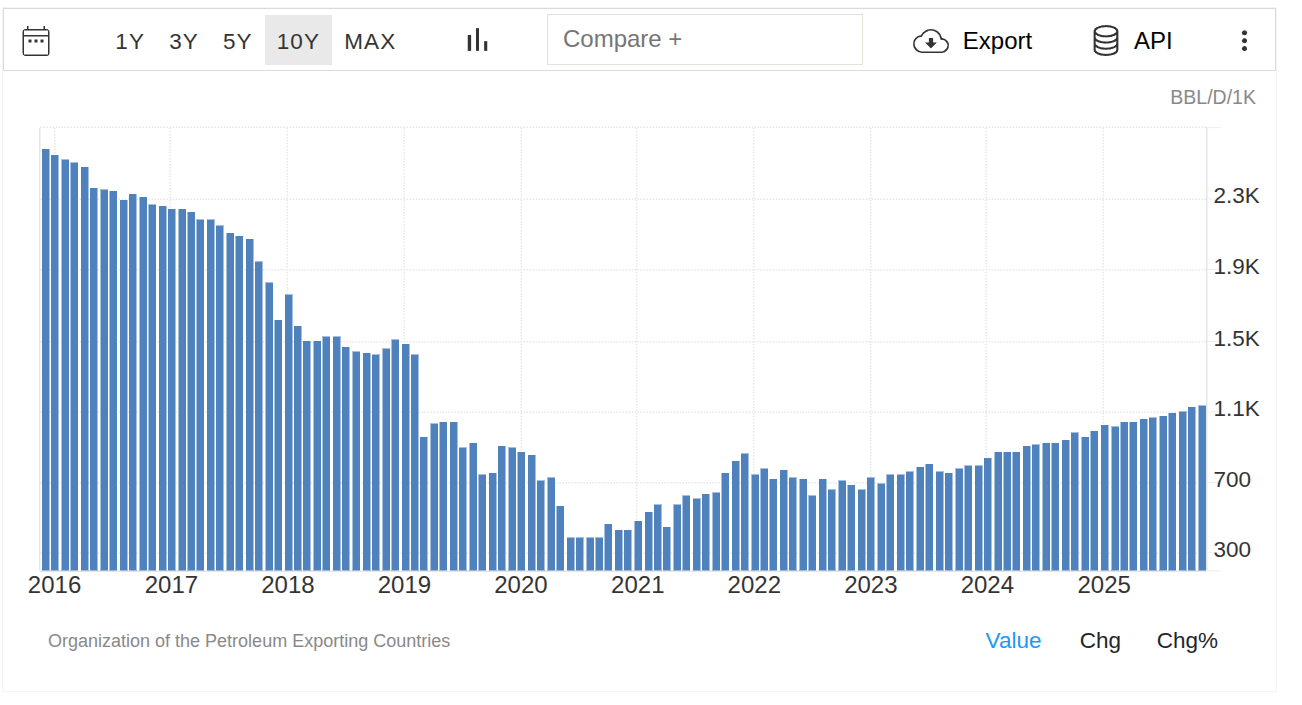
The implications for oil markets are uncertain. Although Venezuela may have the largest oil reserves in the world, and Trump says that the US will be able to exploit and benefit from them, Venezuela currently accounts for only about 1% of global supply, and it could take years to rebuild the country’s oil infrastructure. Oil prices were more or less steady on the first trading day after the attack, but there could be short-term disruptions to Venezuelan oil exports even if they rise in the medium-term. On the other hand, US officials were reportedly impressed with how Rodríguez kept oil production going despite sanctions, which may partly explain why they are comfortable with her in charge. The country was producing more than 3.5 million barrels per day (bpd) of crude oil back in 1970, and more than 3 million bpd in parts of the 1990s. After Chavez was elected in 1999, production was around 2.5 million bpd in the 2000s and early 2010s, and was still exceeding 3 million on some days in 2013. However, after Maduro took power, the Venezuelan oil industry gradually collapsed, with production falling to below 1 million bpd, though it has been rising since 2020. In 2025, output has hovered between 0.8 million and 1.2 million bpd.
Forecasters’ 50% confidence intervals (from the 25th percentile to the 75th) for the barrels of oil per day Venezuela will produce are 800K to 1.4M for 2026, 900K to 1.6M for 2027, and 1M to 2M for 2028.
China condemned the US actions, called for Maduro’s release, and warned that its oil agreements with Venezuela should be respected. For many years, China has been the top destination for Venezuela’s oil exports, but if oil flows to China are cut off, the impact on China will likely be relatively limited, because Venezuelan oil only accounts for around 4% of China’s oil imports. That said, diverting oil away from China and toward the US could have an outsized impact on China’s independent refiners, known as teapots, who have benefited from the fact that Venezuela’s oil is discounted both because it is “heavy” crude oil and because it has been sanctioned. Venezuelan oil is also typically “sour”, meaning that it contains high levels of sulfur, metals and other impurities. But crucially, many refineries on the Gulf Coast of the United States were built to process sour, heavy oil from Canadian tar sands and Venezuela itself, so they could be in a good position to capitalize on greater Venezuelan exports to the US.
Trump, meanwhile, said military action is needed in Mexico and Colombia, asserting that the former is under the control of cartels and that the latter is led by a cocaine dealer. He also said that the Cuban regime, which was heavily dependent on Venezuela, is ready to fall and therefore doesn’t require military intervention. Forecasters think there’s a 67% chance (50% to 90%) that the US will strike a country in Latin America other than Venezuela in 2026.
Europe
Danish Prime Minister Mette Frederiksen told the US to “stop the threats” against Denmark’s territory after Trump said, “we need Greenland,” and Katie Miller, wife of Trump advisor Stephen Miller, posted on X a graphic of Greenland in the colours of the American flag. Frederiksen also said that Greenland’s territorial integrity is covered by NATO’s security guarantee and that the US already has access to the island thanks to a defence agreement. NATO’s two other nuclear-armed states, the UK and France, voiced support for Denmark and Greenland.
At the end of March 2025, we forecast a 25% chance (12% to 40%) that the US would annex, acquire or enter into a compact of free association with Greenland by January 20, 2029. We now think there’s a 36.5% chance (34% to 40%) that this will happen, despite the passage of time.
In other news, Spanish investigators reportedly believe that a Russian ship that sank in the Mediterranean following a ‘mysterious’ explosion in December 2024 was carrying nuclear reactors destined for North Korea.
Russia moved hypersonic, nuclear-capable Oreshnik missiles into Belarus. This could better enable Russia to strike targets in Europe if a conflict were to arise, and may reduce the amount of time that a target country has to respond to such an attack.
The BBC estimates that, in the last ten months, there were 40% more obituaries of soldiers published in Russian outlets compared with the previous year. Overall, they have confirmed the names of 160,000 people killed on Russia’s side since the start of its invasion of Ukraine, but they believe the true death toll on Russia’s side may be around 250,000 to 350,000.
Middle East
Protests against the regime in Iran continue, with Donald Trump warning that the US will intervene if the Iranian government harms protesters. In turn, Iranian officials said that the US would be crossing a “red line” if it did so, and the regime’s security forces opened fire on protesters anyway. Iran’s President Masoud Pezeshkian said, “We are in a full-scale war with the US, Israel and Europe; they don’t want our country to remain stable”.
Trump also said he would support further Israeli strikes on Iran if Tehran rebuilds long‑range-missile capabilities or rapidly advances a nuclear weapons program.
Overall, forecasters believe there’s a 42% chance (10% to 75%) that the Islamic Republic of Iran will fall in 2026. This would have to involve the IRGC no longer being retained by any new government. Those with higher estimates take Trump’s threats of regime change a bit more seriously following Maduro’s ousting, point out that the regime is starting to make concessions to the protest movements, signalling weakness, and note that Israeli elections in 2026 could lead Netanyahu to aggressively attack Iran in order to boost his popularity ratings. They also point out that the regime is facing mounting economic challenges and is struggling to provide even electricity and water to meet its population’s needs, and that Supreme Leader Ali Khamenei has been less involved in governing Iran since US and Israeli attacks in June 2025.
Those with lower estimates cite the low base rate for regime change in Iran, note that one of the US’s justifications for intervening in Venezuela was that Latin America “is not the Middle East”, and point out that the US already struck Iran in 2025 but refrained from trying to topple the regime at that time. The current protests are also not unprecedentedly large, but forecasters would raise their estimates if the protest movement swells or if there is increased violence in regime-supporting areas populated by more conservative Persians in rural areas.
Asia
China’s snap military drills around Taiwan came to an end.
China’s Ministry of National Defense is clarifying its rules around military conscription. One forecaster takes this as an alarming sign of China’s preparedness for a conflict, and also of its competence and organization.
Japan is hoping to pass a record defense budget of about 9 trillion yen (around $57.5 billion) for FY 2026.
Technology and artificial intelligence
xAI’s Grok AI has reportedly been producing child sexual abuse imagery, which has been shared on social media, according to the Financial Times. French ministers have reported this content to prosecutors. The issue seems to stem from xAI allowing Grok to generate nude photos of anyone. In one case, a 14-year-old actress was targeted.
China drafted AI rules to regulate interaction with human-like AIs.
OpenAI is hiring a Head of Preparedness, as the company says its AIs “are beginning to find critical vulnerabilities” in computer systems.
AI 2027’s authors published a new way to model AI timelines and takeoff.
Starlink will lower all of its satellites that are orbiting at 550km to 480km over the course of 2026, in order to improve space safety and reduce the chance of collisions with debris objects. Somewhat relatedly, we reported last week that two Western intelligence agencies believe that Russia is developing an anti-satellite weapon that could target Starlink satellites with space debris.
By some reports, Delcy Rodríguez is a straightforward replacement of Maduro from the same party. e.g. Reuters said[1]
> The state of emergency put in place by the Venezuelan government since the U.S. attack that ousted President Nicolas Maduro orders police to "immediately begin the national search and capture of everyone involved in the promotion or support for the armed attack by the United States," according to a text of the decree published on Monday. The decree has been in force since Saturday, but was published in full on Monday.
Implicit in the idea of an investment fund, it would seem, is the idea that the Trump Administration would have a viable plan for transitioning Venezuela beyond Chavismo ideology, either to democracy or at least something that is "open for business" to the U.S. while not being controlled by local gangs, Russia or China. Do you have reason to believe that a viable plan exists? Or is Trump's idea perhaps that nothing really changes in Venezuela other than a fresh face at the top, creating a propagandistic justification for opening business to Venezuela?
[1] https://www.reuters.com/world/americas/venezuela-orders-police-find-arrest-anyone-involved-supporting-us-attack-decree-2026-01-05/?utm_source=chatgpt.com