



Executive summary
Geopolitics: The US continued to move military assets to the Middle East and Europe. A Russian tanker believed to be carrying oil is on its way to Cuba, in potential violation of a US embargo. There is unrest in Mexico after a cartel leader was killed.
Will the US strike Iran by March 8, the end of March, or the end of June? Forecasters provide estimates of 38% (25% to 51%), 66% (55% to 75%) and 79% (65% to 90%), respectively.
Conditional on this happening by the end of June, will there have been 30 consecutive days without any US strikes on Iran on November 3, 2026 (the date of the midterms)? Forecasters estimate a 78% (60% to 90%) chance.
Conditional on a strike by the end of June, will cyberattacks that the team believe were credibly attributed to Iran occur by the end of June and cumulatively lead to more than 10 estimated deaths? Forecasters give a 6.5% (2.0% to 15%) chance.
Will the US remove (either partially or completely) sanctions against Cuba by the end of 2026? Forecasters believe there’s a 48% (31% to 67%) probability.
Will any oil tanker get through to Cuba by the end of April? Forecasters think there’s a 12% (6.0% to 25%) chance.
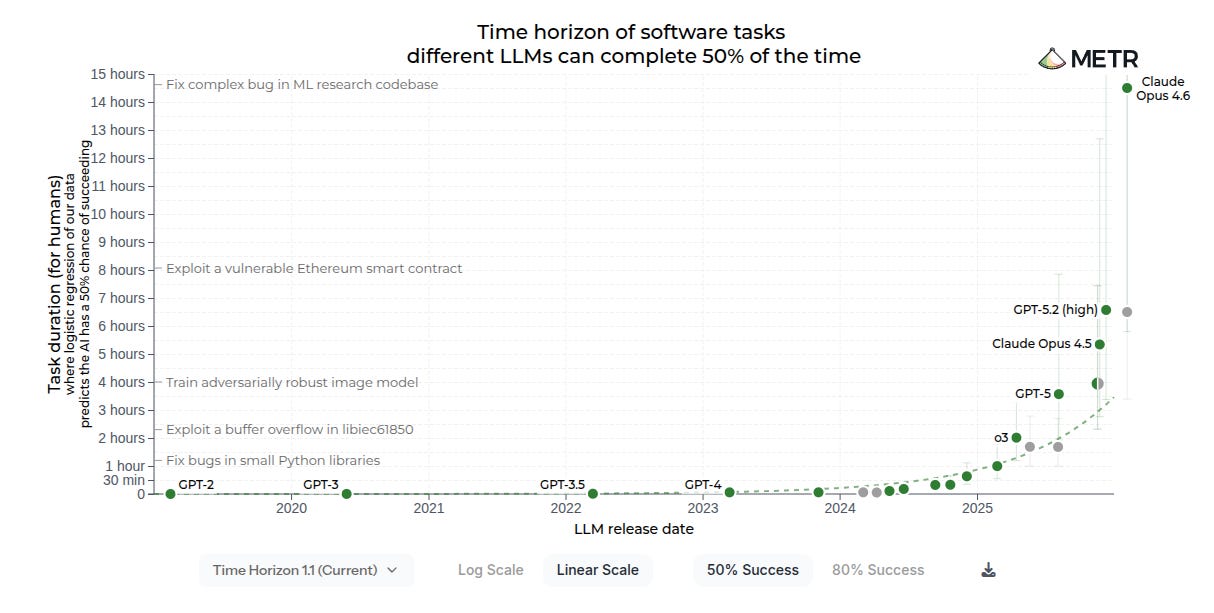
Technology and AI: METR said that Claude Opus 4.6 has the longest measured time horizon to date on their suite of software tasks. The Trump administration says it rejects global governance of AI.
Will an IAEA-like institution for AI that includes the US and China exist or be agreed on in a treaty by 2029? Forecasters think there’s a 6.6% (4.0% to 10%) probability.
Forecasters estimate Anthropic’s valuation at the end of 2026 as ~01 to 1.8T (90% confidence interval).
Economy: Many of the Trump administration’s tariffs were struck down by the US Supreme Court, though Trump later imposed a 15% global tariff, citing Section 122 of the Trade Act 1974.
Geopolitics
Middle East
The United States continues to move military assets to the Middle East and Europe in preparation for a potential attack on Iran. The USS Ford Supercarrier and part of its strike group entered the Mediterranean en route to the Middle East. On Tuesday, F-22 fighter jets were spotted in Britain for the first time since June 2025 (when they arrived 3-4 days before the US strikes on Iran that month), and at least 60 fighter jets were parked at a base in Jordan. Britain and Jordan are both reportedly refusing to allow the US to launch strikes on Iran directly from bases on their territory, with the British government concerned that an attack would violate international law.
If Trump does go ahead with strikes, the options range from limited strikes with the goal of speeding up a nuclear deal, to a large, multi-week or multi-month campaign that aims to topple the regime (for reference, the NATO air war against Serbia lasted 78 days; the air war against Gaddafi lasted around 7 months; the US intervention against Maduro around two hours, and that against Noriega 15 days.) US military preparations for the latter continued over the past week, as a large share of deployable US military aircraft have been staged in the Middle East or Europe. One senior US official said that “full forces” would be in position for operations against Iran by mid-March. With refueling tanker aircraft positioned in key locations in Europe and the Atlantic, it looks likely that any operation against Iran could involve bombers flying from the continental US. There are now about three times as many US military aircraft staged for this operation than were involved in Operation Midnight Hammer last year.
The latest round of talks between the US and Iran concluded in Geneva, with the Iranian delegation saying that an agreement was reached on “guiding principles”. Iran’s foreign minister said that a draft counterproposal should be ready within days, and the next round of talks is set to take place this Thursday in Geneva. Iran is unlikely to agree to give up its current stockpile of highly enriched uranium, but it might agree to diluting it.
Some American sources say that some progress has been made and that the Iranians would be coming back with further details within two weeks. Others say that Trump is getting impatient and that strikes on Iran are very likely to occur within weeks, though they differ on how much time it would take for the US to prepare and note that there are some in the administration who are trying to persuade him not to launch an attack. On Thursday, Trump himself hinted that he will make a decision one way or another within 10 days, implying that we will have more clarity by Sunday 1 March, though forecasters caution that his statements shouldn’t always be taken literally.
Overall, forecasters think there’s a 38% (25% to 51%) chance that the US strikes Iran by March 8, a 66% (55% to 75%) chance by the end of March, and a 79% (65% to 90%) chance by the end of June.
Conditional on a US strike by the end of June, they believe there’s a 78% (60% to 90%) probability that there will have been 30 consecutive days without any US strikes on Iran on November 3, 2026 (the date of the midterms). This could happen both if the US decisively wins quickly, but also if it attains limited goals and then withdraws, and forecasters generally agree that the US doesn’t have the appetite for an extended campaign.
Forecasters also estimate a 6.5% (2.0% to 15%) probability that cyberattacks that the Sentinel team believe were credibly attributed to Iran occur by the end of June and cumulatively lead to more than 10 estimated deaths. Attacks that lead to the deaths of more than 10 people are likely to be counterproductive, galvanizing the general population of the US and/or its allies against Iran.
In other news, a six-decade agreement regarding access to the al-Aqsa mosque in East Jerusalem collapsed, with Israel blocking Palestinians from attending Friday prayers for Ramadan.
Europe
Former UK Prime Minister Boris Johnson said that Britain should send non-combat troops to areas in Ukraine that are away from the frontline, to make a statement about Ukraine’s sovereignty and to make it clear to Putin that he won’t be able to regain much Ukrainian territory and that he should instead settle for a peace deal. He acknowledged that he is getting ahead of thinking in the British government, and forecasters think it’s very unlikely that Britain places boots on the ground in Ukraine outside of training missions and absent a peace deal.
In Ukraine, drones are reportedly killing 33,000 Russian forces per month – and Ukraine aims to increase that number to 50,000 per month by Easter. As of late January, Ukraine’s Defense Ministry reported that drones are now responsible for 75% of Russian casualties and 80% of Ukrainian strikes.
Asia
Satellite imagery reveals that China is building up its nuclear weapons capacity in facilities located deep in the mountains in the southwest of the country.
Chinese hackers continue to target US energy infrastructure.
Africa
In Sudan, UN investigators say they uncovered the “hallmarks of genocide” in El Fasher, with mass killings and ethnic targeting discovered. A reader also recommended a particular charity for Sudan.
Latin America
A Russian vessel believed to be carrying fuel to Cuba could challenge the US blockade of the country. Forecasters think there’s a 6.5% (2.0% to 15%) that at least one oil tanker will reach Cuban shores by the end of April. They also think there’s a 48% (31% to 67%) chance that the US will partially or completely remove sanctions against Cuba by the end of 2026, with some forecasters viewing this as a proxy for whether there is regime change in Cuba. Forecasters note that the Trump administration’s attention is concentrated in Iran.
On Sunday, the Mexican army killed “El Mencho,” the leader of the Jalisco New Generation Cartel, and the most powerful drug cartel leader in the country. In retaliation, the cartel set vehicles on fire and blocked roads in at least 20 Mexican states and at least 25 National Guard troops were killed in 6 separate attacks. The US reportedly provided intelligence for the operation and has pushed Mexico to act against drug cartels.
Technology and artificial intelligence
Capabilities
The 99.9th percentile of Claude code use went from 25 mins to 45 mins in 3 months.
METR estimates that Claude Opus 4.6 has a 50% time horizon of 14.5 hours on software tasks, their highest estimate to date. Some argued that this is evidence of superexponential growth in the length of tasks that AI models can complete, though others suggested that this was less clear from the 80% time horizon results, and METR themselves said that their measurement is extremely noisy because their current task suite is nearly saturated as models are starting to be able to do more tasks in its finite dataset.
Taalas hard-wired models provide ~10x faster inference at ~10x less power. This seems tricky to adapt to a mixture of experts architecture, like that used in current frontier models, although maybe one could hard-wire every model in the ensemble somehow.
There has been a malware distribution campaign targeting Github users. Previously, one could trust and install a random github repository, but this has changed as people can create malicious repositories at scale.
AI progress continues inexorably with new model releases: Gemini 3.1 Pro, as well as various Chinese models (GLM-5, Seed 2.0, Qwen3.5).
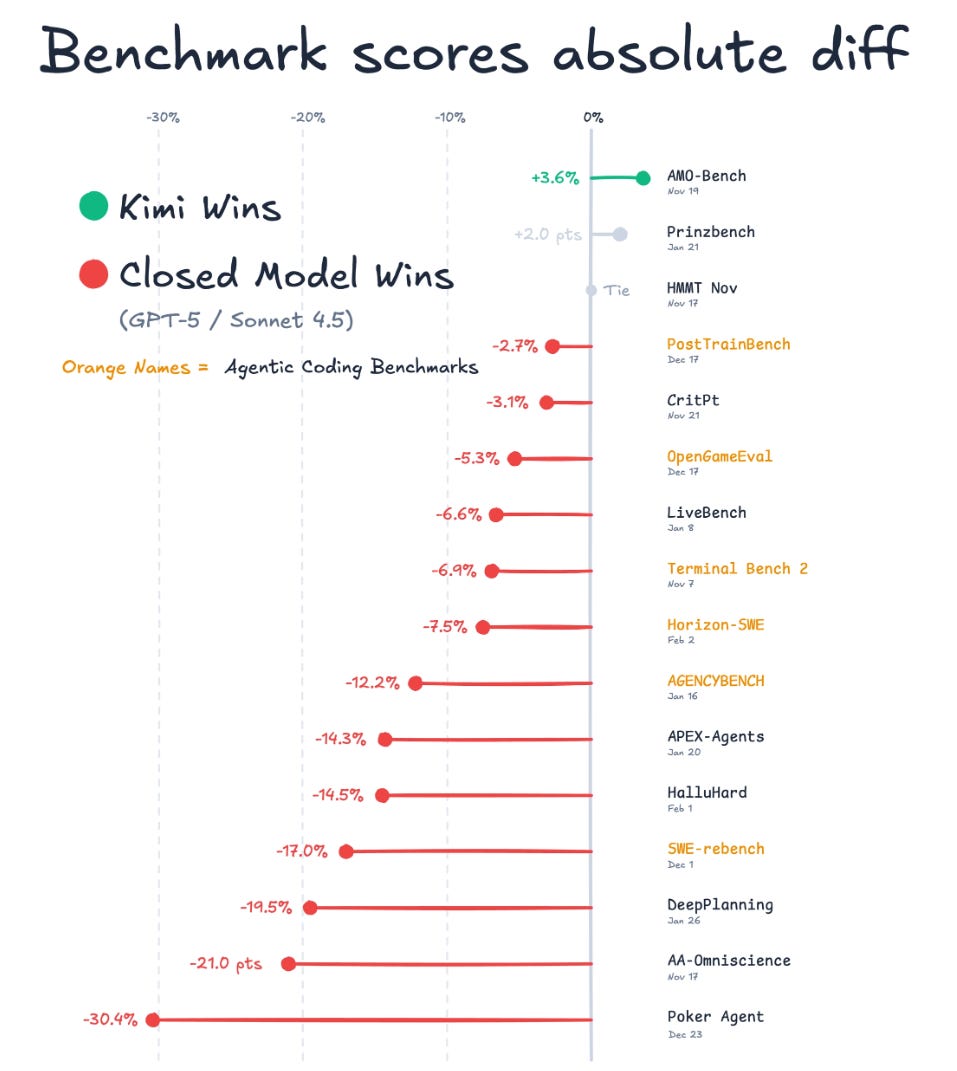
Chinese models might not be as close to Western ones as they might seem, because the benchmarks they mention in their announcements are specifically selected for being close to parity, and models are trained specifically to hit those benchmarks in a way that doesn’t generalize as well to benchmarks that become available after Chinese models are released.
Governance
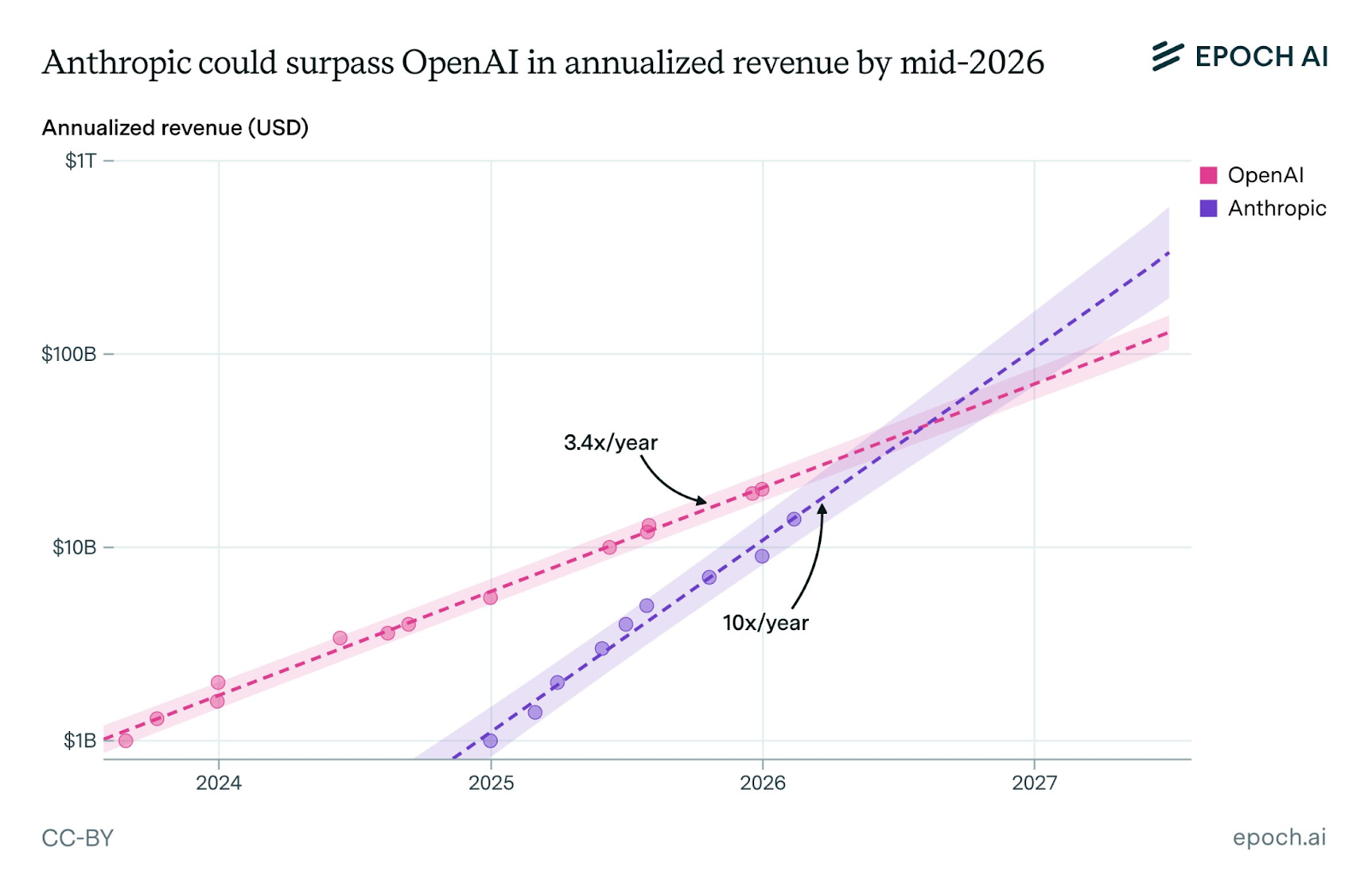
US Defense Secretary Pete Hegeseth threatened to cut ties with Anthropic, saying that he may designate the company as a “supply chain risk,” after Anthropic raised questions about how its AI was used in the Venezuela raid and refused to agree to permit the US government to use its AIs for domestic surveillance purposes. A source said that Anthropic’s stance is not ideological but based on the view that “AI systems are not reliable enough for life-or-death decisions without human judgement and that the technology significantly changes what is possible with domestic surveillance.” DOD Secretary Hegseth is set to meet with Anthropic CEO Amodei on Tuesday. Depending on the degree to which the Pentagon might require companies it does business with to decouple from all business with Anthropic, such a designation could hit Anthropic quite hard. Previously, Anthropic’s revenues had been growing faster than OpenAI’s, albeit from a lower starting point.
Forecasters estimate Anthropic’s valuation at the end of 2026 as ~0 to 1.8T USD, as the aggregate of their 90% confidence intervals. Forecasters engaged in some spirited discussion about whether the Pentagon’s designation of it as a supply chain risk, if played very hardball, could destroy Anthropic through stopping any part of the government, and companies that do business with the government, and their suppliers, and their suppliers’ suppliers, from using Anthropic’s models. For some forecasters, this falls within the worst 5% of scenarios, others think Anthropic would be able to survive such a measure, or that a designation by the Pentagon would not be so recursively strict. Anthropic could take such a designation to court, but in the worst case scenario, courts may not respond in time to save the company: injunctions and emergency rulings would be possible but not assured.
Michael Kratsios, Science Advisor to Trump, says that the US “totally” rejects global AI governance. Although the White House is at times fractious, this reflects current White House policy.
Conversely, at the New Delhi AI summit, Sam Altman says an IAEA for AI may be needed. And the UN Secretary General said that the future of AI can’t be decided by a handful of countries or left to the whims of a few billionaires, although he doesn’t have that much power himself to avoid this.
Forecasters think there’s a 6.6% (4.0% to 10%) that an IAEA-like institution for AI, which includes the US and China, will exist or be agreed on in a treaty, before 2029. This would be a body which oversees and/or sets some international rules on AI, at least some of which have to do with safety.
Forecasters disagree specifically on the likelihood of China agreeing to such a body. Forecaster comments on the no side include:
> 1) China is not that far behind, 2) it doesn’t trust the US to abide by common agreements, and 3) I think they want to go as far ahead with it themselves as they can. I think they see it as a double-edged sword, but primarily, like nukes, if everyone else is going to have powerful AIs, they want to have them, too. I see a lot of quasi-official Chinese statements about wanting lots of (near-)autonomous military capabilities, in particular. As I understand it, they see it as a necessary part of their military’s future
And on the yes side:
> China is in a weaker position, and so would lose less of the upside. Xi and other senior officials have made multiple public statements advocating for global AI governance and on setting international rules on AI. The US is quite clearly ahead, and China has very little chance of overtaking the US. So to the extent China looks at statements AI CEOs like Dario Amodei are making about essentially using superintelligence for world conquest, and believes them, it would want to accept a deal.
OpenAI committed $7.5m to an independent AI alignment research fund created by UKAISI
The White House is opposing Utah’s HB 286 bill, which would force AI developers of the most powerful systems to publish and follow safety plans, along with providing whistleblower protections.
The Pentagon briefly added Alibaba, Baidu, BYD to the Section 1260H list (entities that support the People’s Liberation Army), then withdrew them.
A few weeks ago, we reported on the NY-12 Congressional primary and forecasted that Alex Bores, who co-sponsored AI safety legislation in New York state, has a 34% chance of winning. Recently, a Super PAC backed by Anthropic has backed Bores, while a Super PAC backed by OpenAI’s Greg Brockman continues to oppose him.
Economy
The Supreme Court ruled that Trump’s use of the International Emergency Economic Powers Act (IEEPA) to impose tariffs was unlawful. In November, we forecasted a 71% chance (55% to 90%) that this would be the outcome. Trump announced he would impose a new global tariff of 15% (quickly raising it from 10%) using the Trade Act of 1974, which allows the President to impose tariffs of up to 15% for 150 days. The Tax Foundation estimates that this 15% tariff could replace about 73% of the revenue that will be lost as a result of the Supreme Court decision. One forecaster also thinks it’s more likely than not that Section 338 of the Smoot-Hawley Tariff Act of 1930 will also be invoked to impose tariffs, though it has never been used before. It has not been decided if and how $133 billion dollars of tariffs already collected will be refunded.
At a $300B valuation, it’s hard for Anthropic to actually reach $0, but tricky to figure out the remaining value if it is much much smaller than the previous valuation ($4B, $10B, $40B).
"Taalas hard-wired models provide ~10x faster inference at ~10x less power. This seems tricky to adapt to a mixture of experts architecture, like that used in current frontier models, although maybe one could hard-wire every model in the ensemble somehow."
This shows a misunderstanding of what the mixture of experts architecture is, it is not an ensemble of models