



Executive summary
Geopolitics: The US-Iran ceasefire broke down, and the US did not end up sending a delegation for a fresh round of talks in Oman.
Will Iran take fees from ships passing through the Strait of Hormuz at the beginning of 2027? Forecasters estimate a 64% (60% to 68%) probability that this will occur.
Between now and the end of the year, will Brent crude reach a price of $100 per barrel again? Forecasters give this a 29% (20% to 34%) chance.
Technology and AI: OpenAI released GPT-5.6 following a US government review process and claimed that it produced a proof of a decades-old mathematical conjecture in under an hour. The US government is considering an executive order that would regulate open-source AIs, while China is mulling export controls on its most advanced models.
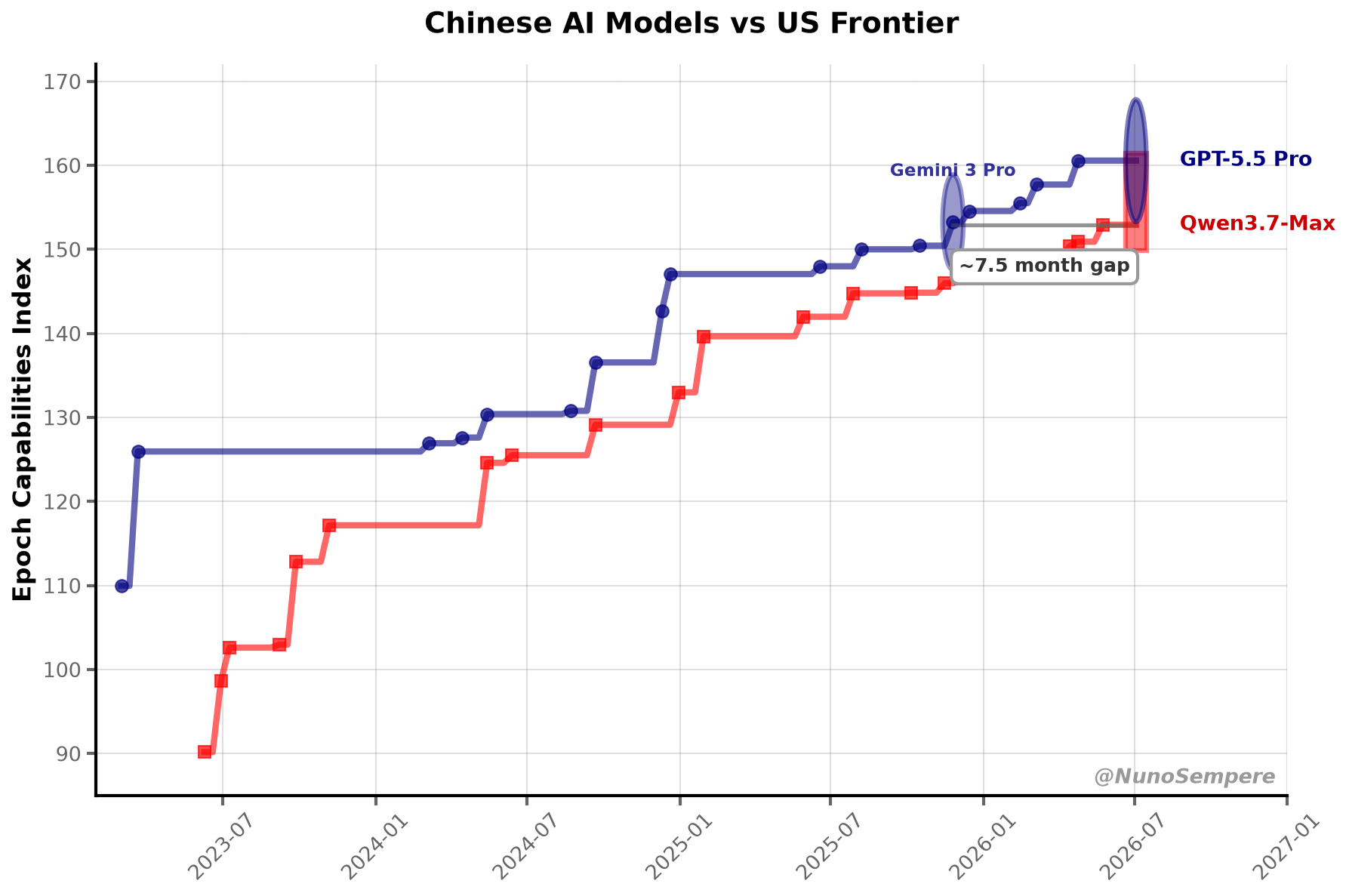
Will there be any Chinese Fable-level models by March 2027, defined as a model with an ECI score of 160 or higher? We give this a 73% (65% to 80%) chance.
Will China restrict foreign usage of its top AI models by March 2027? We’re broadly unsure, at a 45% (22% to 55%) chance.
Biorisk: The Ebola outbreak continues to grow, with 702 confirmed deaths reported, up from 506 last week (1.38x/week). A WHO official said that the outbreak is spreading largely undetected.
Will this Ebola outbreak reach more than 10,000 suspected and confirmed deaths? We estimate that there is a 72% (23% to 90%) chance.
If so, will it reach more than 1,000 suspected and confirmed deaths outside of Africa? We estimate the chance at 3% (1.3% to 5%).
Geopolitics
Middle East
The ceasefire between the US and Iran broke down following IRGC attacks on commercial shipping in the Strait of Hormuz and US strikes on targets in Iran. Iranian attacks on Kuwait and Qatar also resumed.
Brent crude spiked slightly, to $79/barrel.
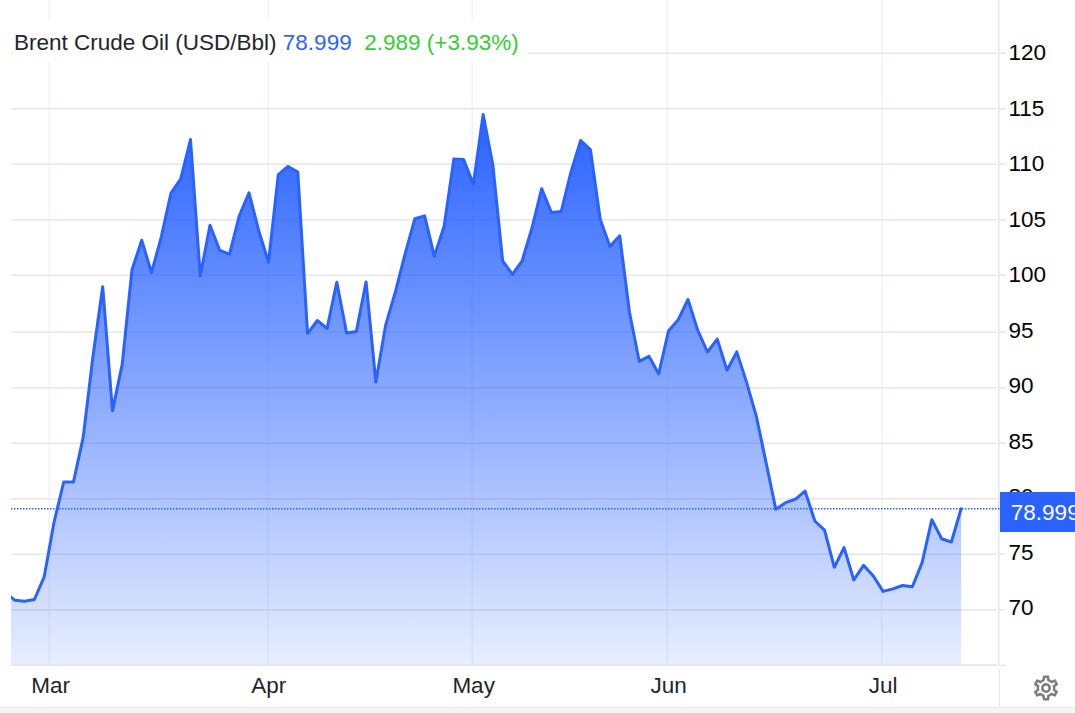
Some reporting suggests that hardline factions within Iran have been trying to undermine the ceasefire, while a faction favoring peace has been conveying to the US that it wants talks to continue. The US wants Iran to publicly state that it pledges to stop shooting at shipping in the Strait; thus far, Iran has done the opposite, saying it is closing the Strait while attacking another vessel. On Saturday, Iran held discussions with Oman about navigation in the Strait of Hormuz, but a US delegation did not end up attending.
Forecasters estimate that there is a 64% (60% to 68%) probability that Iran will be taking fees from ships passing through the Strait of Hormuz as of January 1, 2027, but don’t particularly expect [29% (20% to 34%) probability] that Brent crude oil will reach a price of $100 per barrel by then. A forecaster comments:
> From Iran’s perspective, it is critical to extract fees for passage through Hormuz, and for President Trump, it is critical that the Strait is free. If there is a toll/fee, his entire war will look like an abject failure. The positions of the countries are incompatible with each other, yet neither side has the power to defeat the other. My guess is that it will continue to simmer with peaks and troughs of violence, but with a keen eye on dialing back hostilities when the oil price rises too high, but both sides are prone to overplay their positions.
In Iran, slain Supreme Leader Ali Khamenei was buried after marathon funerals; his son and successor Mojtaba has not appeared publicly since his father’s death.
Europe
At the NATO summit in Ankara, Trump said he would give Ukraine a license to manufacture Patriot missile interceptors, and NATO members pledged €70 billion in assistance for 2026 and “at least the equivalent levels” of support for 2027. But the near-term reality is grim: Russian attacks killed at least 65 people in the Kyiv area in the past week, and Ukraine failed to intercept any of the ballistic missiles fired early July 6 because of a shortage of Patriot missiles.
Licensed production could take months to years to matter, so, in the meantime, Ukraine will pursue a six-pronged strategy of using Patriots wisely, finding alternatives to the Patriot, targeting Russian missile production, hiding its own defense industry facilities, taking shelter from Russian missiles, and attempting to force Russia into a position in which it will accept a partial or full ceasefire in which both sides agree to halt long-range airstrikes. Ukraine allegedly struck 21 tankers in the last few days, while continuing to apply pressure on Crimea.
Germany plans to borrow more than €800bn for defense spending by 2030, upending decades of fiscal restraint.
United States
Sen. Lindsey Graham (R-SC), a leading Republican and Trump ally elected to the Senate in 2002, died on Saturday night from what a preliminary medical report suggests was an aortic dissection (a tear in the aorta). South Carolina is strongly conservative, so his seat in the Senate is likely to remain Republican after the midterm elections. On Sunday, Sen. Mitch McConnell (R-KY), who was taken away from his home by ambulance last month, finally released a statement saying that he was recovering from a fall, losing consciousness and a case of pneumonia, putting rumors about his health to rest.
Trump forced out the remaining three members of the Election Assistance Commission, an independent federal commission that assists election administration officials across the country. One Republican appointee to the commission resigned, and the two Democratic appointees were fired, following the recent Supreme Court ruling that allows the president to fire members of independent federal agencies. Among its other duties, the Election Assistance Commission provides information on election administration and certifies voting systems.
Democratic nominee Graham Platner formally withdrew from the Maine Senate race on July 10 following a rape allegation he denies, after Sen. Schumer and the party campaign arm warned they “will not invest” if he stayed in the race. The Maine Democratic Party must pick a replacement by July 27, via a roughly 600-delegate convention, to face Sen. Susan Collins, who is seeking a sixth term in the only blue-leaning state with a GOP senator. Democrats would need a net gain of four seats to win a majority in the Senate.
As of July 10, the US has seen 2,231 confirmed measles cases so far in 2026, within striking distance of 2025’s 34-year record, with more than five months remaining in the year. Genomic sequencing shows an unbroken transmission chain since the January 2025 Texas outbreak, and the Pan American Health Organization (PAHO) Regional Verification Commission will convene in November 2026 to formally assess whether the US has lost the elimination status it has held since 2000.
Asia
China tested a nuclear-capable ICBM, which may have been launched from a submarine for the first time. China previously launched a nuclear-capable ICBM in a test in 2024, following four decades without any such test.
Technology and artificial intelligence
OpenAI’s GPT-5.6 was publicly deployed. This followed a US government review process (see also) with the Center for AI Standards and Innovation (CAISI). The company also claimed that the model produced a proof of a 50-year-old mathematical conjecture using 64 subagents in just under one hour.
China is reportedly looking at export controls for the country’s most advanced AI models. The White House, in turn, may be considering an executive order on open-source AIs, likely prompted by fears of Chinese models, in particular. OpenAI and Google reportedly sold AI models to blacklisted China groups.
Forecasters estimate that there is a 73% (65% to 80%) chance that China will have Fable-level models by March 2027, and a 42% (22% to 51%) chance that China will restrict foreign usage of its top AI models by then. Although it may be hard to amass the compute to train that model today, China could use distillation, efficiency improvements, renting or aggregating compute, scaling investment through Alibaba’s Qwen rather than DeepSeek, etc. Current gaps are ~7.5 months.
China did not set a target for urban job creation in a five-year plan for the first time in decades, perhaps owing, at least in part, to uncertainty about how AI will affect the labor market. Some reporting suggests that courts in China have been making rulings favourable to workers at risk of being displaced by AI:
There have already been several high-profile rulings siding with workers who were dismissed. In April, a court ruled that a tech company had illegally laid off a worker after replacing him with A.I. software. The ruling delivered an implicit warning to other employers.
“The development of artificial intelligence technology should be applied to liberating labor, promoting employment and improving people’s livelihood,” the Hangzhou Intermediate People’s Court wrote. “Labor law allows employers to undertake technological changes and upgrade their operations, but it should also take into account the protection of workers’ legitimate rights and interests.”
AI 2040 was published by AI Futures, the team behind AI 2027. It presents a plan involving a slowdown of frontier AI development, a US-China deal, and an eventual handoff of control of civilization to AIs around 2040.
A report found that terrorist groups such as Boko Haram have been using AIs to design explosives and improve weapons and tactics.
The UN’s Secretary-General has called for a ban on lethal autonomous weapons. He urged that global rules to protect children be developed, amid a UN-led global meeting on AI governance. At least one forecaster feels these efforts are very uninspiring. Had there been a Democrat administration in the US, these types of efforts would have found more tailwinds.
And: OpenAI’s Head of Safety Systems is leaving the company. AI is more fully assisting ransomware attacks. A custom silicon startup is advertising a 1000x inference speedup.
Biorisk
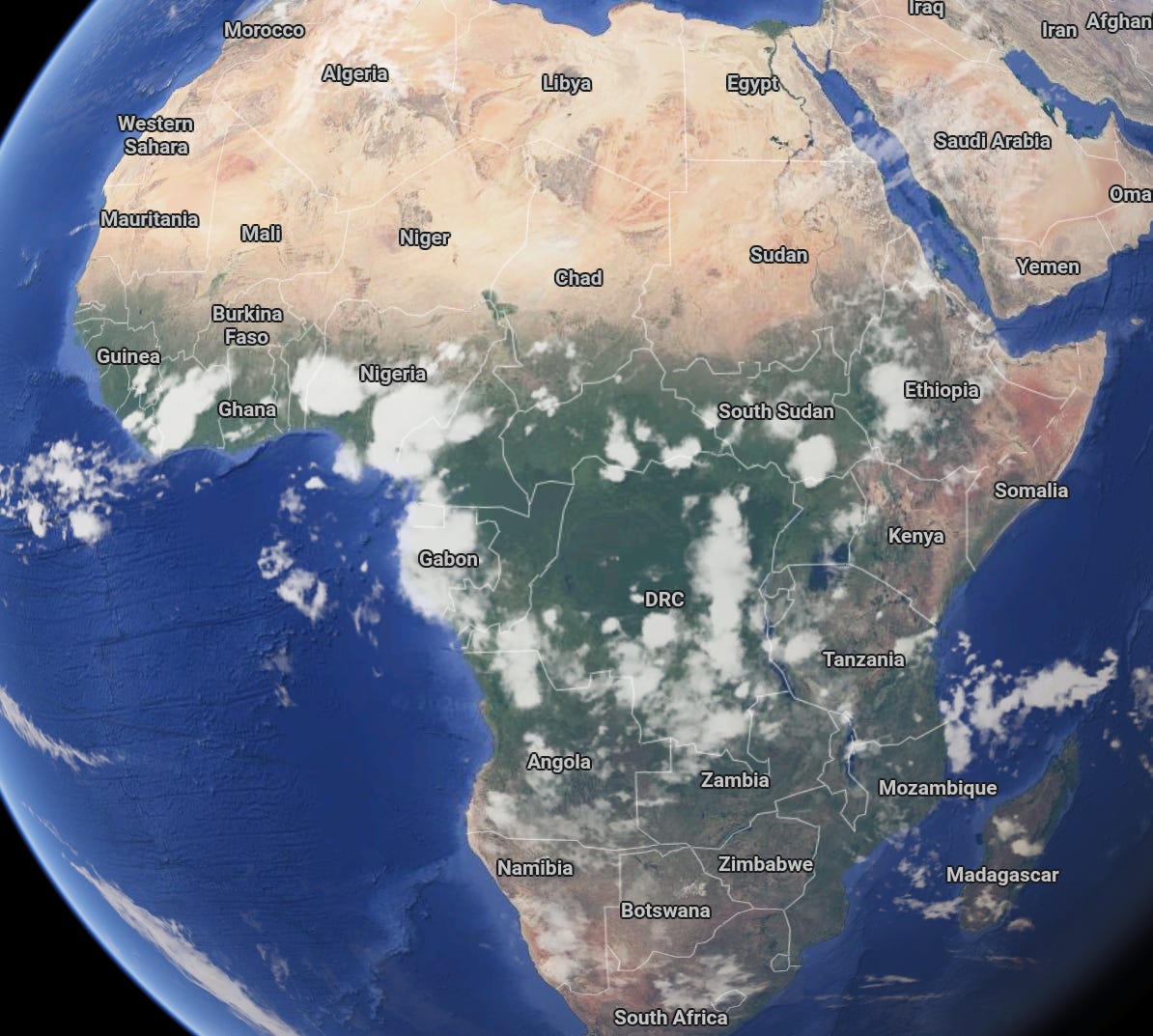
The confirmed death toll in the Ebola outbreak in the DRC reached 702 as of July 12, and Uganda saw 2 additional deaths. However, a WHO official said that 80% of new cases in hard-hit Bunia, in Ituri Province, have no known link to confirmed patients and that modeling suggests that the outbreak could be two to four times larger than that reported in official data. From our experience forecasting early COVID, in the absence of widespread testing, estimating the proportion of cases that are captured by tests is very fraught, although in the case of Ebola, deaths are more difficult to miss. Rapid tests could start to be available in the DRC as early as this week.
Forecasters estimate that there is a 72% (23% to 90%) chance that this Ebola outbreak will reach more than 10,000 suspected and confirmed deaths, and a 3% (1.3% to 5%) conditional probability that it will reach more than 1,000 deaths outside of Africa. They slightly differ in their belief that the outbreak is growing exponentially: because deaths have been growing at ~1.38x/week, it would only take 9 weeks to reach the 10K threshold, and this outbreak is starting off with more rapid growth than was seen in the 2014 epidemic. But other factors may kick in.
The DRC is encouraging people with symptoms to go to treatment centers early in the course of disease, both to improve survival and to reduce disease spread. Approximately 70% of the first 400 deaths in the current outbreak occurred outside treatment centers. This week, 21,000 community health workers began training to conduct house-to-house visits, identify potential cases and encourage people with symptoms to seek care.
Suspected cases have now appeared in the provinces of Tshopo and Haut-Uélé, beyond the Ituri epicenter, North Kivu and South Kivu; Haut-Uélé abuts South Sudan, and some fear the virus may spread northwards into the war-torn country. The Africa CDC calls the current outbreak the continent’s fastest-growing Ebola outbreak ever. Critically, it’s caused by the Bundibugyo ebolavirus, for which existing licensed Ebola vaccines and treatments are not approved; however, clinical trials of two therapeutics, MBP134 and remdesivir, began July 2.
>Will there be any Chinese Fable-level models by March 2027, defined as a model with an ECI score of 160 or higher? We give this a 73% (65% to 80%) chance.
In April, you all wrote "When will there be an open source AI with Anthropic Mythos-level capabilities? Forecasters’ on average expect it to arrive on December 15th 2026, with an aggregate 90%-ile range of May 17, 2026 to May 29, 2028"
I'd love to understand the difference between these two predictions. Was the "Mythos-level" threshold set lower? Or have forecasters shifted their estimates back?
Thanks as always!
> OpenAI and Google reportedly sold AI models to blacklisted China groups.
Just noting that this sounds as if they bought the model (weights and all), but in reality Singapore-based subsidiaries of Alibaba, Baidu and Tencent were simply commercially using the models.