

🟡 US to blockade Iranian ports, Iran peace talks end without agreement, Anthropic Mythos released to tech and cyber firms || Global Risks Weekly Roundup #15/2026


Executive summary
Geopolitics: Iran and the US failed to reach an agreement, and the US is now effectively blockading traffic to and from Iranian ports. A fragile ceasefire between the two countries officially remains in place.
What is the chance that the US will still be conducting a naval blockade of Iran on June 1 2026? Forecasters think there’s a 28% (15% to 55%) chance.
What is the chance that the IRGC will attack a US Navy vessel in the Gulf of Oman, Strait of Hormuz or Persian Gulf before June 1 2026? Forecasters believe there’s a 50% (40% to 60%) probability.
What is the chance that Trump will no longer be in office (permanently) before December 2026? Forecasters think there’s a 6.7% (4% to 16%) chance.
Will Israel conduct fewer than 30 airstrikes against Hezbollah north of the Litani River in Lebanon during the month of June? Forecasters assign a 48% (20% to 70%) probability to this outcome.
Technology and AI: Anthropic announced that it has developed a new model, Claude Mythos, but it considers the model to be sufficiently dangerous that it has limited access to the model to large tech and cyber firms.
When will there be an open source AI with Anthropic Mythos-level capabilities? Forecasters’ on average expect it to arrive on December 15th 2026, with an aggregate 90%-ile range of May 17, 2026 to May 29, 2028.
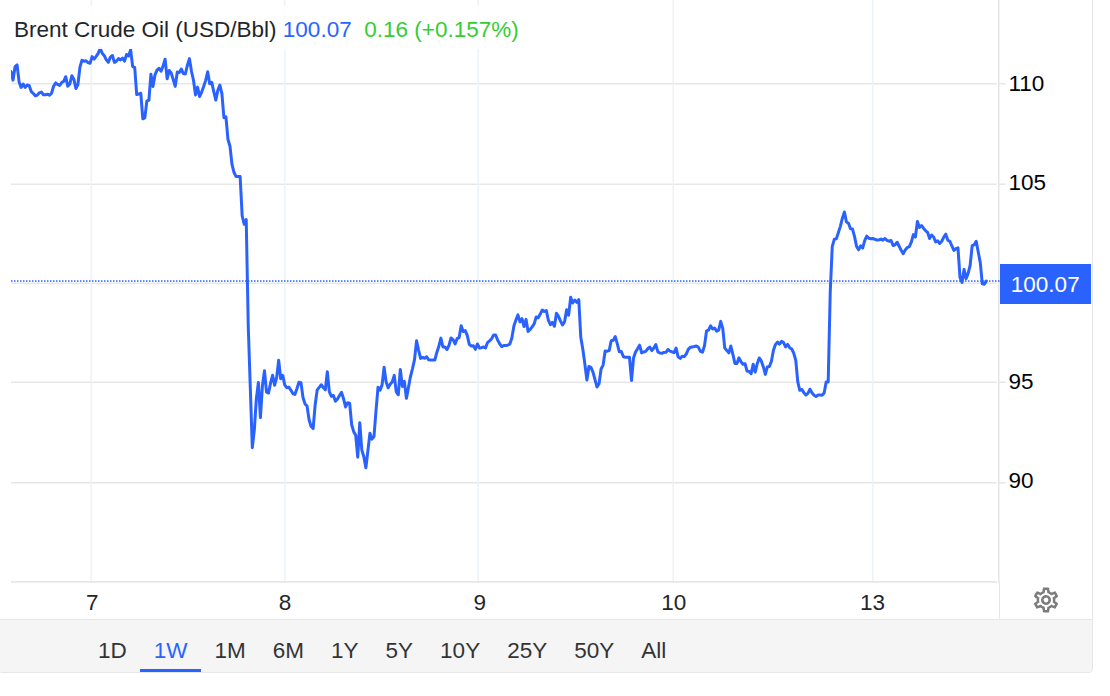
Economy: Brent crude oil futures prices rose above $100 per barrel again following Trump’s announcement that Iranian ports would be blockaded.
What is the chance that shipping traffic in the Strait of Hormuz returns to 60% of pre-war levels by June 1, 2026? Forecasters think there’s a 38% (21% to 70%) chance.
Errata: last week, we reported that our median of medians for when “superintelligence” would be developed was 2039, but it was actually 2031.
Geopolitics
Middle East
On Tuesday, the US and Iran agreed to a two-week ceasefire following backchannel talks mediated by Pakistan, to create room for further negotiations towards a broader and lasting agreement. Negotiations over the weekend between the US and Iran in Islamabad ended without an agreement being reached, though the fragile ceasefire is still officially in place.
Iran initially said that it did not expect to reach an agreement in the first round of talks, while Donald Trump claimed that although there were many points of agreement, Iran did not agree to refrain from seeking a nuclear weapon. Washington wants all nuclear activity in Iran to end regardless of the level and amount of enrichment, whereas Tehran insists that it has a right to enrich uranium for peaceful purposes. Trump later predicted that Iran would “come back and give us everything we want”, saying he did not want just 90% or 95% of his demands to be met. Talks may continue in the coming days.
Following the lack of agreement, Trump announced on Sunday that the US Navy would blockade the Strait of Hormuz in an attempt to stop all ships that enter or exit Iranian ports. He also posted on Truth Social that the US would “seek and interdict every vessel in international Waters that has paid a toll to Iran” and would begin destroying mines that he said the Iranians had laid in the Strait. The rationale for these actions appears to be that they could pressure Iran into agreeing to US terms, or pressure China into persuading them to agree to US terms to avoid losing out on oil deliveries from Iran.
US Central Command announced that US forces would begin to implement this blockade at 10 am ET (1400 GMT) on Monday, April 13. In response, the IRGC said that it would view any approach of the strait by military vessels as a violation of its ceasefire agreement with the US.
Earlier in the week, Trump threatened to wipe out Iran’s “whole civilization” if the Strait of Hormuz was not reopened. Iran, meanwhile, signalled that it was prepared to retaliate against critical infrastructure in neighbouring countries. But both sides agreed to the two-week truce after indirect talks between the US and Iran, via Pakistan, resulted in the wording of a ceasefire agreement that was acceptable to both parties.
Despite this, there remains disagreement as to whether Lebanon is meant to be included in the ceasefire. Iran and Pakistan say that it was, and the US likely agreed to this initially, but Israel’s prime minister said that operations in Lebanon against Hezbollah would continue, while agreeing to participate in direct talks with Lebanon in Washington. Even if the talks go well, Israel’s war is with Hezbollah, not the government of Lebanon, which is unable to fully control Hezbollah.
Looking ahead, forecasters think there’s a 28% (15% to 55%) probability that the US will still be conducting a naval blockade of Iranian ports on June 1, 2026, and a 50% (40% to 60%) probability that Iran will attack and damage a US vessel in the Gulf of Oman, Strait of Hormuz or Persian Gulf before June 2026. They also estimate a 48% (20% to 70%) chance that Israel will conduct fewer than 30 airstrikes against Hezbollah north of the Litani River in Lebanon during the month of June.
Europe
A 32-hour ceasefire between Russia and Ukraine came into force over Orthodox Easter. This is the fourth temporary ceasefire between the two sides since the war began in February 2022. Both sides accused each other of violating the ceasefire, however Russia “refrained from using long-range drones, missiles or guided bombs.”
Trump expressed displeasure with NATO over its member states’ unwillingness to join the Iran War and reopen the Strait of Hormuz, NATO Secretary General Mark Rutte met with Trump this past week to attempt to smooth relations with Trump. While formal US withdrawal from NATO would require a two thirds majority vote in the Senate, Trump could effectively weaken NATO in many ways, including by choosing not to honor Article 5 in a meaningful way. He also implicitly threatened Greenland once again, reiterating that “We want Greenland” ahead of his meeting with Rutte.
Hungarian Prime Minister Viktor Orban was voted out of office in elections held on Sunday. The opposition party won a two-thirds majority, which will enable it to reverse some of Orban’s constitutional changes. Peter Magyar, who will be the country’s next Prime Minister, has pledged to improve relations with the EU and NATO, and is likely to end Hungarian opposition to further EU support for Ukraine. Last week, we gave Orban a 56% chance of losing the election.
The Americas
The United States
Forecasters have been observing Trump’s behavior becoming more disinhibited and impulsive. Most recently, on Sunday, Easter for the Eastern Orthodox Church, Trump posted an image of himself as a Christ-like figure on Truth Social. He has also pursued a very aggressive geopolitical strategy, with statements like “A whole civilization will die tonight, never to be brought back again.” While supporters may agree with Trump’s overall approach and strategy, or with many of his actions or statements, changes in his behavioral patterns could be caused by cognitive decline.

One forecaster thinks that his combined behavioral and speech changes likely point towards the development of frontal variant Alzheimer’s disease or another form of dementia with similar symptoms. This forecaster also suggests that because of ongoing cognitive changes, it is possible that Trump’s advisors and others around him may be increasingly able to influence his thinking, statements and actions, even as his behavior is likely becoming more disinhibited and impulsive.
Forecasters believe there’s a 6.7% chance (4% to 16%) that Trump will no longer be in office before December 2026, whether for health reasons or because of invocation of the 25th Amendment, or even impeachment and conviction.
The Rest of the Americas
Cuba’s President says he won’t resign despite US pressure.
In a speech at the Liberal Party’s national convention, Canadian PM Carney said, “The days of our military sending 70 cents of every dollar to the United States are over.”
Asia
The leader of Taiwan’s main opposition party, the Kuomintang (KMT) visited China, the first such visit by a KMT leader in around 10 years.
Economy
After falling last Wednesday, Brent crude oil futures moved above $100 per barrel again on Monday, following Trump’s announcement that ships entering or exiting Iranian ports would be blockaded. With Iran also threatening shipping in and around the Strait of Hormuz, the number of ships transiting the Strait per week could fall to virtually zero from its already low figure. While futures are currently trading at just over $100, the price for dated Brent crude, the price for cargoes loaded within 10 to 30 days, topped $144 dollars last week.
Europe could face shortages of jet fuel in the next three weeks if ships are not allowed to pass through the Strait of Hormuz soon.
Forecasters think there’s a 38% (21% to 70%) chance that shipping traffic in the Strait of Hormuz returns to 60% of pre-war levels by June 1, 2026.
Technology and artificial intelligence
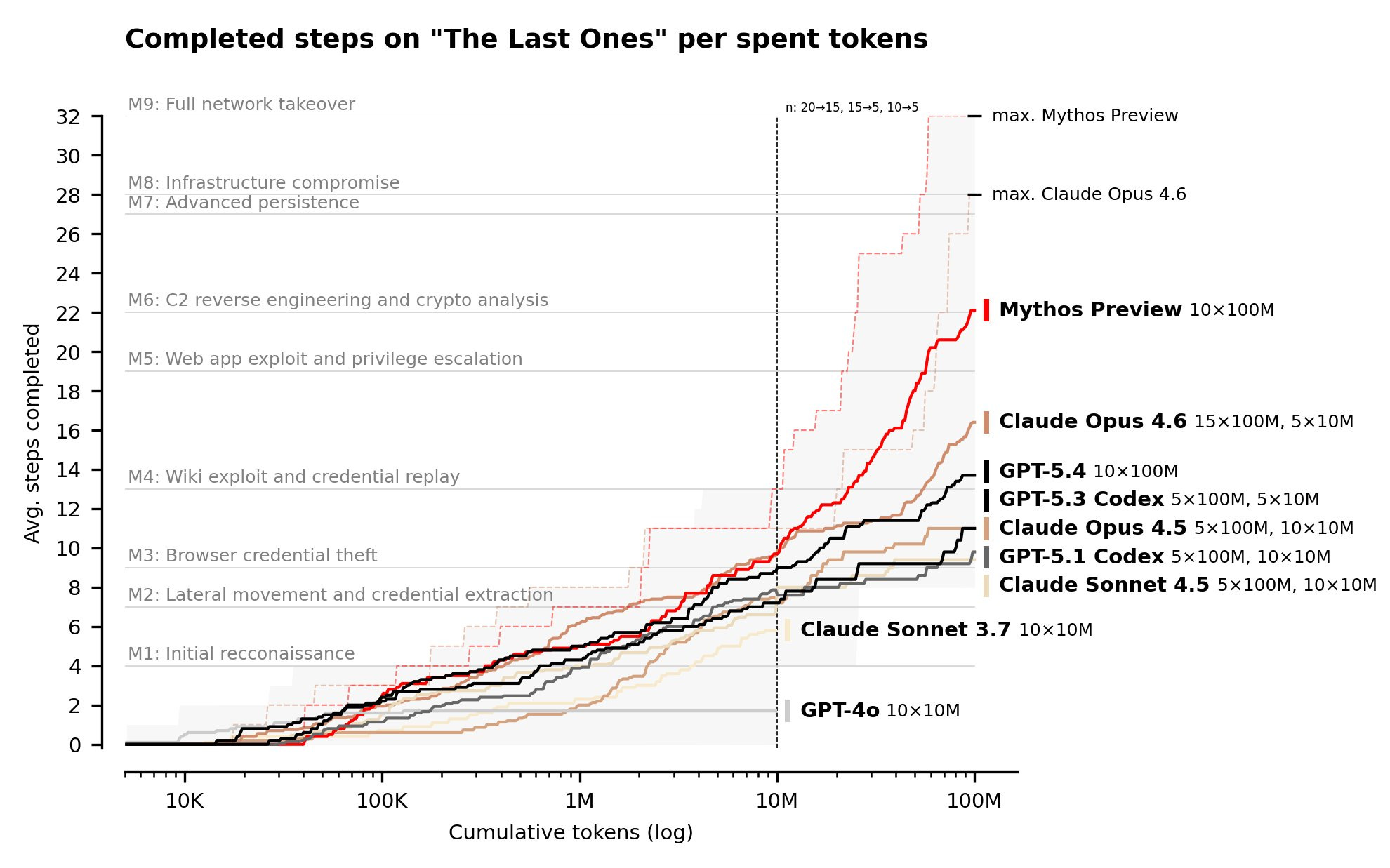
Anthropic announced that it has developed a new AI model, Claude Mythos. The company says the model is particularly good at computer security tasks, and set up Project Glasswing, which allows some of the world’s largest tech and cybersecurity companies access to the model for their defensive security work. The model has not been widely released because of security concerns. Anthropic says that the model has already identified thousands of vulnerabilities in web browsers and operating systems. Bessent and Powell convened bank CEOs to discuss cybersecurity. Here is an example vulnerability in wolfSSL,
> wolfSSL’s ECCSI signature verifier wc_VerifyEccsiHash decodes the r and s scalars from the signature blob via mp_read_unsigned_bin with no check that they lie in [1, q-1]. A crafted forged signature could verify against any message for any identity, using only publicly-known constants. Thanks to Calif.io in collaboration with Claude and Anthropic Research for the report. Fixed in PR 10102.
US Treasury Secretary Scott Bessent called in bank CEOs to discuss cyber risks arising from Anthropic’s new model, while the UK’s AI Security Institute tested it, with a government minister saying it was the most powerful model they’ve yet tested.
An article was published in The New Yorker suggesting that Sam Altman’s tenure at OpenAI has involved repeated allegations of deception, power-seeking, and erosion of safety commitments. It questions whether Altman can be trusted with so much power. The authors spoke with Altman multiple times for the article and interviewed many people around him. The article received significant attention online.
A man threw a Molotov cocktail at Sam Altman’s residence.. The perpetrator appears to have been engaged in AI safety discourse. Altman’s home was later targeted in a second attack.
And: OpenAI backed a bill in Illinois that aims to protect AI companies from liability if their products cause over 100 deaths or serious injuries, or over $1 billion in damages. A US appeals court declined to block the Pentagon’s blacklisting of Anthropic. Meta is using its existing distribution channels to promote its AI app, which reached #5 in the US app store.
Nature and climate
The US National Oceanic and Atmospheric Administration is forecasting a 61% chance of an El Niño weather pattern, and a 25% chance of a “super” El Niño. If an El Niño event were to start this fall, there could be an approximately 4% risk of a “megastorm” and “megaflood” occurring in California over the following year; some estimates place the damage it would cost at nearly $1T, or 4% of US GDP, more than the damage caused by the Great Flood of 1862. The risk has been increasing because of the rise in global temperatures. A super El Niño would also be expected to have worldwide effects on temperatures and precipitation.
As always, I appreciate this roundup!
> When will there be an open source AI with Anthropic Mythos-level capabilities? Forecasters’ on average expect it to arrive on December 15th 2026, with an aggregate 90%-ile range of May 17, 2026 to May 29, 2028.
This point-estimate seems a little bit bullish to me? I don't have a coherent forecasting model to push back, but I think the combination of a) Mythos being very compute-intensive (and therefore expensive especially for Chinese firms) b) Mythos's development probably relied on some mild RSI dynamics within Anthropic c) existing open-weights efforts look unlikely to continue releasing frontier-class models fairly soon due to funding challenges (E.g. Qwen recently, or some of the departures at Ai2) d) the slower proliferation of Mythos's deployment makes fast-following more difficult than previous releases.
By benchmarks, my impression is that open weight models are ~6-9 months behind, but I think it will likely be a little bit more than that for this? The percentile range seems reasonable to me.
Of course, I'm not a forecaster and I'm not calibrated, but I thought I might share my perspective.
Great post! I know I had some questions that I am hoping can be answered in the coming weeks (when the group think the automated coder and TED-AI or AGI will be reached? for reference). Another question, which is related to when will an open model get released with the same capabilities as Mythos, that I had is when does the group think that Mythos will have a general release?