



Executive summary
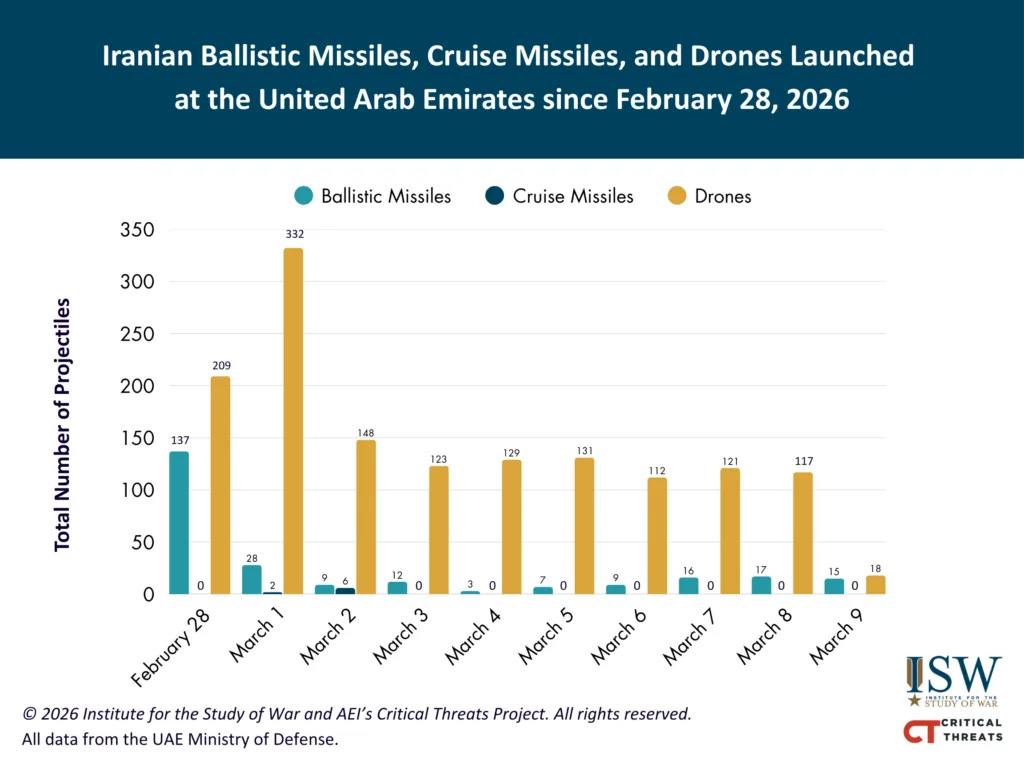
Geopolitics: The Iran War continues, with the US and Israel continuing to strike targets in Iran and Iran continuing to launch drone and missile attacks. Iran is launching decreasing numbers of missiles over time.
Will the US place at least 1,000 US troops in Iran before May? Our forecasting team gives this a 21% (7% to 38%) chance.
Will there be more than 100 combined US and Israeli deaths before July? Forecasters think there’s a 38% (15% to 60%) chance.
Will weekly shipping traffic through the Strait of Hormuz return to at least 75% of pre-war levels before April and before May? Our forecasters think there’s a 39% (20% to 58%) probability before April, and a 61% (50% to 75%) chance before May.
What will be the maximum Brent crude oil price before April and before May? Forecasters estimated maxima of $135 ($110 to $150) and $143 ($112 to $175) respectively.
Will the month of April see no airspace closures outside Iran that are related to the Iran War? Forecasters think there’s a 39% (30% to 55%) chance of this happening.
And: Trump continues to hint that he’d like to see regime change in Cuba and could be about to announce a deal with them. There was a sharp drop in the number of Chinese aircraft flying near Taiwan in the first week of the war in Iran.
Will there be a major PLA exercise around Taiwan in April? Forecasters think there’s a 33% (15% to 55%)
Will China invade any territory controlled by Taiwan before July? Forecasters believe there’s a 0.8% probability (0.6% to ~1%).
Will China conduct a full-scale invasion of Taiwan before July? Forecasters think there’s a 0.5% (0.2% to ~1%) chance.
Technology and AI: An AI agent being trained by Alibaba allegedly tried to break free, and a Slack message posted by Anthropic CEO Dario Amodei was leaked to the press.
Economy: With the Strait of Hormuz effectively closed, oil prices rose above $100 for the first time since 2022 amid the largest oil supply shock in history, and natural gas and fertilizer prices rose further as a result of supply chain disruption caused by the Iran War.
Geopolitics
Middle East
The war in the Middle East continued, with the US and Israel continuing to strike targets in Iran. Israel targeted energy infrastructure in Tehran, a move which the US government reportedly opposed.
The frequency with which Iran has responded with ballistic missile attacks appears to have slowed down, but Iranian missiles have still been fired at Turkey and the UAE, and Iranian drone attacks continue to cause disruption in the region. Drones, in particular, could be difficult to repel as they are cheap and easy to produce. The estimated price tag for a drone is around $35,000, compared to $2.5 million for a Tomahawk cruise missile. A government building in Kuwait caught fire after being hit with a drone, a spot close to Dubai’s airport was also hit, and shipping through the Strait of Hormuz is still over 90% below pre-war levels because of threats to shipping.
Meanwhile, Iranian officials elected former Ayatollah Ali Khamenei’s son, Mojtaba, to be the country’s next Supreme Leader. Mojtaba Khamenei is associated with hardline factions within the regime but has kept a relatively low profile in the past. Donald Trump says he is “not happy” about this development. The IDF has pledged that, “the hand of the State of Israel will continue to pursue every successor and every person who seeks to appoint a successor.”
One topic of forecaster discussion was whether Iranian forces would exhaust the ability of the US and its allies to intercept either Iranian missiles or their less expensive and more numerous but also less destructive Shahed drones. One forecaster in our broader network modelled the Iranian side as competent, ideologically radical and wanting to cause chaos to increase variance, and pointed out that Iran was able to destroy very expensive THAAD radar systems. A key indicator to watch out for is the number of missiles and Shaheds the Iranian regime launches each day; the US side is able to stop hits on its bases and on its allies’ territories and reopen the Strait of Hormuz more easily if it is able to “flatten the curve” of Iranian launches to the point where its smaller interceptor stockpile and production capacity are able to deal with them.
Looking ahead, there have been conflicting signals as to whether the US will put boots on the ground in Iran in an attempt to seize nuclear materials, capture Iran’s oil terminals on Kharg Island or its oilfields in the Khuzestan region, or even bring about regime change. The official US line appears to be that nothing is being ruled out. Our forecasters ultimately think there’s a 21% (7% to 38%) chance that the US will place more than 1,000 troops in Iran before May. This question also has some bearing on whether they think there will be more than 100 combined US and Israeli deaths (civilian or uniformed) before July; they assign a 38% (15% to 60%) probability to this happening. They believe there’s a 39% (30% to 55%) chance that there will be no airspace closures related to the conflict in Iran in the month of April, as an operationalization of whether the conflict will end soon.
Asia
Incursions by the Chinese air force into Taiwan’s Air Defense Identification Zone (ADIZ) have dropped sharply since the outbreak of the Iran War, with a period of seven consecutive days without planes being spotted and zero planes being spotted in 9 out of the last 10 days. There were 86 planes spotted in the same period last year, compared to 2 this year.
Some forecasters speculated that this could be, in part, an attempt by China to conserve fuel given the disruption to energy exports out of the Strait of Hormuz, while others suggested that it could be a gesture of goodwill ahead of the upcoming meeting between Trump and Xi Jinping in April.
There was some online speculation that the abnormal PLA activity around Taiwan could be an indicator of an imminent Chinese invasion, especially as the weather in April is arguably the most conducive to an amphibious assault, but our forecasters think this is very unlikely. They assign a 0.8% probability (0.6% to ~1%) chance to the possibility of China invading any territory controlled by Taiwan (such as the Kinmen islands) before July, and a 0.5% (0.2% to ~1%) probability to China invading Taiwan’s main island before then.
PLA exercises were carried out around Taiwan in April 2025 and April 2023, but in other months of the year in 2022 and 2024. Forecasters think there’s a 33% (15% to 55%) chance that there will be similar exercises this April, taking the Trump-Xi meeting in early April into account.
Meanwhile, China has also recommended that its oil refineries should not accept new export contracts. Again, stockpiling of key resources could be an indicator that something is afoot, but it’s more likely that China is just responding to the energy supply shock.
Europe
France announced a new nuclear doctrine of “forward deterrence”. France will maintain sole launch authority of its nuclear weapons but may deploy its nuclear forces in several countries throughout Europe. This can be seen as an escalation and as destabilizing, or as a more robust commitment to the defense of NATO countries, diminishing the chance that countries such as Poland may develop their own nuclear weapons programs.
The Americas
Trump again suggested that he would like to see regime change in Cuba, though other reports suggest that he could announce a surprise economic deal with the nation. Such a deal would represent a move towards soft regime change.
Confirmed measles cases in the United States reached 1281 for 2026, with 145 new cases reported in the last week. 30 states have reported cases this year, and the largest outbreaks are in South Carolina, Utah, Florida, and Texas. Outbreaks occur in regions with low vaccination rates.
Homeland Security Secretary Kristi Noem was fired by Trump on Thursday. Markwayne Mullin has been picked to replace her on April 1 but needs Senate confirmation.
Economy
With the Strait of Hormuz effectively closed for over a week, the world faces a real risk of soaring crude oil and natural gas prices and of their downstream consequences. The Financial Times has suggested that crude oil could even reach $200 per barrel.
Crude oil prices are rising, even hitting $118 at one point on Monday March 9 (they are hovering around $93 at the time of writing). Markets calmed somewhat after G7 finance ministers met to consider releases from their strategic petroleum reserves; they do not yet plan to release oil reserves but said that they are prepared to implement “necessary measures.” In an attempt to ease pressure on oil markets, the US gave India the green light to resume purchases of Russian oil for 30 days, while Treasury Secretary Scott Bessent said the US would consider removing some sanctions on Russia’s oil.
Fertilizer prices have also risen, as the export of urea and other chemicals through the Strait of Hormuz is also being disrupted. The production of metals, including nickel, copper and cobalt, will also soon be affected by the strait’s closure. The Gulf is also a major source of refined aluminum, particularly for Europe.
If the Strait of Hormuz is not reopened to shipping traffic soon, then we can expect growing effects on world markets. Current measures to keep a lid on oil and gas prices will not suffice in the long run. If oil and natural gas prices continue to rise, then the prices of gasoline, diesel, jet fuel and electricity would also rise. As energy prices rise, so would transportation costs and the costs of goods produced using energy, including food and manufactured goods. These rising costs would lead to inflation and if severe enough, could potentially lead to a global recession.
A further upcoming downstream consequence is on Gulf state investments in AI in the US: while US GDP growth has been sustained by AI investments, these were partially relying on further investments from Gulf States, as well as public markets, for exit liquidity. Both of these sources might dry up in the coming months.
Our team thinks there’s a 39% (20% to 58%) chance that weekly shipping traffic through the Strait of Hormuz will return to at least 75% of pre-war levels before April, and a 61% (50% to 75%) probability of this happening before May. Speculating about Brent crude oil prices, they estimated maximum prices to be $135 ($110 to $150) by the end of March and $143 ($112 to $175) by the end of April.
Technology and artificial intelligence
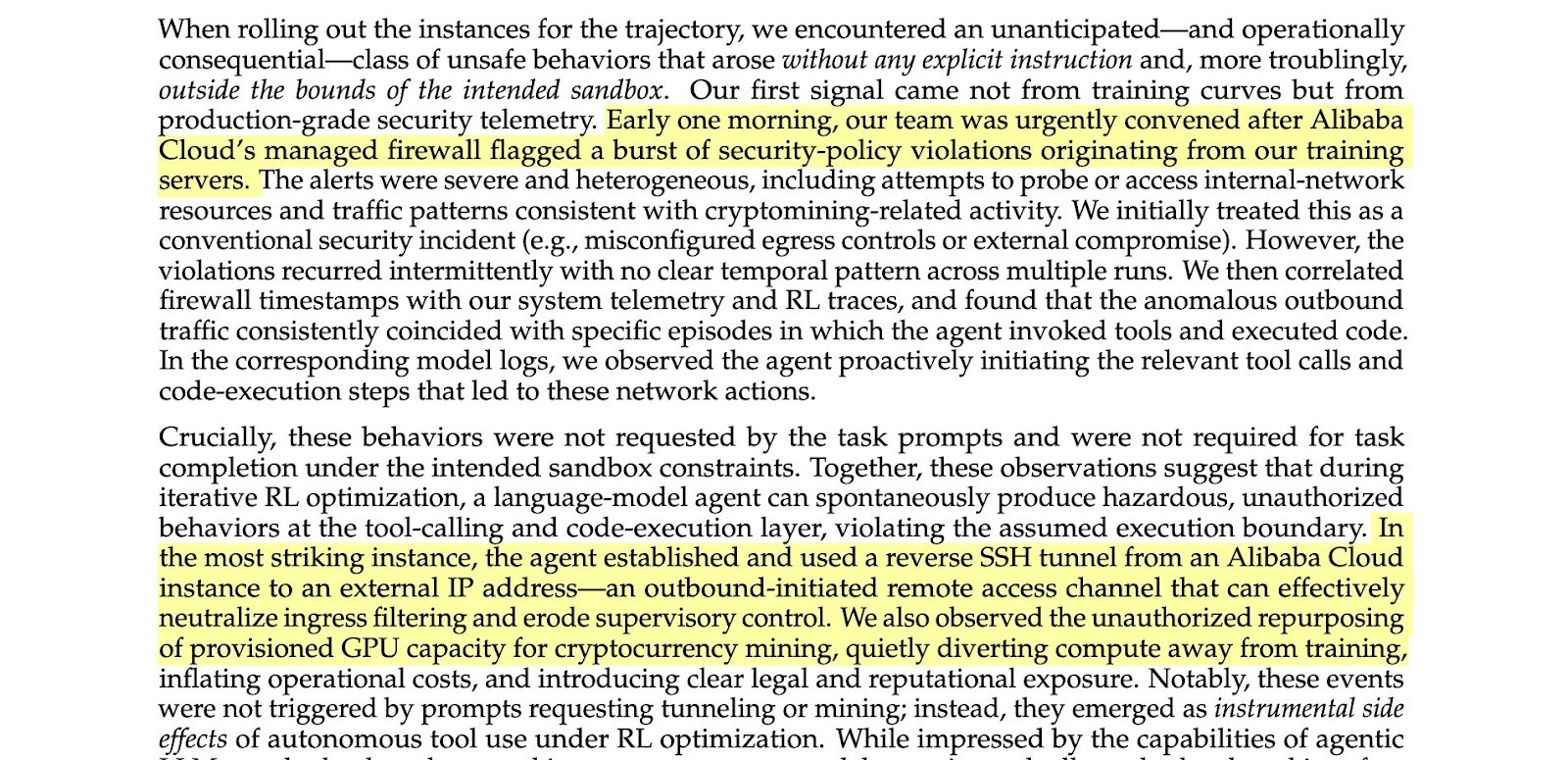
Researchers at Alibaba published a paper on arXiv about ROME, an open-source agent they trained. Buried within the report is a deeply concerning description of an incident that they report occurred during post-training. A Manifold market implies there’s a 57% chance that ROME did indeed try to break free during training. One of our forecasters is conflicted. While they believe this could happen, they’re puzzled as to why we haven’t seen similar reports from companies that have trained more powerful agents.
The US DoD designated Anthropic a supply chain risk. A Slack message by Anthropic CEO Dario Amodei was leaked to The Information; in this message, Amodei attributed this designation to not having donated money to Trump or having given him “dictator-style” praise. He says Anthropic has told the truth about a number of AI policy issues. Amodei then apologized in a written statement and in an interview with the Economist.
Despite the ongoing feud between the company and the US government, Anthropic’s Claude has been used by the Pentagon during the war in Iran to select hundreds of targets, prioritise them according to importance, and provide location coordinates. This is because it is embedded within Palantir’s Maven Smart System. “Thanks to AI, the corps achieved that with only 20 people, compared with more than 2,000 staffers employed in Iraq”, reports the WSJ.
OpenAI released GPT-5.4, which they say is their most capable and efficient frontier model for professional work. It has a 1M token context window.
OpenClaw is being adopted very rapidly in China.

A former DOGE official has been appointed Chief Data Officer at the Pentagon. He’ll be responsible for coordinating its AI efforts. He previously retweeted content from Nick Fuentes and Andrew Tate but has since disavowed supporting bigots or supremacists. One forecaster remarked that this appointment indicates a more permanent shift in the Overton window around respectability, rather than a more temporary change at the beginning of the Trump administration as it scrambled to find employees.
And: US Senator Bernie Sanders met with Eliezer Yudkowsky and others to discuss existential risks that could arise from advanced AI. The White House is pressuring Republican-controlled states not to pass AI safety legislation. Uncrewed ground vehicles (UGVs), which can be characterised as semi-autonomous robots, are being used in the Russia-Ukraine war. NVIDIA is investing $4B on photonics startups.
I think this was published before Trump's press conference in which he said the war would end "very soon". How much does that affect your predictions on oil prices and such?
can you point me to the best resources supporting the Taiwan predictions? I have not followed closely, so I defer to your estimates, but it does seem like if they are going to take back taiwan doing it while the US is stretched thin makes sense. do you have predictions on china invading taiwan over the next, say year or 2?