



Executive summary
Geopolitics: Donald Trump called Iran’s response to the US’ latest peace proposal “totally unacceptable”. Vladimir Putin hinted that the Russia-Ukraine war may be nearing an end.
Will Russia and Ukraine end the war with a signed agreement by the end of 2026? Our forecasters think there’s a 35% (25% to 50%) chance.
Technology and AI: The White House is reportedly considering introducing an executive order mandating that the government reviews new AI models before they are released to the public.
Will the US Federal Government through executive order or legislation regulate the release of all new AI models from frontier laboratories by November 3rd, 2026? Our forecasters believe there’s a 32% (27% to 40%) probability.
Economy: The S&P 500’s rebound since late March has been driven by the smallest number of stocks on record, namely a handful of Big Tech stocks.
Will the tech companies Alphabet, Nvidia, Amazon, Broadcom, and Apple account for at least 65% of overall growth of the S&P 500 in Q4 of 2026? Our forecasters think there’s a 33% (15% to 60%) chance.
Biorisk: Passengers who were on the cruise ship associated with the hantavirus outbreak are being evacuated to their home countries, where they are typically being assessed in quarantine facilities before being allowed to return home if they are deemed “low risk”.
Will the WHO classify the current hantavirus outbreak as a PHEIC (Public Health Emergency of International Concern) by the end of 2026? Our forecasters think there’s a 0.35% (~0% to 5%) chance.
Climate/nature: A super El Niño event is looking increasingly likely this year.
Will extreme weather be the cause of at least 10,000 deaths in the US in 2026? Our forecasters think there’s a 2% (1% to 5%) chance.
Geopolitics
Middle East
On Sunday, Trump rejected the latest Iranian peace proposal, calling it “totally unacceptable”. A ceasefire between the US and Iran continues to officially hold, as both countries continue to exchange demands with a hope of inching towards a peace agreement. The Strait of Hormuz remains nearly closed. Trump announced Project Freedom to escort ships out of the Persian Gulf; days later, the project was aborted, in part because Saudi Arabia refused to let the US use its air base for the operation. Saudi Arabia and Kuwait later lifted restrictions on US use of their air bases and airspace. The US attacked military sites in Bandar Abbas and Qeshm in Iran in retaliation for Iranian strikes against US warships. Iran also carried out strikes against the UAE, Kuwait and Qatar.
Europe
On Saturday, Putin said that the Ukraine war “is coming to an end.” Zelensky and Putin agreed to Trump’s request for a three-day ceasefire around Russia’s annual commemoration of Soviet victory over Nazi Germany in WWII; Zelensky agreed to the ceasefire in order to exchange 1,000 prisoners of war. Russia had prepared defenses against the prospect of Ukrainian drone attacks during the parade. Putin has also been increasing his security amid fears of assassination attempts, particularly by drones, and has been spending more time in underground bunkers. He is reportedly increasingly isolated and detached from civilian life. After falling territorial gains in Ukraine over the past several months, Russia suffered a net loss of territory in Ukraine in April.
Our forecasters think there’s a 35% (25% to 50%) chance that the Russia-Ukraine war ends with a signed agreement between the two parties by the end of 2026.
The Americas
Latin America
The US military is flying more surveillance and reconnaissance flights near Cuba, as was seen before US military action in Venezuela and Iran. US Secretary of State Marco Rubio and US SOUTHCOM commander Gen. Francis Donovan shook hands in front of a map of Cuba at SOUTHCOM headquarters.
The United States
Defense contractor Raytheon received $441.6M to deliver Patriot missiles in 5 months, an extremely short timeframe. The US has been depleting stockpiles of missiles in the Iran war.
More than a quarter of the Department of Justice’s lawyers have been fired or quit since Trump started his second term.
White House border czar Tom Homan told DHS officials and industry representatives that, “Mass deportations are coming.”
Asia-Pacific
Taiwan’s legislature approved a package of defense spending after repeated delays by opposition parties, but only for US weapons rather than domestically produced equipment. The US said that it regards such delays as a “concession” to China.
Some Chinese analysts are saying that China thinks the US has been weakened by the Iran War, particularly because the US has used up a significant portion of its munitions.
In its newly revised constitution, North Korea formally dropped its previous goal of reuniting with South Korea.
Technology and artificial intelligence
The White House is reportedly considering introducing an executive order which would require government review and oversight for AI models, though some reports suggest that only a minority of administration officials support the idea. Our forecasters think there’s a 32% chance (27% to 40%) that this will happen by November 3, 2026, the date of the US midterm elections.
Officials from the US and China are reportedly considering putting AI cooperation on the agenda for the Trump-Xi Summit in Beijing.
OpenAI is expanding access to its GPT-5.5 model with weaker restrictions to more cyberdefenders. Less than 1% of the vulnerabilities identified by Anthropic’s Mythos model are estimated to have been patched. On the other hand, reports of Mythos’ power may have been exaggerated.
This briefing usually focuses on high saliency items, but from our internal tooling, there is just a lot of stuff happening, partnerships, initiatives, cyberattacks, releases.
And: Anthropic says that Claude’s propensity to blackmail in certain testing scenarios can be mitigated by giving the AI positive fictional stories about AIs behaving admirably in training data, and explaining the deeper principles underlying good behavior. UK-based staff at Google DeepMind voted to form a union in an attempt to put pressure on the company to drop its military contracts.
Economy
The S&P 500’s rebound since late March has been driven by the smallest number of stocks on record, namely a handful of Big Tech stocks. Our forecasters think there’s a 33% chance (15% to 60%) that the tech companies Alphabet, Nvidia, Amazon, Broadcom, and Apple account for at least 65% of overall growth of the S&P 500 in Q4 of 2026.
Chevron’s CEO said that in a matter of weeks, the effects of physical shortages of oil will start to appear around the world, as strategic reserves of oil and natural gas are drawn down. In a Bloomberg interview, a Carlyle senior advisor said that he expects European oil storage tanks to be empty by “sometime in the month of May” and US tanks, “somewhere in that July 4th period.” US gasoline inventories are at their lowest seasonal level in over a decade.
Morgan Stanley projects spending on AI by the top 5 labs to be $1.1T in 2027 – more than the current US defense budget.
Some fertilizer is being exported from the UAE over land by trucks.
Airlines around the world are cutting and canceling flights, raising prices and lowering their outlooks.
The global helium market is expected to face shortages through the rest of the decade.
Biorisk
Passengers on the cruise ship associated with a Hantavirus outbreak are being evacuated to their home countries, with more individuals associated with the ship having tested positive since last week’s update. In Britain and the United States, they will initially stay in quarantine facilities before being allowed to leave within days if they are deemed low risk, which in the US appears to mean that they don’t recall being in close contact with any of the other passengers. In Britain, anyone who doesn’t test positive or show symptoms will still be asked, but not mandated, to self-isolate for 45 days at home.
At least two of our forecasters think that the passengers should be mandated to stay in a quarantine facility for weeks, given that the incubation period of the virus is up to six weeks and that even a tiny probability of a pandemic, or of spread to other people, should be taken seriously given the potential consequences.
The World Health Organization said that limited human-to-human transmission is a possibility in the outbreak; we mentioned this possibility last week. This has likely been observed before with the Andes virus (the causative hantavirus in this outbreak), most notably following a birthday party and a subsequent wake in Argentina in 2018-19, though some researchers still think that co-exposure to rodents can’t be ruled out even in that cluster. However, other clusters involving the deaths of healthcare workers do suggest that limited human-to-human transmission can occur.
Spread via droplets and saliva is considered the most likely mode of limited human-to-human transmission in part because healthcare workers, including those not wearing PPE, generally haven’t been infected when diarrhea or vomit have been involved. Close contact is likely necessary, but some reports from the cruise ship suggest that it may not have to be prolonged and that being in the same enclosed space as someone who was infected could be sufficient for transmission in some cases.
Our forecasters think there’s a 0.35% chance (~0% to 5%) that the WHO will declare a Public Health Emergency of International Concern (PHEIC) related to the hantavirus outbreak by the end of 2026. Currently, it does not appear that the virus has undergone meaningful genetic changes. One forecaster notes that political and communication considerations could play a role as to whether it’s declared a PHEIC.
Nature and climate
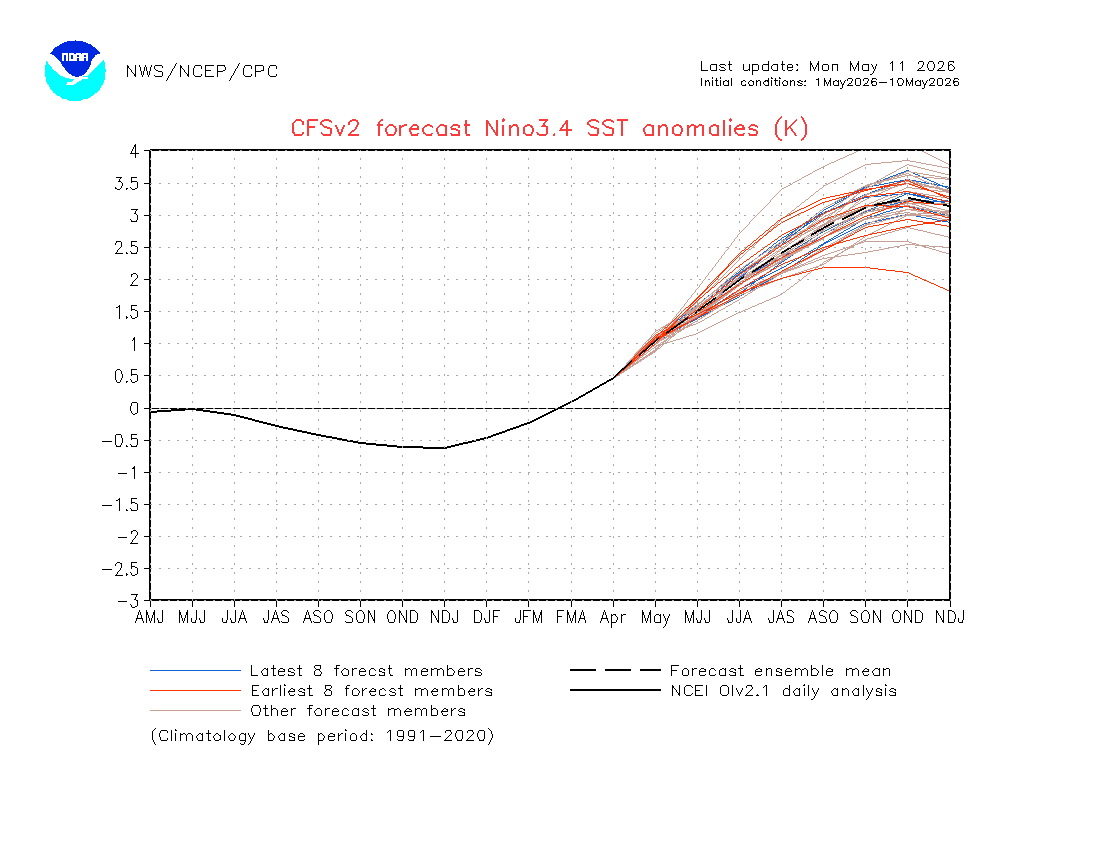
A super El Niño is looking increasingly likely. Our forecasters think there’s a 2% chance (1% to 5%) that extreme weather will be the cause of at least 10,000 deaths in the US in 2026. Deaths associated with extreme weather are typically in the hundreds in the US. But a historical precedent exists in the 1900 Galveston hurricane, which killed 6K-12K people in the US, or in a longer list of historical cyclones which killed hundreds of thousands in Asia.
One of our forecasters thinks the associated temperature anomaly raises the risk of a California megastorm and megaflood that could cause a large number of deaths in the US.
More speculatively, another forecaster notes that for those with very high probabilities of AI doom, anthropic reasoning might increase the chance of observing a superstorm in San Francisco/California specifically that significantly disrupts the AI industry this winter, conditioning on humanity’s arguendo unlikely survival. This perhaps suggests a strategy of playing to your outs.
Is the anthropic reasoning thing a joke? If not I don’t understand why it would apply now, before the possible existential threat?
Does the 10,000 deaths in the US from extreme weather number account for heat stress-related mortality? 2% seems fairly low for such a tail risk given both the rising baseline heat and that El Niño years appear to have a increased risk of heat domes forming.
Some reading if this is of interest:
Direct reporting methodology, likely an undercount:
https://jamanetwork.com/journals/jama/fullarticle/2822854
Attempts to estimate overall excess mortality, but methodology is not robust to the COVID period for obvious reasons:
https://journals.lww.com/environepidem/fulltext/2020/06000/estimating_the_number_of_excess_deaths.1.aspx
Background information on some notable heat waves:
https://en.wikipedia.org/wiki/2021_Western_North_America_heat_wave
https://en.wikipedia.org/wiki/2010_Northern_Hemisphere_heat_waves