

🟡 US-Iran peace talks called off, unauthorized access to Claude Mythos, shots fired at Trump dinner, El Niño coming || Global Risks Weekly Roundup #17/2026


Executive summary
Geopolitics: Another round of peace talks between the US and Iran failed to materialise, with Iran only committing to indirect talks in Islamabad and US negotiators cancelling their trip to Pakistan.
Will direct or indirect US-Iran negotiations, with representatives from both nations present in the same country, resume before June 2026? Our forecasters think there’s an 80% (75% to 85%) chance.
Will the US end its naval blockade of Iranian ports before June 2026? Our forecasters think there’s a 47% (33% to 70%) chance.
Will US strikes on Iranian territory, excluding strikes on boats, ships and waterborne drones, resume before June 2026? Our forecasters believe there’s a 46% (40% to 55%) probability.
Technology and AI: Unauthorized users reportedly gained access to Anthropic’s Mythos model.
Will Anthropic release a model to the general public that outperforms Mythos Preview on over 50% of examined benchmarks including the words “agentic” and “coding” before 2027? Our forecasters think there’s a 73% (51% to 90%) chance.
Economy: The Strait of Hormuz remains largely closed. Trump’s nominee to be Federal Reserve Chair looks set to get a Senate hearing after the Department of Justice dropped its case against current Chair Powell.
Will shipping traffic in the Strait of Hormuz have returned to over 50% of pre-war levels on November 3, 2026? Our forecasters think there’s a 68% (65% to 75%) chance.
Climate and nature: As the chance of a strong El Niño event in 2026-2027 increases, we are looking at the risks of a California superflood and a Southern African famine.
Geopolitics
Middle East
Another round of negotiations in Islamabad between the US and Iran failed to materialise. Our forecasters think there’s an 80% chance (75% to 85%) that direct or indirect negotiations between the two sides will resume before June 2026. This would have to involve representatives of both nations being present in the same country.
Some reports suggested that Iran’s injured Supreme Leader, Mojtaba Khamenei, forbade direct talks with the US. One of our forecasters thinks that Khamenei is leading to a very limited extent but is largely under the thumb of the IRGC, and that the IRGC’s Commander-in-Chief Ahmad Vahidi now has more power than Mohammad-Bagher Ghalibaf, the Speaker of the Iranian Parliament. Several security and policy officials paint a picture of Iran’s current governing structure as a “politburo style system” governed by current and former IRGC officials, together with Mojtaba Khamenei.
When asked about when the Iran War would end, Trump said, “don’t rush me”, and mentioned that the Iraq, Vietnam, WW2, and Korea wars took much longer.
Meanwhile, the US naval blockade of Iranian ports continues, and Iran has fired on and launched drone strikes against American vessels in the Strait of Hormuz. Our forecasters think there’s a 46.5% chance (33% to 70%) that the blockade will end before June 2026.
Israel and Lebanon agreed to extend the ceasefire in Lebanon, but it has already been violated on a number of occasions, with both Israel and Hezbollah accusing the other of failing to abide by it.
Asia
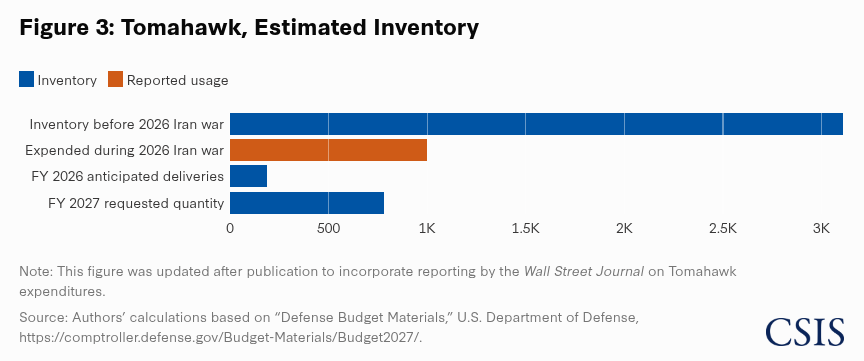
Some US officials argue that the US has used up so many munitions in the Iran War that it would be unable to execute plans to defend Taiwan from a Chinese attack in the “near term”. A report by the Center for Strategic and International Studies similarly suggests that so many weapons have been used in Iran that the US would not have enough in the event of a large conflict in the near future. One forecaster comments that this very slightly raises their probability of a Chinese invasion or blockade of Taiwan in the next year.
A Taiwanese minister made a rare visit to the disputed South China Sea island of Itu Aba.
US and Filipino forces held their largest ever military drills, drawing anger from China.
Russia and North Korea connected a road bridge ahead of its planned opening this summer.
China banned the export of dual-use items to seven European entities that China claims have played a role in arms sales to Taiwan or “colluded with Taiwan”..
The Americas
The United States
Trump and other members of his administration were targeted by a shooting at the White House Correspondents’ Dinner.
Trump signed an executive order that classifies electrical transformers and other equipment important for the electric grid as essential to national defense and called for the Defense Production Act to be used to strengthen the grid. Most large transformers are manufactured abroad, creating a supply chain risk that this order aims to address.
And: The Department of Homeland Security (DHS) plans to spend millions of dollars to buy smart glasses for immigration agents. The Lancet writes that the CDC is on the brink of collapse. The DOJ is pushing to denaturalize about 300 citizens. It will also permit execution by firing squad and by single-drug lethal injection. Trump’s net approval rating hit a new record low.
The Rest of the Americas
Under pressure from the US, Mexico’s President Sheinbaum has doubled down on military operations, high-profile arrests and extraditions to decapitate the leadership of drug cartels. Her government has extradited nearly 100 suspected cartel members to the US since 2025. Cartels have fragmented and retaliated.
The US may consider dropping its support for UK ownership of the Falkland Islands in favor of Argentina’s claims, reportedly in retaliation for a perceived lack of sufficient help from the UK with US military operations in Iran.
Europe
Ukraine is making defense deals with several Gulf countries, including Saudi Arabia, as the country broadens its support beyond the US and Europe.
Economy
The US Department of Justice dropped its investigation of the Chair of the Federal Reserve, Jerome Powell. Key Congressional Republicans had pledged to stall the confirmation process for Trump’s nominee to be the next chair if the case was not dropped, so this clears the way for that process to now begin.
The Strait of Hormuz remains nearly closed. Global crude oil inventories are projected to reach their lowest levels on record even if the Strait of Hormuz were to fully reopen this week. Our forecasters think there’s a 68% chance (65% to 75%) that shipping traffic in the Strait will have returned to at least 50% of pre-war levels on November 3, 2026, the date of the US midterm elections. The 7-day average according to the IMF’s PortWatch would have to be at least 52.
An analysis by the Center for Strategic and International Studies estimates that US GDP would fall by approximately 4%, or $100B per year, if the US were to leave NATO.
Technology and artificial intelligence
Unauthorized users reportedly gained access to Anthropic’s Mythos model. On the question of whether Anthropic will grant the general public access to a model that outperforms Mythos Preview before 2027 on over 50% of of the benchmarks they showcase which include the words “agentic” and “coding”, our forecasters estimate a 73% probability (51% to 90%).
With the help of Mythos, Mozilla reportedly found 271 vulnerabilities in its Firefox web browser. Many banks are pushing for access to the model.
OpenAI launched GPT-5.5, which they say is their smartest AI. They report that gains are particularly notable in “agentic coding, computer use, knowledge work and early scientific research.…” They also announced a biorisk bug bounty for the model. OpenAI briefed federal agencies, state governments and FVEY countries on the capabilities of GPT-5.4-cyber. Qwen, Kimi and DeepSeek also saw new model releases.
The Pentagon is seeking $54B for an AI-enabled autonomous drone warfare program, aiming to increase funding more than 200x for its Defense Autonomous Warfare Group.
The White House pushed out Anthropic researcher Collin Burns from the directorship of the Center for AI Standards and Innovation (CAISI, formerly the AI Safety Institute) after just 4 days. The WSJ reports that the White House has been lobbying against AI regulation in at least 6 Republican states.
Google will reportedly invest $40 billion in Anthropic, $30 billion of which is conditional on meeting performance targets. Amazon is investing $5B now and will invest up to $20B more later.
The Democratic governor of Maine, Janet Mills, vetoed a bill imposing a moratorium on data center construction in the state. Her rationale was that it would have halted an ongoing project in the state.
Anthropic told a federal appeals court that it can’t control its own models once they are deployed for military purposes. In other words, they don’t have a “killswitch”. Their aim is to counter the Pentagon’s claim that the company could interfere in military operations, which could justify labelling them a “supply-chain risk”. But this also diminishes the degree of monitoring, oversight and error correction they can employ, in tension with their stated values.
Nature and climate
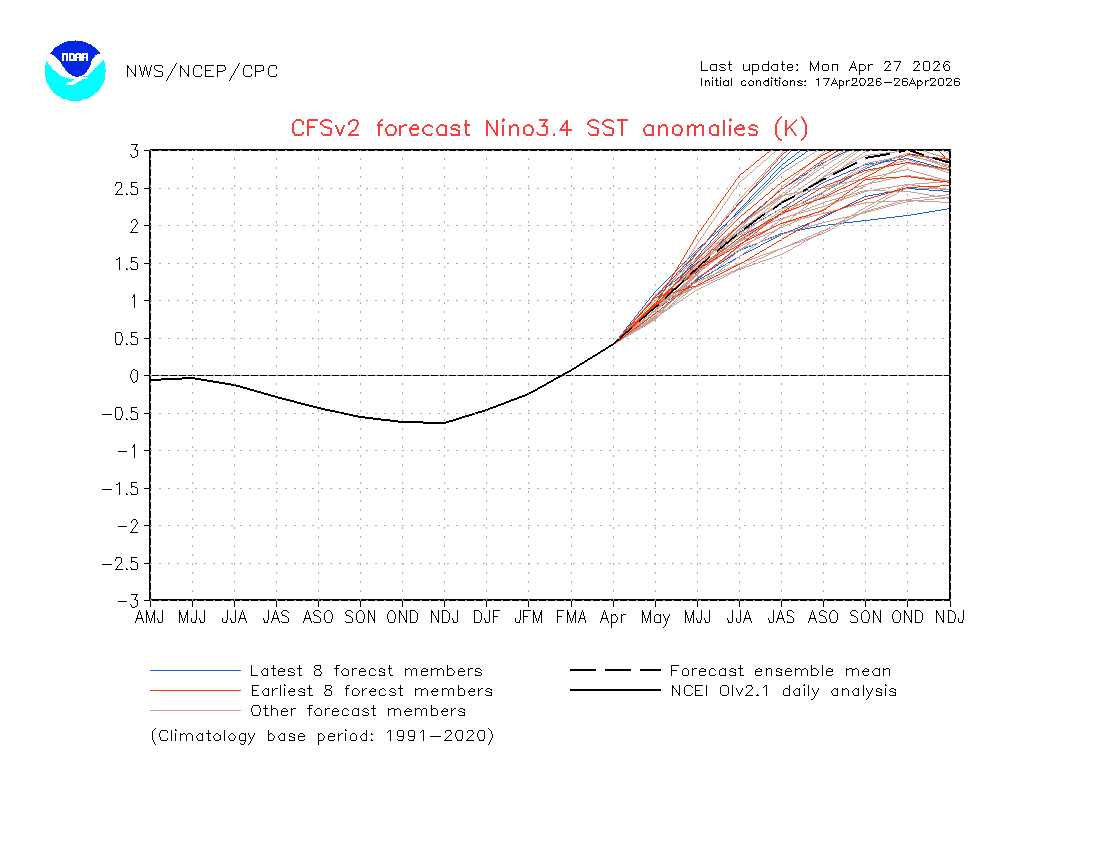
Previously we reported about the likelihood of a strong El Niño event later this year:
The US National Oceanic and Atmospheric Administration is forecasting a 61% chance of an El Niño weather pattern, and a 25% chance of a “super” El Niño. If an El Niño event were to start this fall, there could be an approximately 4% risk of a “megastorm” and “megaflood” occurring in California over the following year; some estimates place the damage it would cost at nearly $1T, or 4% of US GDP, more than the damage caused by the Great Flood of 1862. The risk has been increasing because of the rise in global temperatures. A super El Niño would also be expected to have worldwide effects on temperatures and precipitation.
Now, the latest climate ensemble model from NOAA, with data from April 17-26, shows an even wilder oscillation, reaching a 3°C shift or higher in the Niño 3.4 spot. This shifts one forecaster’s probabilities of a megastorm/megaflood in California in November-March to 6-7%, from our earlier 4%.
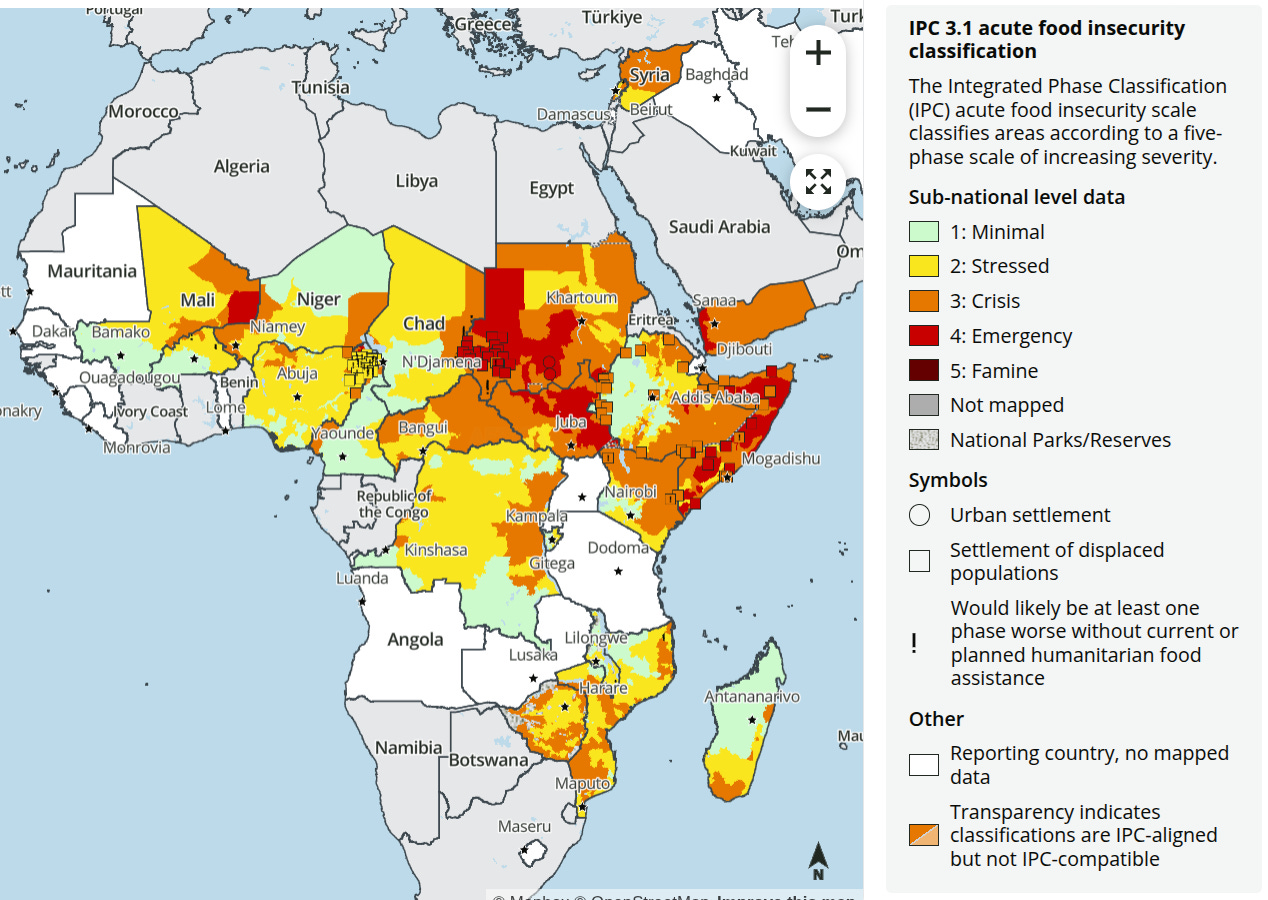
As El Niño events are a primary driver of elevated risks of serious droughts in Southern Africa, it is also looking increasingly likely that next year will bring drought and famine to parts of Southern Africa. The far weaker El Niño event in 2023-2024 resulted in widespread drought and the worst hunger crisis in decades in several southern African countries. An extreme El Niño event starting later this year would be expected to raise the risk of drought and hunger striking the already vulnerable region again. This risk might also compound as a blockade of the Hormuz strait reduces worldwide fertilizer shipments.
Miscellaneous
Fifteen giant agricultural drones, typically used for spraying pesticides, were stolen in the US state of New Jersey. Some fear that if they fall into the hands of terrorists, they could be used to carry out a chemical or biological weapons attack.
Any predictions for war in Ethiopia given the increased likelihood of famine?
Brilliant work this week